The most telling K-array product does not look much like a speaker. Anakonda is a long, flexible strip that can curl around a column, follow a curve or run where a conventional cabinet would look absurd. It is the kind of object that makes an architect lean closer and an audio engineer ask several follow-up questions. That small moment contains the K-ARRAY USA pitch: a room should not have to choose between looking considered and sounding alive.
From an office in Needham, Massachusetts, K-ARRAY USA imports, markets, sells and services three Italian audio brands across the country. K-ARRAY handles the serious professional line. KGEAR stretches the catalog toward broader commercial applications. KSCAPE combines architectural lighting and sound. The customer is often not the person eating dinner under the speakers or dancing in front of them. It is the consultant, dealer or systems integrator responsible for making the whole room behave.
That distinction matters. This is not a direct-to-consumer gadget story with a checkout button and a cheerful unboxing. A finished system may include slim arrays, point-source speakers, hidden subwoofers, rack amplifiers, network audio, mounting hardware, acoustic modeling and a control layer. K-ARRAY USA sells the equipment through a national channel and supports the people who specify, install and commission it. The box is only the visible fraction of the business.
A complaint with a carrying handle
The parent story begins in 1990 in the hills near Florence. Alessandro Tatini, his father Carlo and Massimo Ferrati started an audio and lighting rental company. Touring equipment imposed a blunt tax: big PA systems were heavy, expensive to move and slow to unload. Their response was not a branding exercise. It was an engineering brief - find a way to get useful output from less material and a smaller footprint. The K-array brand followed in 2005.
The U.S. subsidiary arrived in late 2018. It now operates as the exclusive distributor and official representative for K-array, KGEAR and KSCAPE in the United States. President Rusty Waite leads a small team with two domestic warehouses and a web of commercial and residential sales representatives. The supplied company record counts 10 employees. That is lean for a business serving venues from rooftops to churches, but the channel is the multiplier: local firms sell the gear, model the room, run the cable and answer when opening night gets close.
The object is compact audio. The product is confidence that an integrator can make it work.YesPress analysis
The culture travels with the channel. K-academy offers designer and installer courses that qualify for AVIXA renewal units. Two-day K-experience sessions in Tuscany mix product demonstrations, software training, case studies, a factory tour, dinner and networking. There is an Italian instinct for hospitality in that schedule, but also a sober commercial point: unusual hardware is easier to specify after someone has heard it, modeled it and met the people who will support it.
Small is not the same as simple
K-array's catalog can be theatrical. The names include Lyzard, Vyper, Python, Kobra, Kayman, Dragon and Thunder. The engineering proposition is calmer. Arrays use multiple small drivers and controlled dispersion to distribute sound more evenly than a single loud box shouting from one corner. Slim metal enclosures reduce visual weight. Subwoofers handle the frequencies those narrow columns cannot. Kommander amplifiers supply processing, routing and power. K-Framework3 helps designers predict coverage before drilling begins.
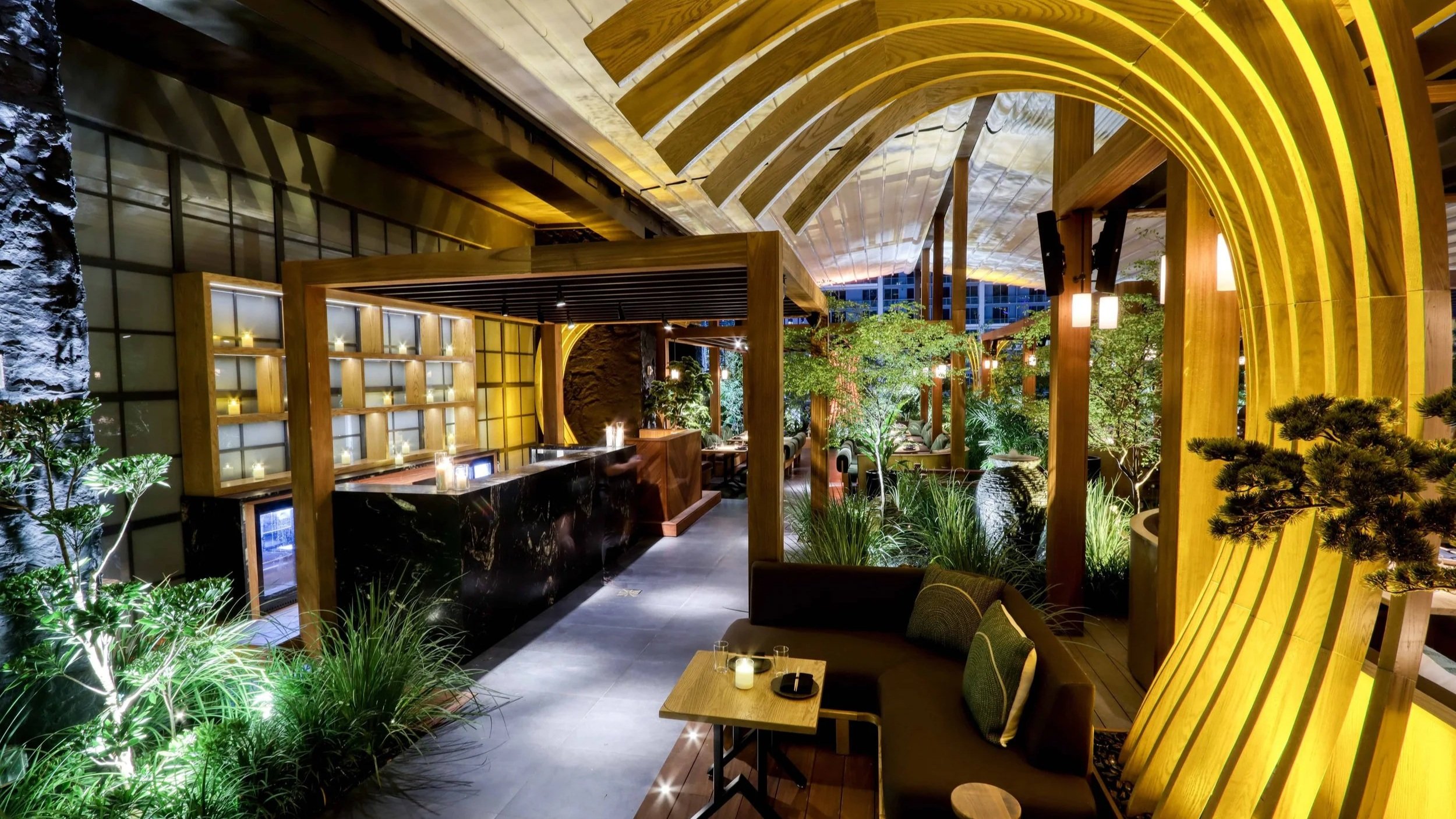
Yamashiro Miami is a useful demonstration because the brief contains several fights at once. The 9,000-square-foot rooftop restaurant is exposed to sun, wind, humidity and rain. It wants calm, detailed music during dinner and enough energy for DJs later. It also has a panoramic view that would not be improved by bulky cabinets. Integrator DRVCS AV used 18 weather-rated Python KP52 I line arrays, seven Thunder KS2P I subwoofers in custom wooden housings and two Kommander KA208 amplifiers. The system stays in place as the venue changes mood, so staff do not roll in temporary equipment after dessert.
At Café Boulud and Maison Barnes in New York, the concealment becomes almost mischievous. Tornado speakers sit in millwork. Kobra arrays were custom-painted to match ironwork and canvas wallpaper. Rumble subwoofers disappear into banquettes. Separate zones support dining, a bar, private events, video calls, a piano, wireless microphones and DJs. The audio is not one system performing one task. It is infrastructure for the venue's whole day.
The product line keeps filling gaps in that workflow. Koral, shown in 2026, is a compact column that switches between array and point-source behavior. KSCAPE CORE controls light and sound through the RAIL ecosystem. The Thunder KSCARDIO412P puts four 12-inch woofers into a single cardioid enclosure rated to 138 dB SPL. A traditional cardioid bass setup may need multiple cabinets, delay configuration and external processing to reduce unwanted sound behind the stack. K-array's version packages that behavior into one box. Less setup is the feature.
Software makes the metal easier to buy
The most interesting recent move did not require a forklift. In 2025, K-array added native NDI network-audio support to the full Kommander amplifier range through a free firmware update. Thousands of units already installed could gain bidirectional audio-over-IP without an external gateway, added license or replacement box. Hardware usually begins depreciating the moment it enters a rack. Software that makes old hardware more capable pushes in the opposite direction.
In 2026, the company put its catalog into D-Tools SI and Cloud. That sounds less exciting than a new speaker, which is precisely why it matters. Integrators use those systems to specify products, build quotes and manage projects. Authorized data reduces copying, checking and procurement friction. If the unusual slim array is as easy to place in a proposal as the familiar alternative, design becomes less risky to the person signing the specification.
ecosystem Conventional
large-format PA Consumer
wireless audio Bespoke
architectural audio
This is where K-ARRAY USA fits in the market. L-Acoustics, d&b audiotechnik, Meyer Sound, JBL Professional and other pro-audio companies compete for performance venues and installed sound. Bose Professional, Renkus-Heinz, Fohhn and specialist architectural brands overlap in visually sensitive work. K-array's sharpest position is not “better sound everywhere.” It is a particular bundle of compromises: serious output, controlled coverage, small enclosures, custom finishes, outdoor options and a broader system that reaches into lighting and software.
Powersoft put a financial marker on that bundle in April 2025. The publicly listed amplifier maker acquired 51 percent of K-Array S.r.l. for about €22.3 million, based on a €50 million enterprise value for the whole Italian company. The deal included K-Array's 50 percent interest in K-Array USA LLC. Powersoft cited complementary amplification, processing and transducer expertise, along with opportunities in new markets. This was an acquisition rather than a venture round; its clearest public financial marker belongs to the Italian parent.
The part a beautiful rendering leaves out
Compact speakers do not repeal physics. Small full-range elements still need low-frequency support. A slim enclosure placed badly is still placed badly. Outdoor ratings do not replace sensible drainage, mounting and maintenance. An expensive room with several zones can become a control headache if no one decides who is allowed to change what. The first thing likely to fail is not the aesthetic thesis. It is the project discipline around coverage, bass, cabling or commissioning.
Pricing runs through K-ARRAY USA or its dealers because each quote depends on the room and system. The useful comparison is total installed cost: hardware, amplification, mounts, custom finishes, design labor, cable, programming, commissioning and support. A tiny visible speaker can sit on top of a substantial invisible system. That may be entirely rational in a luxury restaurant or historic interior, but it is not a shortcut to bargain audio.
Where the thesis works
- Architecture and sightlines have real economic value.
- One venue changes use or volume through the day.
- Controlled coverage or weather resistance matters.
- An experienced integrator can model and commission it.
Where it may not
- Lowest upfront equipment price is the only criterion.
- The room needs a simple consumer setup.
- No budget exists for subs, processing or installation.
- Visual discretion has no value in the application.
The decision changes when the buyer stops asking “Which speaker sounds best?” and starts asking “Which complete system lets this place do what it needs to do?” At Vinile Chophouse, that meant even coverage for a large record collection and several distinct rooms. At a marina restaurant, it meant salt-air durability plus live music. At Tenax nightclub, it meant moving from line arrays to a point-source Dragon configuration for high impact and controlled coverage. The winning detail varies. The sales method is consistent: begin with the room's conflict.
The stealable playbook
- Choose a painful constraint your category treats as secondary. K-array chose size, weight and visual intrusion.
- Build the missing complements. Slim speakers need subs, amplification, prediction software, control and mounting.
- Train the channel. A novel product cannot scale if only its inventor knows how to deploy it.
- Enter the buyer's workflow. D-Tools data and familiar control plug-ins make specification less adventurous.
- Show complete rooms, not isolated objects. A hidden speaker is most persuasive when the venue looks good and still works at midnight.
K-ARRAY USA's lesson is pleasantly unfashionable. Hardware differentiation is not enough. The company has to help a chain of professionals understand, quote, install and maintain the difference. That is why the warehouses, training courses, control plug-ins and project photography belong in the same story as the steel and neodymium. The loudspeaker may disappear. The system around it cannot.