The tidy version of Gaurav Verma's career says that an engineer became a marketer. The more useful version is that the engineer never quite left. He simply moved from building and repairing enterprise systems to explaining why anyone should care about them. Across more than 25 years, the labels changed - product developer, Oracle consultant, MBA, product marketer, portfolio marketer, chief marketing officer - but the reflex stayed put. Find the system. Trace the dependencies. Then tell the story in language that can survive a sales call.
Today Verma is chief marketing officer at Kanerika, an enterprise technology firm working across data, automation and AI. His public biography is full of the usual modern nouns: pipeline, positioning, demand, agents, transformation. Yet his advice is strikingly unfashionable. Before the AI program, fix the data. Before the content engine, decide what the company means. Before scaling a campaign, prove that a narrow workflow has become more efficient. In a trade fond of confetti cannons, he arrives carrying a multimeter.
That is partly a consequence of sequence. Verma studied technology at the National Institute of Technology Warangal, worked in product operations at Oracle's India development center and then moved through Wipro and Oracle consulting. His LinkedIn record recalls client work for organizations including Cincinnati Public Schools, Celgene, Stryker, Invacare and Fidelity Investments. Long before he was responsible for top-of-funnel language, he was close to the consequences of imprecise systems.
“AI is really going to hit when you pick a very specific workflow and make that more efficient.”Gaurav Verma, on enterprise adoption
The translator learns the instrument
Translation became the career. After an MBA at the University of Michigan's Ross School of Business, Verma worked in product marketing at Sprint, Telerik by Progress, ServiceMax, Reflektion, Rockwell Automation and Alight Solutions. The companies changed, but each role sat near a difficult commercial border: the place where technical capability meets a buyer's attention span.
At Telerik, he wrote about mobile backends, cross-platform development and digital transformation. One of his first published pieces described coding a mobile application in his first days on the job. It was a fine product-marketing gesture: do not merely arrange the adjectives around a developer tool; open it, build something and locate the splinters. Later, at Rockwell Automation, he wrote about industrial edge computing, where the glamorous abstraction called “the edge” eventually becomes a remote site with shaky connectivity and nobody nearby who can reboot the box.
There is an amiable oddness to the extracurricular record. A Progress biography says Verma published Android apps, learned harmonium, posted tutorials to YouTube and organized private musical gatherings around the Bay Area. LinkedIn adds volunteer work: he co-founded the Atlanta chapter of Sewa International and later organized spoken-Sanskrit workshops and learning groups across the Midwest.
These details prevent the executive biography from hardening into laminated conference copy. They also reveal the same habit in miniature. A harmonium is another system to learn. A tutorial is another translation. A gathering is another distribution network, though nobody sensible calls it that while the music is playing.
A brand assembled in layers
When Verma describes Kanerika's marketing build, he does not begin with a lavish campaign. He begins with missing foundations. The company had years of delivery experience but little inbound machinery. The early work was basic and consequential: sharpen the identity around data, AI and automation; rebuild the website affordably; clarify sales materials; establish a more consistent social presence; and create content that answered questions buyers were already asking.
The content menu was broad but not random. Problem-and-solution pages reached people defining a need. Comparison pieces met buyers closer to a decision. Technical guides earned credibility with practitioners. Calculators and assessments converted curiosity into intent. Executive commentary offered a view of where the market was going. The system worked because each piece had a job, rather than because each piece had a keyword density.
In a 2026 podcast conversation, Verma said Kanerika moved from ranking for roughly 200 keywords to attracting about 30,000 website visits a month without a large advertising budget. Elsewhere he wrote that an inbound program only 18 months old had come to account for half of pipeline. Those are his reported figures, and the useful idea beneath them is patience: content can look slow until the accumulated surface area starts answering thousands of small questions at once.
Give every piece of content one clear job: define a problem, compare a choice, help a practitioner, capture intent or state a point of view. “Publish more” is not a strategy. A designed library can become one.
Verma now talks about “search everywhere optimization.” Google remains important, but discovery has escaped the old results page. Buyers ask LinkedIn, YouTube, Reddit and AI answer engines. A company therefore needs coherent evidence across the web, not only a technically groomed domain. It is a more demanding version of brand consistency: the story must still make sense after an algorithm takes it apart and reassembles it as an answer.
The data beneath the demo
The same systems instinct governs Verma's view of enterprise AI. In a Freshworks interview, he estimated that only one company in five is AI-ready when Kanerika first engages. The obstruction is often mundane: scattered knowledge, uneven data quality, unclear ownership and a workflow nobody has bothered to map. A model cannot create institutional coherence by inhaling institutional clutter.
Verma's estimate is an operator's warning, not a market statistic. Most first conversations, in his experience, begin with work on data, knowledge and workflow alignment.
This is where his rhetoric becomes usefully narrow. Pick a workflow. Define the baseline. Improve it. Measure the difference. The logic has little of the breathless promise attached to AI, but it gives an executive somewhere to put a budget and an employee somewhere to put a question. It also leaves room for governance before an autonomous system acquires permission to do anything irreversible.
Verma's recurring newsletter, The AI Advantage, scans model releases, tools, research and mishaps. His filter is commercial utility. What changes the cost of an application? Which capability becomes a commodity? Where will judgment remain scarce? On Qwoted, he argued that AI can automate much of marketing production while leaving a valuable human residue: strategic thinking, commercial literacy, data interpretation and taste.
“The differentiators will be strategic thinking, commercial literacy, data interpretation, and taste.”Gaurav Verma, on marketing after automation
The engineer returns, wearing a marketer's badge
That residue points toward Verma's favored future role: the marketing engineer. The name is slightly mischievous and almost inevitable. As AI makes asset production cheaper, the valuable person is not simply the one who can generate another landing page. It is the one who can connect the website, content model, distribution system, buyer signals and revenue data - then decide what the entire machine ought to optimize.
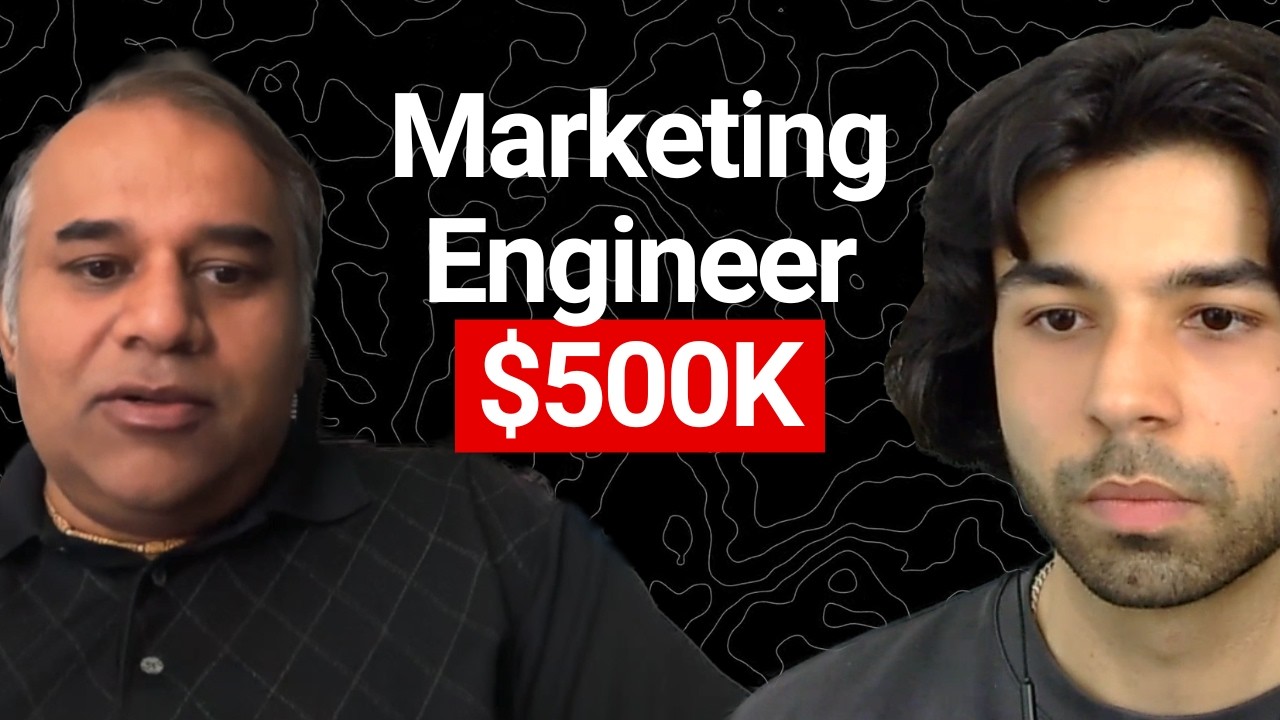
His own career is a prototype. The technical background helps him converse with product and engineering teams. Consulting supplied empathy for the customer living with a system after the launch party. Product marketing taught him to find the claim that can survive contact with a skeptical buyer. The current CMO role lets him arrange those skills into an operating model.
It also preserves some room for play. One colleague's public recommendation praises Verma's humor as much as his product sense. A favorite anecdote comes from a technology conference, where he stopped at a booth advertising pretty video-call backgrounds but could not understand the actual proposition. After questioning the founder, he discovered the larger idea was a virtual workspace concerned with culture and engagement. The display had featured the garnish and hidden the meal. Verma turned the encounter into a lesson about messaging.
That is the thread from Oracle ticket to Telerik app, from harmonium tutorial to Kanerika pipeline. Learn enough to notice what is missing. Ask until the claim becomes clear. Build the smallest structure that can carry it. Then allow repetition to do its slow work.
Marketing likes to borrow the vocabulary of magic: virality, lightning, sparks. Verma's vocabulary is closer to engineering and gardening: layers, workflows, readiness, compounding. Less dramatic, perhaps. More likely to be there on Monday morning, still producing an answer.