A mobile DJ, a saxophone player, and a stack of stroopwafels are not the usual instruments of enterprise software marketing. Kris Lande used all three. She knew that attendees at a European conference tended to drift in late, and she refused to treat the queue outside the keynote hall as dead time. So the waiting became a party. The nuisance became a memory. The people holding conference badges were treated like people.
This is Lande’s preferred scale of observation. Big strategies arrive disguised as small details: the mood at the door, the accuracy of a claim, the last impression after a two-day event. In August 2026, she explained her affinity for Disneyland’s experience design even while cheerfully declaring herself a non-Disney adult. The parks, in her telling, work because thousands of intentional choices cooperate. A brand works the same way. The slogan gets the billboard, but the queue gets the customer.
Now the details carry more weight. Lande became chief marketing officer of OutSystems in October 2025, moving into the job as enterprise technology entered its agentic-AI season. Her assignment spans global marketing, brand, and growth. It also asks a less tidy question: how do you sell the speed of AI without racing past credibility?
Being clear about what your AI can’t do often makes customers believe you that much more when you tell them what it can do.Kris Lande
The honest pitch in a noisy market
Lande’s answer begins with a word that sounds almost antique beside “agentic”: trust. She talks about security and governance, but not as fine print applied after the exciting demo. They are part of the product’s social contract. Enterprise buyers are placing important systems, proprietary information, and employee workflows behind these tools. The promise has to survive contact with procurement, developers, risk teams, and Monday morning.
Her prescription for marketers is direct. Explain what the system can do. Explain what it cannot do. Clarify how data is used. Measure pipeline quality, time to value, and revenue impact instead of admiring a cloud of activity metrics. Keep sales, product, and marketing on one governed version of the truth. The language is less carnival barker, more air-traffic controller.
That restraint does not make her pessimistic about AI. She sees it shortening analysis from weeks to minutes, helping teams test ideas quickly, and improving the relevance of customer experiences. But when execution becomes cheap, execution stops being special. Marketers have to move from completing tasks to owning outcomes, from narrow specialization to connecting the system. Judgment, context, and choosing the right problem become more valuable precisely because a machine can produce so much.
A career built around the user’s career
The shape of that argument becomes clearer in the rear-view mirror. Lande studied Business Administration and International Business at Washington State University from 1998 to 2002. She then spent roughly six years leading marketing at Escapia, a vacation-rental software company acquired by HomeAway in 2010. It was practical SaaS: a specialized product serving people with real operational work to do.
She joined Salesforce in 2010 and stayed for about 15 years. Her titles changed as her canvas widened. Product marketing led toward admin marketing. Admin marketing opened into developer relations, Trailhead, and the Trailblazer ecosystem. By the end, as senior vice president of Marketing & Community, she led a cross-functional group of about 250 people across product and developer marketing, learning content, editorial content, events, creative, and demand generation.
Trailhead is the useful hinge. Salesforce’s free learning platform gave users a place to practice in a real developer environment. The surrounding community gave those users an identity and one another. Lande and her colleagues were not merely explaining software features; they were helping people acquire skills, find mentors, and imagine jobs. During the isolation of 2020, she said viewership for Trailhead LIVE rose 306 percent after March. Tutorials were valuable. Connection was the scarce thing.
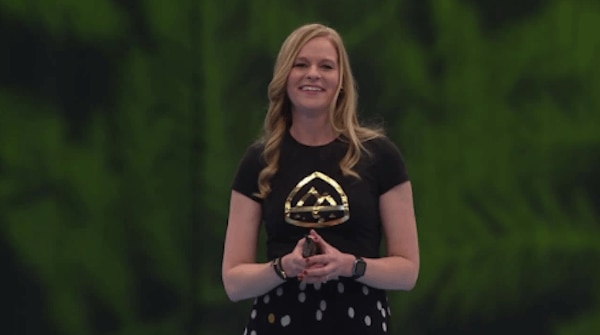
The Trailblazer idea turned customers into protagonists rather than case-study furniture. They were learners, builders, administrators, developers, and career changers. The product had a vocabulary, but the community gave it folklore. Lande has carried the lesson to OutSystems: a platform becomes more durable when the people around it feel equipped, recognized, and proud of what they build.
This is also a particular kind of translation. Enterprise software is full of abstractions: platforms, ecosystems, orchestration, transformation. Lande keeps translating those nouns back into verbs a person can perform. Learn a skill. Build an application. Find an event. Meet a mentor. Her marketing career has advanced alongside increasingly complicated technology, yet her unit of attention has remained stubbornly legible. What can someone do now that they could not do before, and who will help them do it?
The Lande loop
The goodbye is part of the brand
Lande’s events philosophy sounds almost mischievous after all that governance. At OutSystems ONE, her team closed the gathering with a spirit tunnel: employees lined the exit with music, dancing, and high fives. She wanted attendees to leave feeling gratitude, celebration, and energy. Most corporate events end when someone thanks the sponsors and the lights become unflattering. Lande designed the final ninety seconds.
The instinct is not frivolous. “Brand is a promise to the customer, and culture is how you actually deliver on that promise,” she has said. If every employee carries some part of marketing, then the brand exists in the sales call, the webinar, the copy, the queue, and the wave goodbye. A campaign can set an expectation. Only behavior can fulfill it.
When you care and you're passionate about the details, your customers are gonna feel that. They can feel when you brought fun into something. And if you care, they will care.Kris Lande
She likes setup days for much the same reason. Months of abstractions suddenly become screens, signs, rehearsals, and last-minute adjustments. Planning develops fingerprints. At OutSystems ONE 2026 in Amsterdam, she obsessed over keynote storylines, messaging, the expo experience, and swag before making her debut on the company’s keynote stage. Her favorite part afterward was not the spectacle. It was seeing customers and developers discuss how they were putting AI to work in real systems.
Governed data, yacht-rock rhythm
There is another revealing scene from her first months as CMO. Her leadership team spanned California, Massachusetts, and Portugal. They met in person to work through the FY26 plan and debate priorities using Salesforce’s V2MOM planning framework. Later came a boat tour of Miami, dinner, and a great deal of yacht rock, which Lande has identified as her favorite musical genre.
The combination feels accurate: a management framework followed by soft rock polished to a suspicious gleam. She wrote that being face-to-face invited a different degree of honesty and alignment, producing progress that would have taken longer remotely. Her broader 2026 priority follows naturally. As more digital interactions become automated, she wants more chances for humans to meet humans - customers, builders, partners, and teams.
It is tempting to treat human connection as the warm garnish on a technical strategy. In Lande’s work, it is closer to the delivery mechanism. People adopt unfamiliar systems through other people. They learn in public, compare notes, borrow courage, and decide whom to believe. Community supplies context that a product page cannot. It also creates accountability: a company making inflated claims has to face the users living with them.
That makes her fondness for in-person gatherings more than nostalgia for a room with decent coffee. Physical events expose the seams of a brand. People can see whether executives listen, whether builders are celebrated, and whether the community exists beyond a mailing list. Automation can make the invitation more efficient. It cannot supply the glance between two developers who have just realized they solved the same irritating problem on different continents.
From faster apps to better promises
When Lande needs a compact example of practical speed, she points to The Pokémon Company International. Its team needed an event locator capable of helping players find live events around the world. Using OutSystems, the project met security and performance requirements in ten days. Within a month, it was live in seven languages and had helped more than 14,000 players discover events.
The numbers matter because they describe a finished experience rather than an AI aspiration. Ten days. Seven languages. Fourteen thousand people finding somewhere to play. Speed is useful when it ends in somebody’s hand. The same principle explains Lande’s preference for time to value over surface activity and for governed data over dazzling ambiguity.
Her new chapter at OutSystems is still young. The company hired her to amplify its position as businesses move from AI experiments toward applications and agents that operate inside consequential systems. Lande’s public ambition is to help customers, partners, employees, and developers build that future securely and with control. The marketing challenge is to create momentum without manufacturing certainty.
Here the two sides of her playbook meet. Governance protects the promise. Community tests it. Details make it felt. The AI era may be new, but the underlying exchange is old: a company asks people to believe it, then spends every interaction proving whether they should. Occasionally, the proof arrives as an audit trail. Occasionally, it arrives as a stroopwafel and a saxophone solo at precisely the right moment.