Navneet Singh has a useful complaint about enterprise marketing: too much of it is beige. The products may reorganize companies, reroute budgets and alter careers, yet their stories arrive scrubbed of consequence. Singh, an engineer who migrated through product management into marketing, prefers the stakes left in. A buyer is making a career bet. An employee is hoping to be seen. A recruiter is deciding whether a résumé describes a whole person or merely preserves an old version of one.
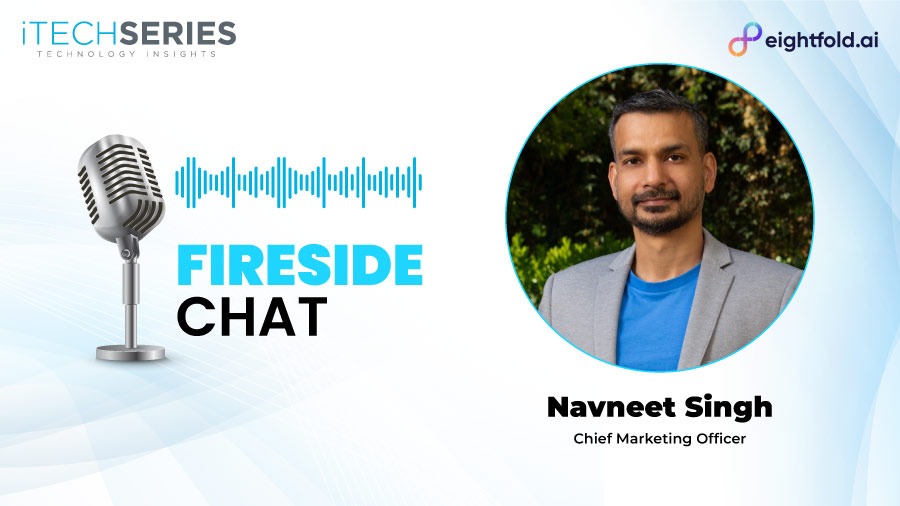
That tension now sits at the center of his job. In October 2025, Singh became Chief Marketing Officer of Eightfold AI, the talent-intelligence company in Santa Clara. His assignment is outwardly conventional - sharpen the message, create demand, align with sales. The material is not. Eightfold sells AI for hiring, development and workforce planning, places where an algorithm's judgment can touch paychecks and futures. Singh talks about the work less as a software category than as a contest between potential and history.
The mission landed personally. When he joined, his daughter was in high school and his son was in college, both navigating choices that can feel final long before a life has taken shape. Eightfold's promise of the “right career for everyone” addressed something he could see from the bleachers and at home: career decisions are defining, daunting and routinely made with incomplete evidence.
“The best stories start with a solid foundation, and that foundation is truth.”Navneet Singh
The engineer learns to leave the stakes in
Singh's route to the C-suite did not begin with slogans. He studied engineering at the Indian Institute of Technology Delhi, earning bachelor's and master's degrees, then completed an MBA at the Indian Institute of Management Ahmedabad. Executive education at Northwestern's Kellogg School of Management came later. The sequence matters because he still describes storytelling as a structure built on technical truth. The machinery must survive inspection before the metaphor is allowed out.
His early career moved through consulting at Deloitte and Pramati Technologies, then into product management at Oracle in 2003. Five years later he went to Cisco. By the time he joined the cloud-security startup Bracket Computing in 2013, he had spent more than a decade close to the product: databases, networks, software, buyers with precise questions and little patience for vapor.
A 25-year translation job
Marketing became less a departure from engineering than its public-facing twin. Product work asks what a system can do. Marketing asks why anyone should care. Singh's preferred answer joins the two without letting either become decorative. Technical depth earns credibility with the CIO; the consequence of the technology makes a CHRO or hiring manager lean forward. “The customer is the hero,” he has said. The company is the guide.
Selling security without selling dread
At Palo Alto Networks, where Singh arrived in 2016, the category offered a powerful and rather cheap emotional instrument: fear. Cybersecurity vendors could show attackers at the gate, enumerate catastrophes and leave the buyer with a pulse elevated enough to sign something. Singh argued for the opposite posture. Marketing should communicate optimism and confidence, educate the customer and show what the business could do securely.
The distinction sounds mild until one considers how thoroughly anxiety lubricates the security market. Optimism gave his team a way to look and sound different while making the customer, rather than the adversary, the protagonist. He summarized the principle as B2H - business to human. Acronyms do not make decisions. People do, carrying ambition, skepticism and the unpleasant awareness that a wrong choice may be remembered at performance-review time.
The commercial record supplied evidence for the philosophy. Palo Alto Networks credits his leadership with helping its Secure Access Service Edge business reach $1 billion in bookings within four years. He led marketing for a network-security and AI portfolio measured in billions of annual bookings and helped several businesses travel from zero to more than $100 million. Singh speaks about those figures with a revealing qualification: the point was not only the number. It was the rewriting required to enter factory floors, hospital systems and unfamiliar buying centers, followed by training teams, meeting resistance and adjusting until the story worked.
There is discipline in his optimism. In a 2025 interview about marketing AI, Singh was asked where the technology delivered its strongest return. He declined to produce a tidy figure he did not possess. He could describe observed gains, especially in localization, but separated anecdote from measurement. The moment is small and instructive. Someone who insists that truth precede story has to tolerate the occasional unsatisfying answer.
A CMO with a prestige-TV syllabus
Singh's storytelling references are wonderfully uncorporate. He points to Breaking Bad for high stakes, Game of Thrones for sustained conflict and The Sound of Music for emotional resonance. He is not proposing dragons in the quarterly business review. He is noticing that memorable stories make transformation costly, conflict legible and joy worth protecting.
In talent technology, his central conflict is ready-made. Legacy systems are records of what a person has done. Skills-oriented AI claims to model what that person may be able to do next. In a 2026 conversation about federal workforces, Singh described systems that analyze skills and career trajectories to surface people who could move into hard-to-fill roles with training. He emphasized responsible, explainable AI, bias mitigation and human oversight. The future workforce in his telling contains agents, but it still reserves judgment, leadership and strategy for people.
This is also where the marketing challenge becomes morally heavier than a sharper landing page. Saying that AI can “see” potential is a consequential claim. Singh connects it to fairness, opportunity and scale. The credible version requires more than inspiration; it requires the technical grounding he values, along with transparency about how a recommendation was reached and room for a human to question it.
“The future of work isn't just about technology - it's about people.”Navneet Singh
What AI should give back
Inside marketing, Singh expects AI to compress creative cycles from weeks to hours and blur the boundary between brand and performance. Yet speed is not the most interesting part of his case. Marketing has accumulated process: production queues, disconnected data, repetitive adaptation, dashboards breeding dashboards. He sees AI clearing some of that undergrowth so people can return to insight, creative risk and listening.
The job he imagines is orchestration. A marketer connects data, story, technology and intuition, then decides what should be made and what should be discarded. Curiosity and adaptability matter because the tools will change. Positioning, empathy and narrative remain because people do not stop being people when a model enters the room.
That distinction also protects against a familiar corporate mistake: confusing output with progress. Faster drafts are useful; a faster route to the wrong message is merely efficient wandering. Singh's standard returns the conversation to business questions. What outcome matters? Which work genuinely benefits from a model? Where does a person need to inspect the answer? His approach to AI is enthusiastic without being indiscriminate. The technology belongs inside a governed operating system, connected to sales and customer evidence, rather than sitting apart as a collection of clever demos.
At Eightfold, the first operational task was message. Singh wanted every employee to be able to state, clearly and consistently, that Eightfold is an AI company transforming talent. From there came the website, events, social work, customer touchpoints and a closer demand-generation partnership with sales. It is the engineer's order of operations applied to brand: establish the premise, make the interfaces consistent, then scale the system.
His leisure time offers a pleasant counterweight to orchestration. Singh calls himself a nature enthusiast. He takes road trips, with the mountains and lakes of the Yukon, Alberta, Montana and British Columbia high on his list. He has explored reefs in Mexico and the Florida Keys. Closer to home, he goes birding with binoculars or cheers from the high-school bleachers for his daughter's marching band. Rare birds are not known for respecting quarterly timelines.
The hobby fits the work more neatly than any executive metaphor ought to. Birding rewards patient attention, specific evidence and the willingness to look again. Singh's career has been an exercise in looking again at technical products, anxious markets and recorded careers. Security can be narrated through confidence rather than panic. Marketing automation can return time rather than merely increase volume. A person's work history can be evidence without becoming a verdict.
Enterprise software will always arrive carrying jargon. Singh's contribution is to ask what human drama the jargon has concealed, then restore it without loosening the facts. At Eightfold, that means giving potential a vocabulary a machine can process and people can recognize. It is a difficult promise, which is precisely why beige will not do.