Gabriel Rogoff arrived at Ramp on August 21, 2023, to do a job nobody there had done before. He was its first technical account manager, linking customers with product and engineering. He had passed the technical interview. He had experience. Picking up his laptop in New York, he still wondered whether the people who hired him had got something wrong.
“What if everyone who hired me made a mistake? Why me?”
It is an unusually candid opening to a career story. The appointment came before the confidence. A new role offered room to make decisions, but it also removed a familiar comfort: the colleague whose work tells you what good performance looks like. A predecessor can leave instructions. Being first means helping write them.
Rogoff’s route to that desk ran through economics, enterprise software and a restaurant internship. His work now concerns finance systems, purchasing and the awkward spaces between teams. The recurring question is practical: who understands what needs to happen next, and who has the time to make it happen?
A chef’s time is expensive
One early lesson came at Major Food Group in New York, where Rogoff interned during two summers. When he needed to explain changes to online orders, he prepared his words before approaching the chef. He also remembered seeing Leonardo DiCaprio in a restaurant and asking whether he could say hello. His boss discouraged the idea. The customer’s dinner took precedence over the intern’s souvenir.
The two incidents make a useful pair. In one, doing the job meant communicating clearly. In the other, it meant leaving someone alone. Both required noticing what another person was there to do.
A restaurant supplies immediate feedback on that distinction. A conversation can interrupt somebody else’s work even when its speaker has excellent intentions. Preparing an explanation is a small courtesy with a practical return. Rogoff’s account is appealing partly because he includes the occasion when his judgment needed correcting. Professional education occasionally arrives wearing an apron.
Economics, then the implementation desk
Rogoff grew up in Boston and describes himself as a Celtics fan. He graduated from Boston University with a degree in economics. The local allegiance supplies one recognizable detail in a career otherwise populated by accounting software and implementation questions.
His technical background developed through NetSuite work at Oracle and Deloitte Digital. In February 2024, he introduced himself in Ramp’s community forum and offered integration tips. The subjects included splitting transactions across entities, handling vendors attached to multiple subsidiaries, and using custom fields in conditional workflows.
That vocabulary needs translation for anyone who has never lived inside an accounting system. A business can have several legal entities, different approval rules, and costs that must land in particular places. The usefulness of a finance tool depends partly on whether those distinctions survive the trip from one system to another.
The work calls for attention to the receiving end. A transaction arriving somewhere is only a beginning. Someone still has to understand what it represents and how to handle it.
The freedom hidden in a fifth of the day
Rogoff has explained his move from consulting in terms of control over work and learning. Consulting taught him about technology and people. Yet staffing decisions and the available projects influenced what he could do next. Completing one engagement and beginning another did not give him the kind of continuity he wanted.
He described his startup experience using an 80/20 split: most of his time went to required responsibilities, then largely customer conversations, while the remaining share allowed him to choose where to contribute.
It is a modest formulation of freedom. There are still duties. A customer waiting for an answer does not become less urgent because somebody has an interesting idea. But the discretion left around those duties can matter a great deal.
For a reader considering a similar move, the useful question is concrete. What can you do with a problem you notice? Can you reach the relevant team? Can you help solve it? Rogoff’s account puts those questions ahead of the romance attached to a startup address.
A personal account of his experience, rather than a company-wide time allocation.
Three months, ten different perspectives
By November 2023, his attention had shifted toward how Ramp’s teams worked together. Product had to choose among requests. Engineering had to maintain existing software while building more. Customer-facing teams had to set expectations and deliver on them. His Solutions team supported people across those functions.
Rogoff described helping establish its operating procedures. He also acknowledged the need to choose which colleagues and problems received time. The excitement of working across departments came with a finite calendar.
This is where a loosely defined role becomes more demanding. An open boundary lets useful work enter. It can also admit every unresolved question in the building. The task becomes deciding what deserves attention, explaining that decision, and making a response repeatable.
“When you have that many stakeholders there’s no way to please everyone.”Gabriel Rogoff, reflecting on his first three months
The observation gives the account some welcome texture. Cooperation sounds agreeable until several perfectly reasonable people need something at once. An operating procedure is one way to preserve what the team learns while avoiding a fresh negotiation every morning.
Put the accounting on the screen
In December 2024, Rogoff co-hosted a Ramp and Netgain session about simplifying financial operations. The discussion covered NetSuite integration and allocating transactions between entities. He appeared alongside Eric Lengerich and Tanner Larsen, bringing the same implementation concerns into a demonstration format.
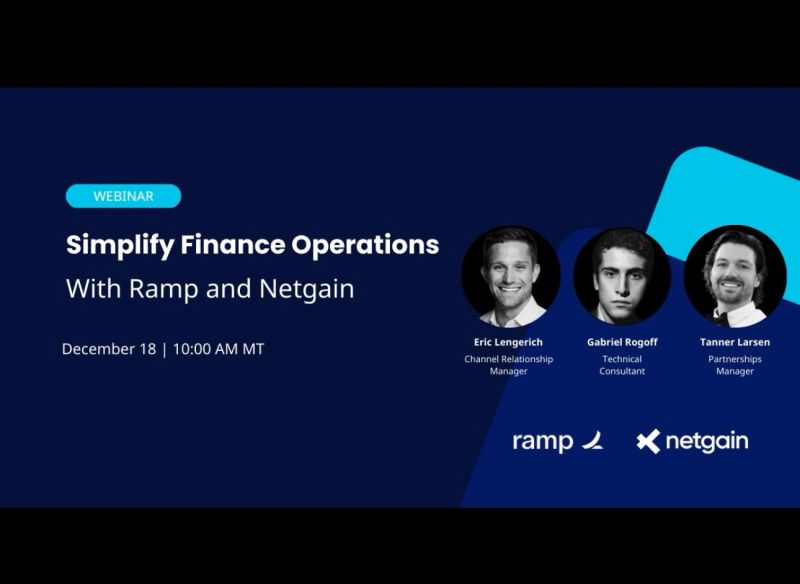
A demonstration has a useful discipline: eventually somebody has to show where the information goes. Words such as integration can carry a lot of promise. A screen makes that promise easier to examine.
For an audience responsible for accounting, a familiar transaction is often a better starting point than an abstract description. Follow its movement. See which information accompanies it. Ask who must intervene. The resulting conversation has room for detailed questions, including the inconvenient ones. Those questions are part of the value of bringing practitioners into the room.
An ERP choice comes with a second choice
Rogoff also founded ERPQuote, a project intended to help businesses compare ERP systems and implementation partners. In its first episode, he spoke with Stephen Gillis about failed implementations. Their discussion grouped the risks into planning, resources, customization, training and data migration.
The pairing matters. Selecting software and selecting the people who will put it into use are related decisions. A list of features does not explain how an accounting team will make the change while continuing its existing work.
- Are the business requirements clear?
- Are time and budget realistic?
- How much customization is needed?
- Will people be trained to use the system?
- Is the data ready to move?
There is a quiet ambition in making those questions accessible. Buying business software can be difficult to inspect from the outside. A conversation with an implementer lets the prospective buyer hear where problems can emerge before the project begins.
The distinction is useful well beyond accounting. Choosing a tool is one decision. Organizing the work around it creates many more.
Let the guest show the details
Another ERPQuote episode brought in Dan Krishman to demonstrate Sage Intacct. The discussion explored accounting across multiple entities and the way dashboards lead into transaction details. Rogoff asked whether intercompany accounting functions were available within the system itself.
That question has a buyer’s shape. Before counting on a capability, understand where it resides and what else it needs. The answer changes how someone evaluates the whole arrangement.
The recording also offers a window onto Rogoff as a host. He makes room for a practitioner to show the software, then asks questions about what the demonstration means. The conversation stays close to use.
There is a particular pleasure in an explanation that permits inspection. You can pause it, follow the screen, and return to the part you did not understand. A demo can be patient in a way that a sales meeting sometimes struggles to be. Here, the accounting details get their turn in the foreground.
AI earns its place in the workflow
Rogoff’s March 2025 essay on AI argued that convenience helps determine business value. His interest was in putting a capability into an existing workflow without requiring people to move between tools.
It is an implementation-minded argument. The question reaches beyond what a model can produce to the conditions under which someone can use that output. A useful result still has a destination.
That perspective offers an ordinary, inspectable test: consider a task, the person performing it, and the steps required to finish. Then ask what changes. The test leaves room for disagreement about any particular tool while keeping the conversation attached to work.
It also explains why the subject belongs in this career story. Rogoff keeps returning to the interval between a technical capability and a person getting something done. His AI argument examines that interval at a different scale, with the same practical concern for the user’s day.
A colleague opens another door
There is a human connection behind the ERPQuote discussion with Gillis. In a public reflection on his second anniversary at Ramp, Gillis thanked Rogoff for helping him get in the door. Their collaboration had extended from Oracle into Ramp and then into a conversation for other software buyers.
It is a small piece of evidence about how a career can accumulate. Experience brings familiarity with systems. It also brings people who know your work well enough to collaborate again.
In a later procurement post, Rogoff described focusing on Ramp’s purchasing product and working with a team of procurement architects. The next set of questions concerns requests, approvals and getting purchases underway.
The job he entered in 2023 began without a predecessor. Since then, his public work has included explaining systems, shaping procedures and helping another colleague arrive. That gives the opening question a satisfying answer without pretending the work is finished. A new role can acquire its definition through the people and problems it makes room for.
Follow the conversation
- Gabriel Rogoff on LinkedIn
- Ramp
- ERPQuote
- My first day at a startup
- My first three months at a Startup
- Restaurant internship essay
- Is AI actually valuable?
- Watch: ERPQuote with Stephen Gillis (YouTube link shared by Rogoff)
- Watch: Sage Intacct deep-dive playlist (shared by Rogoff)
- Ramp and Netgain webinar post
- Stephen Gillis’s anniversary reflection
- Rogoff on consulting and startup work
- Rogoff on procurement