Mary Thompson had a checklist with 267 items. In the Neighborly case study published by FranConnect, the then chief operating officer of its franchise brands described an early attempt to understand what was happening during site visits. The ambition was admirable. The results were difficult to digest. An inspection could produce a small encyclopedia while leaving the operator wondering what to do next.
- FranConnect connects the work before and after a franchise opens.
- Its acquisitions added field audits, frontline learning and quality management.
- Customer examples show the value of focused workflows, with results specific to each deployment.
- The buying decision turns on handoffs, data quality and adoption as much as features.
Thompson narrowed the analysis into smaller, time-bound pieces. At Mr. Rooter, the team spotted a weakness early in customer-service calls, changed the approach and added training. The useful discovery was a manageable correction. It suggests an appealing test for business software: does it help somebody decide what to change?
“don’t teach them the platform, teach them how the platform fits into their daily life.”Advice recounted by Mary Thompson · Neighborly case study
That is a good place to enter FranConnect’s world. Franchising offers the public a recognizable promise: the same brand, delivered in many places. Behind it sit agreements, owners, opening dates, training records, inspections and money owed. Each has a different keeper. FranConnect’s proposition is that those keepers should be able to work from connected information. The storefront gets the applause; the handoff does the work.
The founder meets his own bottleneck
Amit Pamecha started FranConnect in 2000. In a founder-advice publication from investor Serent Capital, he says he began at 28 without venture investment. By around 2014, he described a profitable business serving more than 600 franchisors. Yet hiring experienced leaders was difficult, the management structure was weak, and too much knowledge remained with the founder. Demand had arrived before a sufficiently independent organization.
Pamecha’s account explains what changed his mind about bringing in a partner: Serent’s emphasis on operational work, alongside his own wish to pursue other interests. The partnership began in 2014. He also acknowledges hiring mistakes. There is something refreshingly ordinary about that admission. Software companies can make human organization sound like a problem that their customers alone possess.
Serent’s separate account identifies a technical constraint: a heavily customized legacy codebase made maintaining and expanding the customer base resource-intensive. GlobalLogic helped assess the infrastructure and map a SaaS transition; development leadership was reorganized, and The Walker Group supported the launch. Serent reports adoption of the new product. The lesson is architectural: customization creates obligations that survive the sale. A more repeatable service requires investment in both code and the people responsible for it.
A franchise sale becomes years of work
A conventional CRM helps a team understand a prospect and move a deal forward. FranConnect’s franchise-specific approach continues into opening and operating a location. A candidate may become an owner with several units. Each unit has its own agreement, milestones and performance history. Treating that whole relationship as one completed sale leaves a considerable amount of business outside the frame.
Sales handles candidate pipelines. Opener organizes the work of bringing locations into business. Info Manager holds franchisee, location and agreement records. Operations supports field execution and brand standards; performance tools help teams examine results. Hub handles communication and shared material. Analytics supplies views across these activities. The expertise lies in the franchise relationships these tools recognize, including the distinction between an owner, a unit and the contract governing it.
- 01Candidate
- 02Agreement
- 03Opening
- 04Operations
- 05Royalty
Shared owner and location context follows the work.
Editorial workflow illustration, not a product screen.The company reports nearly 1,500 brands across its ecosystem. Customers include restaurant, retail and home-service organizations, with documented examples ranging from Firehouse Subs to Neighborly. Users have different jobs: development teams recruit owners, field consultants support locations, finance teams administer fees, and frontline staff learn the routines. A platform covering all of them must make sense at several levels of the business.
Buying the frontline, piece by piece
Three acquisitions explain the direction. FranchiseBlast, acquired in January 2021, brought field audits and franchisee self-assessments. Those capabilities extend observation beyond the headquarters report and into the unit. Between visits, operators can assess their own execution. An audit also needs scheduling, follow-up and a way to see whether a correction actually happened.
World Manager followed in August 2022, adding learning management and employee engagement. Its capabilities included onboarding, content creation, performance appraisals and surveys. Its customers included Domino’s and Nando’s. Training moves the platform closer to the employee who must carry out a standard, a different audience from the owner who agreed to uphold it.
RizePoint arrived in February 2024 with quality management, mobile auditing and supplier oversight. The acquisition announcement named Wendy’s, Ecolab and Sodexo among its customers. A supplier can affect many locations at once; quality work therefore reaches beyond a franchise relationship. Together, these purchases broadened FranConnect toward the operating needs of multi-location businesses, including networks with company-owned sites.
The field visit
The employee
Quality and suppliers
Royalties without the retyping
Capriotti’s offers a concrete example of the machinery. When it acquired Wing Zone in early 2021, it needed to bring the subsidiary’s royalty administration into its own operation. FranConnect’s case study describes Wing Zone’s previous process as manual and ad hoc, with limited tracking and room for error. Growth had acquired a spreadsheet-shaped inconvenience.
The move to Royalty Manager connected existing point-of-sale technology with automatic fee calculations and electronic collection. The case reports minimal configuration for that connection and easier access to royalty agreements. This is a specific customer implementation, rather than a promise that every POS or every contract will connect equally easily.
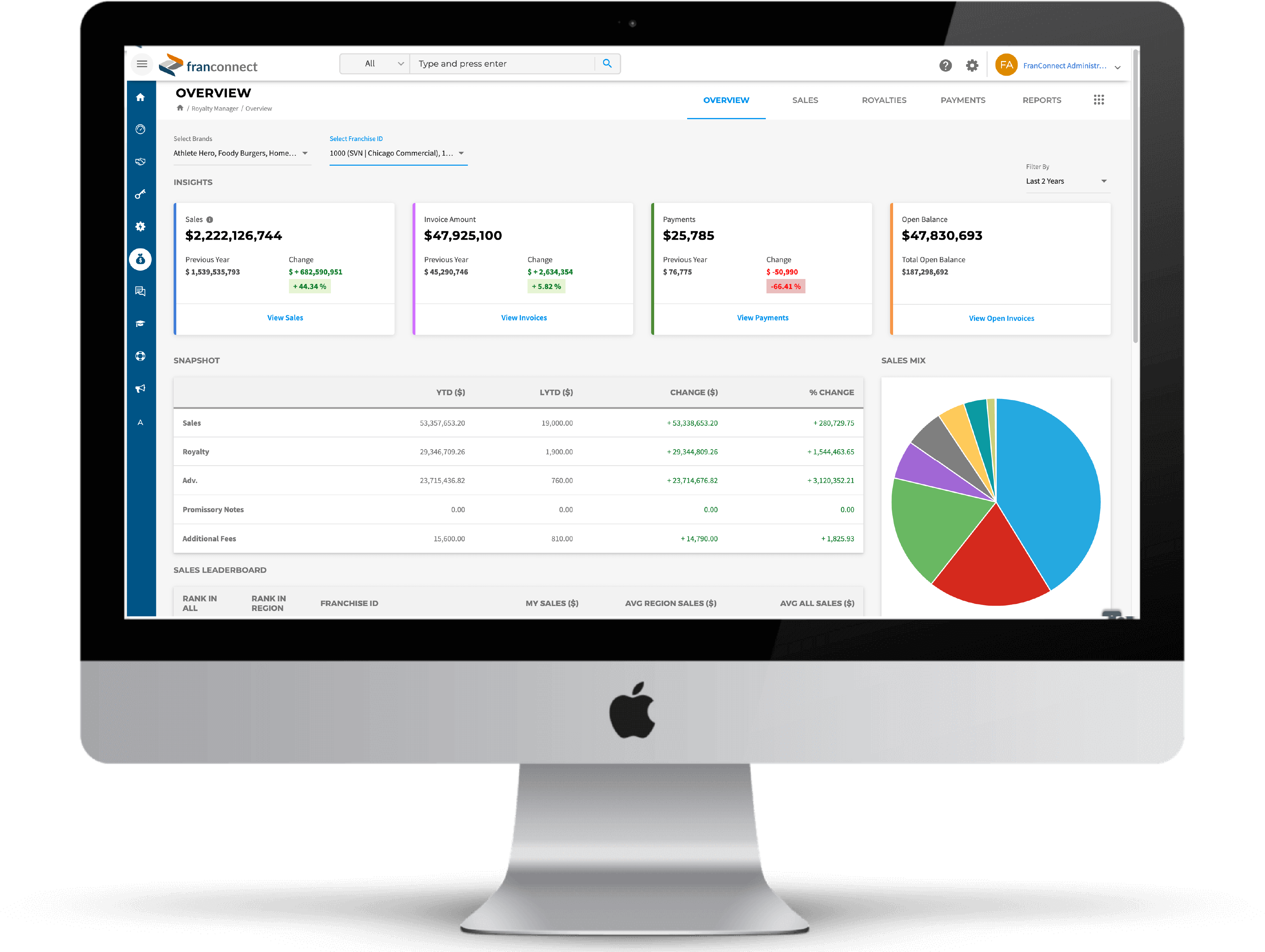
The current product covers a sequence: import sales, apply agreement terms, calculate fees, invoice, track payment status and reconcile. It belongs beside broader accounting systems. Its distinctive task is retaining the franchise context of the calculation. A rate tied to the wrong agreement can produce an impressively tidy invoice that is still wrong. Automation is most useful when the underlying records deserve its confidence.
AI needs a well-kept cupboard
FranConnect’s AI family is called Frannie. May 2025 release notes documented mobile access to agents for analysis, sales coaching and support. November notes added lead assessment inside the sales workflow and extraction of agreement data for human review. These are practical places to reduce searching and retyping, provided the person using them checks consequential outputs.
The Franchisee Support agent’s documentation is especially revealing. It answers from configured documents and does not search the public internet. Administrators must supply the knowledge base. That makes the operations manual, the approved policy and the current training document part of the product’s working machinery. Keeping one authoritative version of a procedure suddenly becomes a service to every operator who asks a question.
The implication is straightforward: an organization with contradictory or obsolete manuals needs to fix them. A conversational interface makes information easier to retrieve; it cannot make an outdated instruction current. Reviewing unanswered questions and negative feedback can expose gaps in the material. The useful work includes assigning responsibility for the cupboard, then checking what is inside it.
The bill includes the handoffs
FranConnect sells B2B cloud software through scoped subscriptions and implementation work. Its pricing guidance says modules, migration, integrations and rollout design determine the proposal. A buyer should budget staff time for preparing records and teaching new routines as well as the software bill. Brand count, regions and user groups change the work. A focused deployment and a multi-brand migration are different projects.
The alternatives depend on the job. BrandWide and FranchiseSoft sit in franchise management; ClientTether addresses franchise sales and engagement. General CRMs such as Salesforce offer broader configurable sales tools, while products such as SafetyCulture overlap in inspections. FranConnect’s argument rests on connecting lifecycle work. An organization needing one narrow workflow may place more value on a specialist’s simplicity. A network struggling with repeated data entry may value the shared context more.
Shorter franchise sales cycle at Firehouse Subs, according to FranConnect’s customer evidence.
A customer outcome, not a forecast for another brand.The result is worth examining through a demonstration of the exact work a buyer wants to improve. Follow a real candidate into an opening, or a sales report into a royalty invoice. Ask who handles an exception. Copy the discipline of choosing a small operational question, assigning an owner and checking whether the answer changes behavior. FranConnect becomes useful at that moment: somebody sees the relevant information, understands it and does something with it.