At Bahrns, a materials-handling equipment business, paperwork once had its own transport system. Mechanics carried forms in compartmented clipboards, then drove the completed sheets back to the office. Only after the paper arrived could the next administrative step begin. A repaired forklift and a billable repair were separated by a car journey.
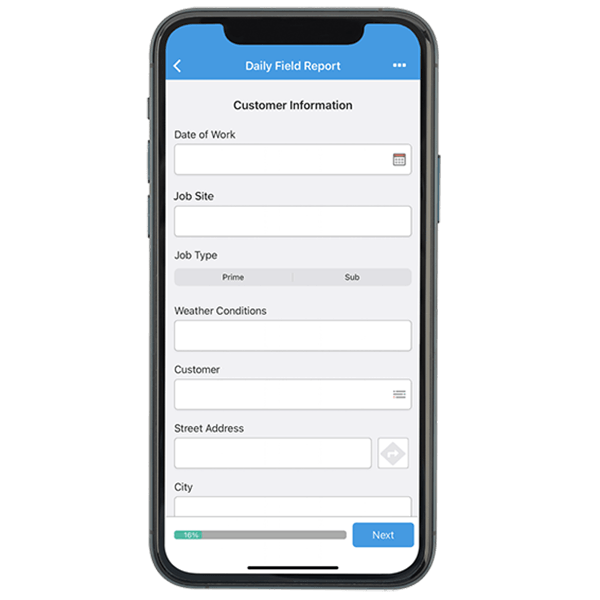
That is a useful place to begin with GoCanvas. Its product is mobile forms. Its subject is the peculiar interval in which work has happened but the business cannot yet make proper use of it. Anyone who has chased a signature, deciphered a work order or asked which photograph belongs to which job will recognize the territory.
- Capture once. Turn work orders, inspections and reports into configurable phone and tablet forms.
- Finish the handoff. Route records into PDFs, workflows and existing business systems.
- Budget for people. Advertised plans start at $29 per user per month, billed annually, with three seats minimum.
- Watch the drawings. Bluebeam’s Task Link gives GoCanvas a concrete place in Nemetschek’s construction portfolio.
01 / THE DELAY HAS A PRICEThe work is done. The office is waiting.
Bahrns’s lost forms could become lost invoices. Its office manager, Tara Funneman, began with one service technician and one salesperson, revising their forms as feedback arrived. The customer account says support helped win her over. The eventual system connected GoCanvas with Softbase, its back-office software. Bahrns reported being able to invoice before the technician returned. The change was modest enough to describe in a sentence, and substantial enough to affect cash flow.
Case Design, the Washington-area remodeling firm, offers another version of the same problem. Its craftspeople used iPad minis for work orders; automatic calculations improved billing accuracy. Completed documents reached project managers by email and were attached to customer records in Microsoft Dynamics. The familiar work order survived. Its need to be physically delivered did not.
Read those accounts carefully and a pattern appears. The gains come from what happens around the form: fewer missing fields, less transcription, earlier scheduling, a record already sitting where the office expects it. A screen replacing a sheet of paper is the visible change. The more consequential change is the disappearance of a queue.
02 / SOFTWARE FOR PEOPLE WITH OTHER JOBSThe person who knows the form can change it
GoCanvas began in 2008, originally as Canvas. Co-founder James Quigley had spent years in mobile and wireless business software. In a 2011 interview, he described demand for mobile applications without the usual implementation cost and complexity. Early financing was difficult: the company was selling its vision before it had a product, during the financial crisis.
“Our biggest competitor is paper forms”
James Quigley / StartUp Beat interview, 2011
The proposition remains recognizable. An operations person can configure an inspection or work order, publish it to field users, and decide what information must come back. GoCanvas supplies the mobile capture, PDF output, dispatch and routing machinery. Its expertise lies in making repeatable field activity produce repeatable records.
Today, Quick Start offers a particularly shrewd concession to habit: upload an existing PDF and build a mobile form around it while keeping the report’s appearance. AI Forms adds assisted conversion. Familiarity has value. A customer, supervisor or office administrator may still need the document they already understand, even when the crew fills it out differently.

03 / FASTER MESSAGES, SAME CONFUSIONA group chat is a poor filing cabinet
Clear Water Products, an oilfield services business, had already moved beyond paper in one respect: people used group texts. Yet managers still searched through messages, important details went missing, and different employees used different names for the same chemical compound. Faster transmission had preserved a reporting problem.
With GoCanvas, chemical names became menu choices. Different reports went to the appropriate managers. The company’s account reported more than 200 hours saved annually. The useful detail is the menu: consistency becomes easier when the worker selects a shared answer instead of inventing a description.
That distinction explains the customer base. Construction crews, manufacturers, service businesses and transportation teams need evidence from places where an office administrator is absent. They want records with enough structure to compare, search and act on. Photos, signatures, GPS and barcode capture can add context; required fields can prevent an otherwise complete job from producing an incomplete report.
04 / THE SUBSCRIPTION ARITHMETIC$29 is the seat price, not the starting bill
GoCanvas sells subscriptions per user, with unlimited forms and submissions in its advertised packages. Essentials includes offline mobile access, photo capture, dispatch and configurable PDFs. Pro adds multi-user workflows, API access and instructor-led onboarding. Max adds features including departments, single sign-on, web forms and one custom form build.
Prices are per user per month, checked October 1, 2026. Three-user minimum on each plan. Annual totals are calculated from the advertised rates, before taxes, add-ons or discounts.
Implementation has its own arithmetic. Someone must design the fields, test them with the crew, settle permissions and connect the receiving system. Bespoke integration and analytics costs require a quote. Subscription prices therefore answer only part of “What will this cost?” The other part is how much work separates a blank form from a reliable process.
GoCanvas occupies the space between generic form collection and broader business systems. Fulcrum offers a direct alternative for configurable field workflows, with a pronounced geospatial emphasis. Buyers should compare one actual job across the full journey. If an existing system already captures and delivers the necessary record, another subscription needs a specific justification.
05 / THE DRAWING ACQUIRES A NEXT STEPWhy the buyer was Nemetschek
K1 invested in GoCanvas in 2019. It later reported nearly fourfold revenue growth over its ownership period, alongside acquisitions of Device Magic and SiteDocs. Nemetschek’s purchase closed on July 1, 2024. The approximately $770 million transaction joined field data collection to a construction software group that already owned Bluebeam.
Reported by Nemetschek at the acquisition announcement. ARR measures recurring subscription value; it is not the same figure as recognized annual revenue.
Nemetschek reported more than 300,000 active GoCanvas users in the first quarter of 2024 and a purchase multiple of roughly 11.5 times 2023 ARR. Its rationale included complementary technology and opportunities to expand geographically. Those are transaction ambitions. The more interesting evidence arrived in a product release.
Task Link launched in December 2025. A Bluebeam Revu user can assign a task from a drawing markup using a GoCanvas form. Field records link back to the markup; drawings and task documents can be exported together. It gives the office-to-field relationship an address on the plan, making the connection more useful than a shared corporate parent.
The September 2026 release notes are less theatrical: faster admin pages, PDF label fixes, department-aware API form creation and follow-ups visible in the Web Client. They concern the mundane details that determine whether an operational tool remains dependable. A missing label can be an everyday nuisance long after an acquisition announcement has stopped being news.
06 / A SMALL EXPERIMENT WORTH STEALINGFollow one form all the way home
The lesson readers can copy is a method, rather than a promise of vendor-reported savings. Choose a process whose missing records, re-keying or delays are already visible. Ask a field worker to complete it. Watch what the office does next. Count corrections and waiting time. Change the form while the objections are still fresh.
Offline capture needs particular care: a worker can collect data without a signal, but the office cannot receive it until connectivity returns. Required fields need care too. A compulsory answer helps only when it is something the worker can honestly provide. A beautifully digitized bad process can remain an exhausting bad process.
GoCanvas’s published values include empathy, customer obsession and, pleasantly, “Cheeky.” These are company aspirations. Its customer accounts offer a more practical test of the personality: can someone close to the work change the tool when the tool gets in the way?
For a business waiting on paperwork, that is a sensible question. The forklift may already be running. The remaining job is to get the evidence home.