The odd thing about comfort is how little attention it wants. A good heater disappears into a room. A thermostat does its work without demanding applause. Ventilation is noticed most clearly when it fails. Yet behind that quiet experience sits a noisy industrial puzzle: sheet metal and electronics, cables and controls, shift schedules and maintenance windows, suppliers and warehouses, quality checks and promises made to customers across a continent.
François Séguin has spent much of his public career inside that puzzle. He is now Chief Manufacturing Officer at Innovair Solutions, the Quebec-rooted heating, ventilation and air-conditioning group created around a portfolio that includes Stelpro and Ouellet. The title is worth spelling out. In his case, CMO means manufacturing, not marketing. His terrain is the place where strategy acquires weight, tolerances and a production deadline.
Séguin studied business administration at ESG UQAM from 1996 to 2000 and says he began his career in 2001. The public trail becomes clearest at Stelpro, where he served as vice-president of operations and later added human resources to his remit. It is a record told less through personality profiles than through capital projects, production targets and the vocabulary of a working plant. That reticence fits the subject. Manufacturing tends to reveal its leaders through the systems they choose to build.
Productivity, made visible
In 2016, Stelpro announced a $750,000 investment to automate baseboard production at Saint-Bruno-de-Montarville. Séguin's explanation was direct: robotization and automation were occupying an increasingly important place in the company's strategy for remaining competitive. The planned result was not a smaller organization. It was more volume at the same staffing level, lower production costs and safer, less physically demanding work.
“Increasing productivity ... is not a luxury; it has become a necessity.”François Séguin, on manufacturing in Quebec and North America
That line carries more useful tension than the usual hymn to technology. A factory in Quebec competes with plants that may have different labor costs, supply routes and market proximity. Local pride does not clear a bottleneck. Automation can. So can faster feedback, fewer quality variations and a manager who knows about a stoppage now instead of at the end of the shift.
A later Stelpro connected-factory program made those ideas concrete. Equipment collected live production data. Analysis surfaced trends, deviations and improvement opportunities. A mobile application helped first-line managers interpret what was happening. Management routines added floor walks and employee feedback. Training mattered because information without adoption is only a better-decorated blind spot.
The connected-factory loop
The reported outcomes included productivity improvement maintained at a minimum of 5 percent a year, reduced quality variation and more proactive operations. The exact technology will age. The loop is more durable: observe, interpret, act, learn. It turns “digital transformation” from a conference phrase into a shorter gap between a problem and a decision.
The shovel and the system
Two years after the baseboard project, Stelpro made a larger bet. The company announced $24 million over three years for Saint-Bruno, including 65,000 additional square feet, more production and distribution capacity, improved product-development facilities and 50 planned jobs. Automation and robotization were again part of the program. The stated aim was flexibility: a factory able to adjust to demand in real time while facing higher material costs and global competition.
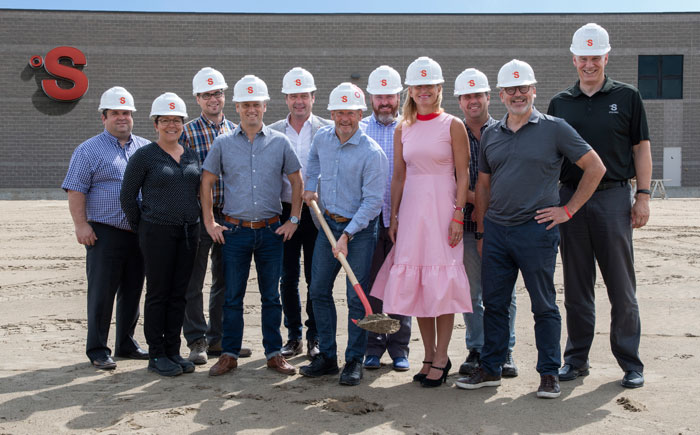
Groundbreaking photographs compress a complicated future into one clean frame. Everyone wears a hard hat. The shovel is spotless. What the picture cannot show is the sequence that follows: layout decisions, commissioning, software integration, maintenance planning, hiring, training and hundreds of ordinary days when the new capacity has to justify the concrete poured for it.
Séguin's later responsibility for both operations and human resources makes sense in that light. Machinery and people do not occupy separate plans. In 2022, discussing the attraction of a nearby daycare for workers, he called it a definite plus for an organization and its employees. It was a small public comment, but it recognized a factory-floor reality: reliable production depends on the lives that arrive at the gate each morning.
Pair every technology investment with a management behavior. A sensor needs an owner. A dashboard needs a decision. A variance needs a conversation. The return comes from the complete loop, not the purchase order.
From Stelpro to Innovair
The organization around Séguin is now much larger. Innovair Solutions says it has 18 complementary brands, 17 sites and nearly 1,300 employees across Canada, the United States, Mexico and China. Its catalog spans electric heat, heat pumps, heating cables, ventilation and thermostats, sold through a network of 600 distributors and major renovation retailers. The Stelpro combination, completed in 2024, joined manufacturing expertise and distribution networks that had been built separately.
In April 2026, La Caisse invested $150 million in Innovair, while the Fonds de solidarité FTQ provided $80 million in financing. The money is intended to support acquisition-led growth while keeping the company controlled and headquartered in Quebec. That places manufacturing at the center of a classic expansion problem. Buying brands creates a portfolio. Coordinating factories, product families, systems and standards is what creates an operating advantage.
That is the implied assignment behind Séguin's promotion to Chief Manufacturing Officer. The techniques he discussed at one Stelpro plant now meet a network. Which production data should look the same everywhere? Where does standardization help, and where does a specialized brand need autonomy? How should capital move between a bottleneck in one facility and an acquisition integration in another? Scale creates more information, but it does not automatically create clarity.
The portfolio itself makes the choices tangible. A radiant-floor system, an explosion-resistant industrial heater, a heat pump and a smart thermostat do not share one simple production recipe. They serve different channels, operate under different constraints and reward different kinds of expertise. The manufacturing office has to respect those differences while looking for common leverage in procurement, quality, maintenance, planning and data. Consolidate too little and the group leaves savings untouched. Consolidate too much and it can sand away the specialist knowledge that made an acquired brand useful.
This is where Séguin's business education and operating history meet. A machine has a cycle time, but a portfolio has trade-offs. Capital assigned to one line cannot be spent twice. Inventory that protects customer service also ties up cash. A larger production run may lower unit cost while making the network slower to respond. The manufacturing chief sits inside those arguments, translating financial goals into physical consequences and factory limits back into executive choices.
Séguin's public comments during the 2025 tariff uncertainty suggest how he approaches noisy signals. Quebec and Canadian companies exposed to U.S. sales and supply chains were facing uncertainty, he said. Stelpro was thinking through contingency plans, but he was cautious about significant changes before policy became official. Prepare the option, preserve the plan, wait for the fact. It is an operator's answer to a political spectacle.
“We are an agile and resilient company. We will get through this ordeal and emerge stronger.”François Séguin, April 2025
He was similarly plain when Saint-Bruno proposed steep tax increases for commercial and industrial properties. The measure seemed excessive at first glance, he said, and unhelpful for attracting new companies to the industrial park. The comment linked a municipal budget to the location decision every manufacturer eventually faces: where is the next dollar of capacity welcome?
A factory should get less surprising
There is a temptation to make automation sound cinematic: robots arrive, lights dim, output rises. Séguin's record points elsewhere. A useful factory becomes less surprising. Quality varies less. Managers learn sooner. Equipment can run flexibly. A contingency exists before it is required. Employees have clearer feedback. Each improvement reduces the number of reasons a customer might notice the machinery behind the comfort.
That perspective also explains why his story is easier to see through investments than interviews. The artifacts are operational: a baseboard line, an expanded building, a mobile dashboard, a signed supply-chain report, a cautious sentence about tariffs. Together they outline a consistent ambition without requiring a grand declaration. Keep manufacturing in Quebec by making it earn its competitiveness. Use technology, but attach it to the daily work of managers and teams. Grow, but preserve the ability to respond.
The next chapter will test whether those habits travel. Innovair's capital, brands and geographic footprint give it more room to expand. They also give Séguin more interfaces to manage and more places where complexity can hide. His job is to turn that sprawl into rhythm: machines producing signals, people reading them, decisions arriving in time. If it works, the evidence will be almost boring. The heater will ship. The thermostat will respond. The room will feel right, and nobody will wonder how many choices were required to make comfort disappear.