Jannis Frank went to Bremen to explain a decidedly unglamorous business: helping people find funding. He left with a €10,000 prize. Then came the more interesting number. Within a week of his FOUNDERS LEAGUE appearance, his startup, Förderfrage, received more than 260 enquiries through LinkedIn and other networks, he later reported. The applause had acquired an inbox.
- A startup community built around live pitches, investor access and founder education.
- Its pitch shows turn a business explanation into something people want to watch.
- A free Berlin residency extends the conversation across ten weeks.
Enquiries are not sales, and a founder’s account is not a controlled experiment. Still, the episode supplies a better question than whether a networking event looked busy. Did anyone come looking for the business afterward? FOUNDERS LEAGUE’s proposition rests on that passage from being watched to being contacted. The stage supplies the occasion; the network supplies possible consequences.
A good idea needs a guest list
The company’s April 2022 launch announcement named Marcus Diekmann, SNOCKS founder Johannes Kliesch, BDX Media’s Benjamin Diedering and Julian Rauch. Later company material also names Marc-Niclas Janz as a co-founder. Their premise was straightforward: young businesses in Germany, Austria and Switzerland could benefit from the visibility and relationships that established entrepreneurs already possessed.
The original announced format paired five-minute pitches with experienced jurors and a live chat, streamed through LinkedIn and YouTube. Advertising partners would finance it. A pitch therefore addressed several audiences at once: people assessing an investment, people considering a purchase, and people simply curious enough to keep watching. This was a practical use of entertainment. Business introductions seldom arrive with such accommodating distribution.

The room got bigger. The pitch got shorter.
By June 2023, the company reported 600 guests at its Mainz show in the MEWA Arena. Mynt, a maker of ecological paints, won the €10,000 prize. Its founder planned a project with the local hospice organisation, donating paint for a renovation. A pitch contest had produced an unexpectedly domestic destination for the winnings.
Mannheim brought nearly 700 guests in the company’s September recap. SongPush, which connects creators and musicians, won there; its founders earmarked the prize for app development and some wellness benefits for their team. By February 2024, the seventh edition in Munich attracted nearly 1,000 guests, according to the company. MaleUp, a men’s cosmetics startup, took the prize. The assortment of businesses matters: these rooms accommodate consumer products and digital services rather than one narrow investment thesis.
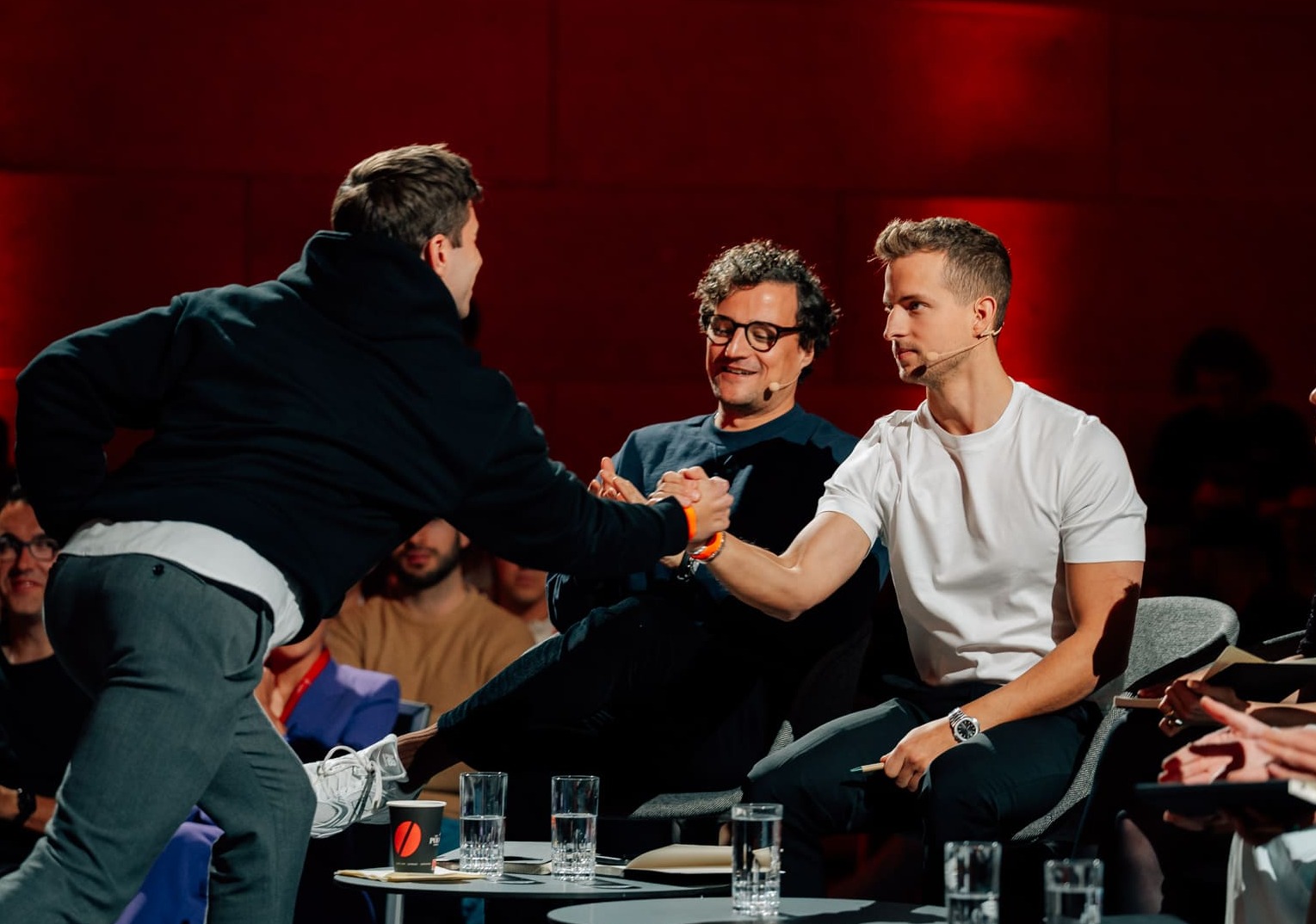
The March 2026 Mannheim listing described four startups pitching for three minutes apiece, with the audience and jury choosing a €10,000 winner. Around that short contest sat two stages, more than 20 speakers, masterclasses, an expo and an after-party. The headline attraction occupies minutes; the opportunities to meet people occupy an afternoon and evening.
Possible sequence, not a conversion forecast.
Who pays for the introduction?
There are several customers here. Founders want feedback, customers and capital. Investors want businesses to examine. Partners want contact with founders and decision-makers. A sponsor buys visibility within that gathering, while an exhibitor buys a place to begin conversations. FOUNDERS LEAGUE’s partner page invites companies to choose services and receive a tailored offer.
Tickets supply another revenue stream. The March 2026 Mannheim listing started at €39. A historical Munich ticket page advertised a €59.90 discounted classic ticket, a €99.90 investor ticket and a €399.90 VIP option. Those prices belong to particular offers, rather than a permanent tariff. The Academy has also advertised access from €200 a month. Different payments purchase different degrees and kinds of access.
Its own financing reflects the same social logic. January 2023 reporting put the company’s valuation at €5 million. A May company announcement placed it at €6.5 million and welcomed investors including footballer Julian Draxler and educator Daniel Jung. In early 2024, coverage described another 11 shareholders, including K5’s Verena Schlüpmann and Sven Rittau. These are historical valuations; they are not cash raised. The shareholder list also brings people with audiences, experience and useful connections.
Applause cannot do the homework
FOUNDERS LEAGUE expanded into smaller meet-ups and education. Its first Academy cohort began in January 2024, combining expert calls with online learning. The company now advertises a ten-week Berlin residency as free and non-dilutive, with Delta Campus office space and more than 30 mentors. For a founder, that makes the commitment principally one of time and participation.
Read together, the offers suggest a useful distinction. A show can get a stranger interested quickly. Reworking a pitch deck, discussing positioning and responding to difficult questions take longer. The combination places FOUNDERS LEAGUE between a pitch competition, a founder conference and a mentoring program. A television appearance or conventional networking event may serve part of that need; the League tries to keep the relationship going.
The teachers had their own homework
In a January 2024 interview, Rauch called product-market fit a major challenge for FOUNDERS LEAGUE itself. Janz described early difficulties delegating, deciding who should do what, and overwhelming shareholders with information. Clearer processes and communication helped. Rauch also credited advice from Lukas of Vickii, a startup in their own circle. Knowledge travelled back toward the organisers.
“test, learn, build bigger”Marcus Diekmann’s motto, recalled by Julian Rauch in January 2024
Their lesson for founders was experimentation. That sounds pleasant until it involves assigning responsibility or admitting that an offering needs work. Rauch also drew a boundary: they could help with positioning, but could not find the product for a founder. Connections have value when there is something worth connecting people to.
Take the recording home
HYDR8’s founder described an investor withdrawing two weeks before a notary appointment, after he had already rented office space. He had initially committed a €55,000 loan and €20,000 of his own money. Later, he kept sending his FOUNDERS LEAGUE pitch video to new contacts. The recording became a reusable introduction. His account also favoured taking time over negotiations rather than reacting under pressure.
That is a sensible thing to copy: prepare a clear explanation, preserve it, and use it in follow-up. An introduction still needs a product someone wants, an appropriate investor and the capacity to handle enquiries. A team seeking specialist technical validation may need a different room. A founder seeking instant money will need patience. The show opens a conversation; the business must give people a reason to continue it.