The most revealing sentence in a furniture catalog can be the one beneath the furniture. On a specification sheet for Flores Designs’ Hanover seating, below the drawings and their neatly assigned inches, a note allows for measurements to vary by one to two and a half inches. A sofa, apparently, has a little latitude. The wall behind it is less accommodating.
That small qualification is a useful way into Flores Designs, the California upholstered furniture manufacturer. Custom furniture invites us to imagine control: the right fabric, the right proportions, the right place to put our feet. Its drawings remind us to leave room for the physical object. Anyone furnishing a tight corner should find that tension more interesting than another photograph of a tasteful living room.
Dimensional variation noted on the Hanover sheet. A model-specific warning, not a tolerance to assume for every Flores product.
A family business behind the showroom
Flores Design Inc. describes itself as a family-owned manufacturer established in 1988. Its address is in Vernon, in the Los Angeles area. The company’s own account centers on modern and contemporary upholstery, craftsmanship and furniture for homes and businesses. The official range runs through sofas, beds, chairs and case goods. This is a business of objects that occupy space and, in the case of its seating, accommodate bodies.
Its public website makes a particularly telling choice: a prominent route leads to a dealer catalog. Follow the furniture outward and the retail names appear. Contempo Furniture in San Jose carries Flores Design. Greathouse in San Diego lists the brand. Sacramento Furniture Store maintains a collection, and Skylar’s Home & Patio lists its sectionals. The factory’s identity travels through other companies’ showrooms.
That distribution arrangement gives the furniture two audiences. A retailer needs a line it can present and sell. The eventual owner needs something that works in a particular room. My reading of the dealer presence is straightforward: much of the value depends on how well the choices survive the conversation between those two audiences. A product name can pass from one to the other easily. An exact preference for seat depth takes more care.
The sofa is a set of decisions
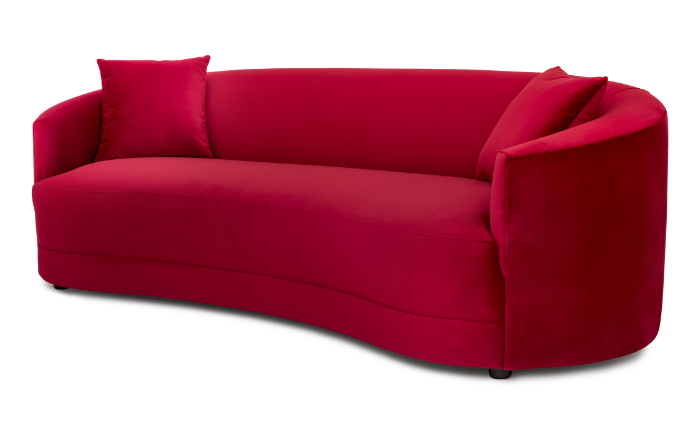
Consider the Boston sectional sold by Contempo. Its listed arrangement combines a left-arm sofa with a right-arm chaise. The overall width is 125 inches, and the chaise depth is 87 inches. Its seat depth is 29 inches. These numbers describe different experiences: how much wall it occupies, how far the chaise reaches into the room, and how far back a person sits.
Before getting attached to the upholstery, sketch that footprint. Imagine the route from the doorway to the next room. Then imagine the same route with someone’s legs stretched out. This is practical advice drawn from the published dimensions, rather than a claim that any one layout suits every home. The chaise can look wonderfully relaxed while asking a surprisingly firm question of the floor plan.
The Montpelier collection offers a different illustration of choice. Contempo describes a wooden plinth base and options that include a sofa, an L-shaped sectional and modular arrangements. Its listing also describes choices in fabric, dimensions, cushion fill and arm style, with wood tray tables among the possibilities. A shopper has more to settle than beige versus blue.
Those options suggest a useful way to order: settle the structure first, then the surface. Write down the arrangement and the dimensions being requested. Identify the seat feel. Only then does the fabric discussion have a stable object to attach itself to. The retailer’s particular options should govern that conversation; a feature offered for one collection should never be assumed to exist across the catalog.
“Measurements may vary from 1” to 2 ½”.”
Flores Design Hanover specification sheet
Three prices, three different purchases
Flores occupies a visible place in the custom upholstery market, where shoppers can compare named seating models through furniture retailers. At the time of research, Contempo’s Flores assortment listed the Bennet sofa at $1,399. Its Boston sectional was $3,298. The Maxwell sectional product page displayed $5,298. The spread is useful, but it is not a ranking of value: these are different pieces with different dimensions and specifications.
Maxwell makes the tradeoff especially clear. The retailer describes down-blend seating and choices of firmness, fabric, depth and configuration. The listing identifies it as made to order and gives a standard production estimate of three to five weeks, dependent on fabric and customization. That estimate belongs to this retailer’s offer; it should be checked against the actual order before arranging a room around a delivery date.
For comparison shopping, carry the same written brief to the alternatives. Contempo also presents American Leather and Luonto, while Skylar’s lists The Couch Company alongside Flores products. Those shared shelves establish shopping alternatives, not identical construction or performance. Compare the particular model, its seat, its dimensions and its delivered price. A brand-level comparison is too coarse for a purchase that can turn on a few inches.
The order needs a paper trail
The dealer relationship becomes especially interesting after the sale. In a 2018 review reproduced by Yahoo, a reviewer identifying as a designer described difficulty seeking a replacement slipcover after the original store had gone away. It is one person’s account, not proof of a current policy or a representative service record. Still, the situation raises a good question for a custom purchase: who will help when the original transaction is no longer simple?
A sensible buyer can answer part of that question before paying. Keep the model name, fabric identification, agreed configuration and order confirmation together. Ask the seller who handles replacement components and service inquiries. Put the contact details with the paperwork. These are recommendations for managing the purchase, not services this profile promises Flores will supply. A fabric description remembered as “the pale one” is a difficult starting point years later.
The same discipline helps with timing. A made-to-order piece suits someone prepared to decide on specifications and plan around production. For a room that must be furnished immediately, confirm actual stock and delivery availability. For an alcove with almost no clearance, obtain the tolerance for the exact item. The Hanover note gives a reason to ask; it does not give permission to apply its numbers to everything else.
What can another business copy from this picture? Make the choices understandable at the point where a customer commits. A furniture drawing, a named configuration and a clear description of cushion options give a conversation something to rest on. For the buyer, the corresponding habit is wonderfully unglamorous: save the drawing, measure the space, and leave a little room.