In a two-story house in Las Vegas, the future had a kitchen. During CES 2024, WeBranding Global put technology into domestic rooms: entertainment in the living space, appliances in the kitchen, outdoor equipment in the backyard. A coffee demonstration belonged on a counter. A pool-cleaning robot had a pool. For once, the setting needed very little explanation.
Feng (Rebecca) Ding, the agency’s founder and CEO, had spent years dealing with the harder part: explaining a product to people for whom its brand meant little. A company can develop something useful, manufacture it, ship it and arrive in another country with almost everything ready. Almost. The audience still has to understand where the thing fits.
The house offered a practical answer. It gave unfamiliar products familiar surroundings. Visitors could encounter technology as part of an ordinary activity, with questions arising from what it actually did. An appliance relieved of the duty to stand majestically on a pedestal can finally get on with being an appliance.
The advantage of having been inside Samsung
Before WeBranding, Ding worked at Samsung Electronics, including as Vice President of Marketing. Her professional background spans about two decades there. That experience placed her inside an established technology business, dealing with the work of building brands and bringing products to market. Her later company would take on that work for businesses with very different levels of recognition.
Consider the position of an emerging manufacturer entering a new country. Its engineers know the product intimately. Its customers may have never heard the company’s name. An explanation that seems obvious inside the business can require considerable translation outside it. The language on the packaging is only the beginning of the problem.
Ding’s route toward entrepreneurship included conversations with dozens of entrepreneurs operating in overseas markets. She listened to their difficulties. The question behind the business was how emerging brands could reach audiences with some of the effectiveness enjoyed by established global companies. It is an appealingly concrete question for someone who had worked inside one.
There was an academic chapter, too. Ding attended Harvard Business School’s Advanced Management Program in 2017, and her background includes visiting-scholar experience at Columbia University. These sit alongside the corporate experience in a career that eventually turned toward running a business of her own. In 2019, she founded WeBranding Global in New York.
in New York
at CES
recognition
A counter, a backyard, a reason to care
Smart Living Showcase gives a particularly clear view of Ding’s approach. At CES 2024, the house was organized around situations people could recognize. The living space contained entertainment technology. Kitchen products could be demonstrated where someone might prepare food or coffee. Outdoor devices had an outdoor setting. The arrangement made use the organizing principle.
Among the products were an AWOL Vision laser television, a Eureka robot vacuum and a Midea cooking appliance. Topher Ou gave live coffee demonstrations using Cocinaré equipment. In the backyard, a Beatbot robot worked in the pool. The variety mattered: a household can accommodate several kinds of technology without demanding that visitors think in exhibition categories.
For Ding’s business, this was a way to put international products into a shared everyday setting. Journalists and industry visitors could explore, test and discuss devices in greater detail. The room supplied context; the demonstration supplied something to ask about. A marketing conversation became easier to start because there was something happening in front of everyone.
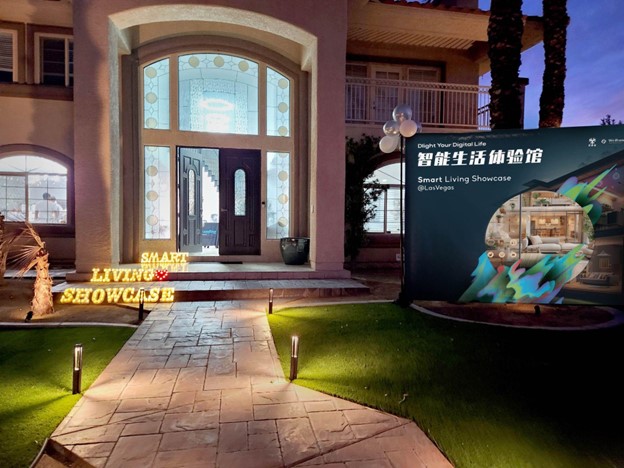
The approach also reveals an editorial choice. Someone must decide which products belong together and how visitors should encounter them. A useful device can become easier to understand beside another useful device, in a setting that explains both. The agency’s work includes arranging that encounter, then giving people enough room to examine what they have been shown.
Listening before the demonstration
The house is the visible part of a business that also deals in data. In January 2023, WeBranding introduced Adtarg at CES in Las Vegas. The marketing platform was presented as a way for brands to monitor social conversations, examine competitors and analyze customer feedback across online marketplaces, including Amazon and Walmart.
For a company entering an unfamiliar market, those activities serve a practical purpose. They can help it hear what customers are saying after the launch material has done its work. A product description tells the audience what the company considers important. Questions, comments and reviews let the audience offer a view of its own.
The relationship between listening and demonstrating runs through Ding’s work. One produces information about how a product is being received; the other creates a place to encounter it. Neither automatically establishes trust. Together, they give a brand more opportunities to understand what people need explained, and to improve the way it explains it.
- 01ListenCustomer feedback and market context
- 02DemonstrateA product in a recognizable situation
- 03Keep talkingCreators and local communities
The people who keep explaining
More recently, Ding’s work has increasingly involved the people who explain technology to audiences of their own. She founded TechxFluencer, a creator community connected to WeBranding. Its activities bring together access to products, education, professional relationships and commercial opportunities. The premise allows a connection to continue beyond an isolated piece of promotional content.
That continuation is central to her thinking about trade shows. A launch concentrates attention into a short period. Local creators can continue using and discussing a product after the exhibitors leave. At IFA in 2026, TechxFluencer organized activity beyond the exhibition space, extending encounters with products into settings where creators could experience and explain them.
The distinction has consequences for the founder’s job. A launch needs preparation for a particular date. A community needs reasons for people to return. Product access, workshops and relationships offer different reasons to participate, depending on where someone is in their work. Maintaining those connections becomes part of the marketing business itself.
By August 2026, TechxFluencer was describing Saturday programming in Times Square through its Creator Academy. Workshops covered AI video and content creation, with hands-on production, templates and opportunities to keep learning through the community. The activity placed education beside product access. Someone expected to explain emerging technology could also receive help learning the tools used to explain it.
The same month, TechxFluencer described back-to-school campus activations with Dlight Shop and the TikTok ecosystem. An event at the University of Southern California included educational robot dogs. The setting had changed again: from a house during a technology show to a campus, with student creators encountering products in a place where they already spent time.
A September 2025 gathering in Berlin, co-produced by WeBranding and BrandFactory Norge, brought together more than 100 senior executives, retail channel leaders and industry specialists from China and Europe. Ding discussed technology, environmental considerations and cultural resonance in European growth. The audience included people involved in the retail decisions that help determine a product’s next destination.
Recognition, with a working business behind it
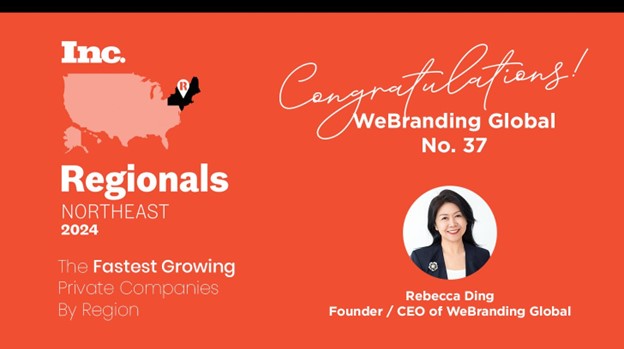
Ding has received recognition for this work. Forbes China included her in its 2024 list of 30 leaders in overseas expansion. WeBranding also appeared at No. 1,860 on the 2025 Inc. 5000. The company was founded in 2019, giving those later entries a place in the story of an agency built over several years.
Her colleague Jessica Yang is WeBranding’s co-founder and chief operating officer. Yang’s background includes creative work at Ogilvy and Ralph Lauren, and her responsibilities include the agency’s strategy and creative direction. Ding’s own experience in technology marketing sits alongside that creative background. The business requires both a market argument and a way to make it intelligible.
Ding has also established Women in Front, an initiative supporting women entrepreneurs. The aim includes helping women gain visibility and opportunities to speak. It adds another setting to her work on access: people trying to get their businesses heard, with attention to who gets the opportunity to present them.
“Innovation has no passport.”
Rebecca Ding, on global educational cooperation
The room after the launch
There is a commercial discipline underneath these settings. A creator needs to understand what is being offered, a brand needs a useful explanation, and an audience needs room to judge. Each encounter has to accommodate all three. The arrangement asks a marketing agency to think about the conversation after the introduction, including whether the people involved have a reason to continue it.
That helps explain why Ding’s projects return to places where people can gather. A demonstration house, a workshop and a campus serve different purposes. Each puts a product or an idea within reach of someone who can question it. For a founder working across markets, those questions are part of the work.
In remarks about global educational cooperation, Ding has advocated mentorship, cross-border training and international exposure for younger talent. These concerns sit comfortably beside the creator education in her business. Both involve access to people and situations through which someone can learn. The products change quickly; the need to understand and explain them keeps returning.
The through-line in her career is the encounter between a technology business and an audience that has other things to think about. Samsung supplied one vantage point. Her conversations with entrepreneurs supplied another. WeBranding gave her a business through which to work on the problem, moving between data, demonstrations and people who could carry an explanation further.
Return to the Las Vegas house. A kitchen counter gives a product a task. A visitor has a question. Someone is close enough to answer it. Ding’s work keeps arranging versions of that meeting, across different markets and different rooms. The next stage of a global launch may look surprisingly ordinary: a person trying something, and deciding whether it belongs.