A linen closet is an unlikely place to look for an internet business model. Yet in 2009, a customer could buy Martha Stewart’s advice on organizing one as part of a seven-part video collection sold through iAmplify for $9.95. The footage had a familiar teacher, a practical purpose and a price. Somewhere between the television archive and the untidy cupboard, an old recording had become a new product.
- Sell useful audio and video from recognizable experts.
- Put branded stores on websites that already attract the right readers.
- Offer downloads, bundles and subscriptions for portable learning.
That small transaction explains iAmplify better than the language of its era: viral marketing, premium content, Web 2.0. This was a New York publishing and commerce company built around a fairly ordinary human preference. When people want help doing something, they may want a particular person to show them how.
Expertise, with a play button
Murray and Jack Hidary co-founded iAmplify, whose company profile dates its founding to 2005. The brothers already had experience building internet businesses through EarthWeb and the expert-network company Vista Research. With iAmplify, expertise became something a consumer could carry away: a recording, purchased online, ready for a computer or portable player.
The catalog could look wonderfully incongruous. Fitness and yoga lived alongside business advice, spiritual teaching and poker instruction. Familiar names included Eckhart Tolle, Marianne Williamson and Phil Hellmuth. The unifying subject was the teacher. A customer wasn’t simply buying minutes of video; the offer depended on whose judgment those minutes contained.
Its publishing proposition reached beyond a retail website. Authors and instructors supplied material. Publishers supplied readers with relevant interests. iAmplify supplied ways to package and distribute the recording. A fitness magazine could offer an instructor’s workout through its own branded store, placing the sale close to the reader’s existing reason for visiting.
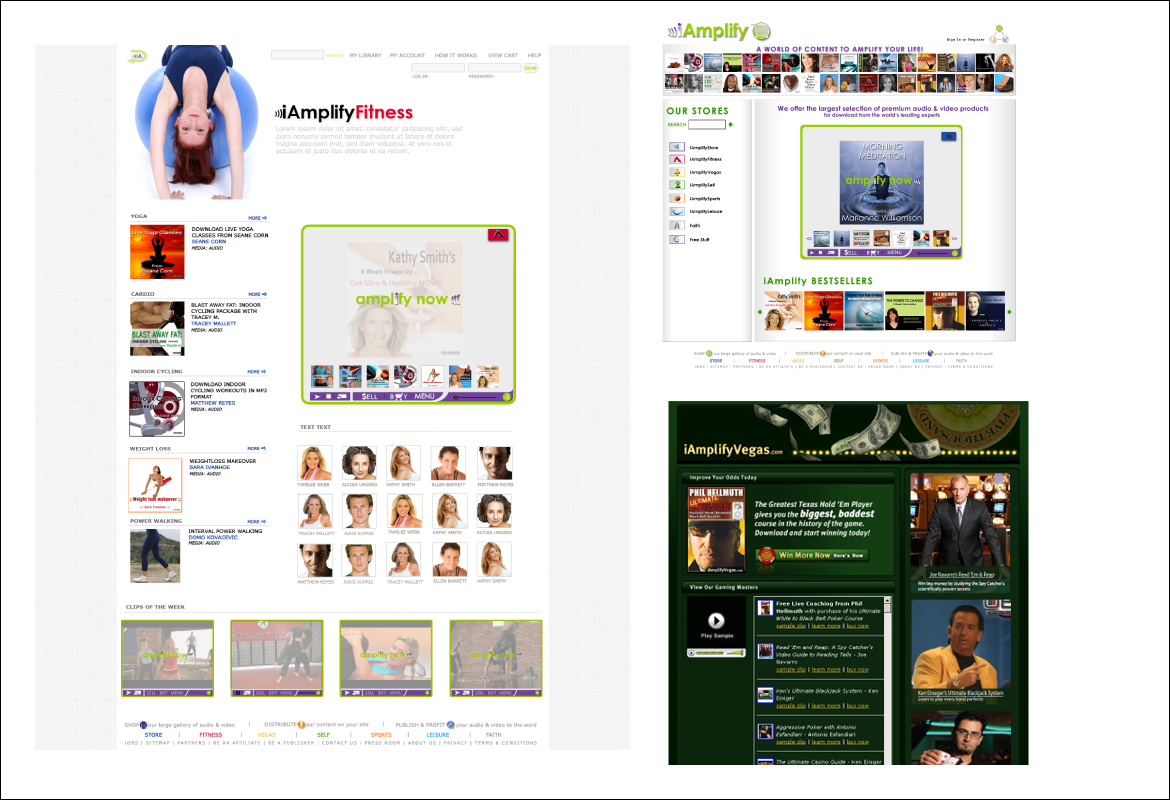
The store went to the audience
Consider the distribution problem. A good instructor might have recordings but little ability to operate a digital shop. A publisher might have an audience but no ready-made catalog of lessons. Matching them created a proposition neither had to assemble alone. iAmplify’s place in the market was at that junction of publishing, specialist retail and distribution.
HarperCollins offered an early example. In 2006, it introduced a Digital Media Café with free and paid streaming audio and video, using iAmplify technology. Material could be accessed through the publisher, iAmplify’s retail site and other partner sites. The publisher could experiment with another format while keeping its existing books business in view.
MediaFactory made the packaging flexible. Creators could upload recordings, set prices and offer individual downloads, bundles or ongoing subscriptions. An embedded commerce widget let them sell from their own websites. That flexibility matters: a single lesson and a recurring program ask customers to make different commitments, even when both begin as files in the same library.
recording
package
audience
download
The publisher’s brand stays close to the purchase.
What did the lesson cost?
The organizing collection’s $9.95 price is one concrete example, rather than a universal tariff. iAmplify supported several ways of charging for content. The commercial question was which arrangement suited the material: one purchase for one problem, a themed collection, or a subscription that promised a continuing supply.
The infrastructure also required investment. Public funding records associate iAmplify with a $6 million Series A backed by Kodiak Venture Partners. A later Hidary Family Office presentation lists the same round. That figure describes capital raised, rather than operating costs or proof that the publishing model produced a profit.
Martha Stewart’s seven-part organizing collection, reported in August 2009. A product price, not a platform fee.
For publishers with extensive archives, the appeal is easy to understand. Production work might already exist. Digital delivery removed the need to manufacture and ship another physical copy. But selecting the material still mattered. A cupboard full of footage needs a useful organizing idea before it becomes something a customer wants to own.
Free was waiting in the next tab
By February 2008, the instructional-video field was crowded. VideoNuze placed iAmplify among paid-download businesses and described a growing collection of advertising-supported alternatives, including ExpertVillage, VideoJug, Howcast and WonderHowTo. YouTube also offered free instruction. The competition concerned both the quality of a lesson and whether buying one was necessary at all.
Then the advertising market weakened. A May 2009 account of Martha Stewart’s download experiment connected publishers’ interest in paid offerings to the downturn in advertising. The practical response was to test another source of revenue: charge for selected material while leaving the larger website available free. Existing archives made that experiment possible.
“Content providers have full control of the business model.”Murray Hidary, in an interview about iAmplify’s platform
Even the route could change
In May 2013, iAmplify appeared among participants in YouTube’s paid-channel pilot. Its Fitness and Yoga channels were listed at $4.99 per month each in a contemporary industry report. The company’s instructional proposition had reached a different storefront: the enormous video platform where people were already watching.
Read together, the experiments suggest a useful discipline for publishers today. Start with a specific task your audience cares about. Find material you have the rights to sell. Package a small, complete answer, then test the offer with people who already trust the teacher. Treat purchases as evidence; a large archive alone proves little about demand.
That approach depends on the lesson earning its price. A plentiful free substitute, weak audience trust or expensive customer acquisition can undo the arithmetic. iAmplify’s historical offers make the underlying question tangible. Before building a vast content business, ask whether someone will pay to solve one small problem. A linen closet will do.