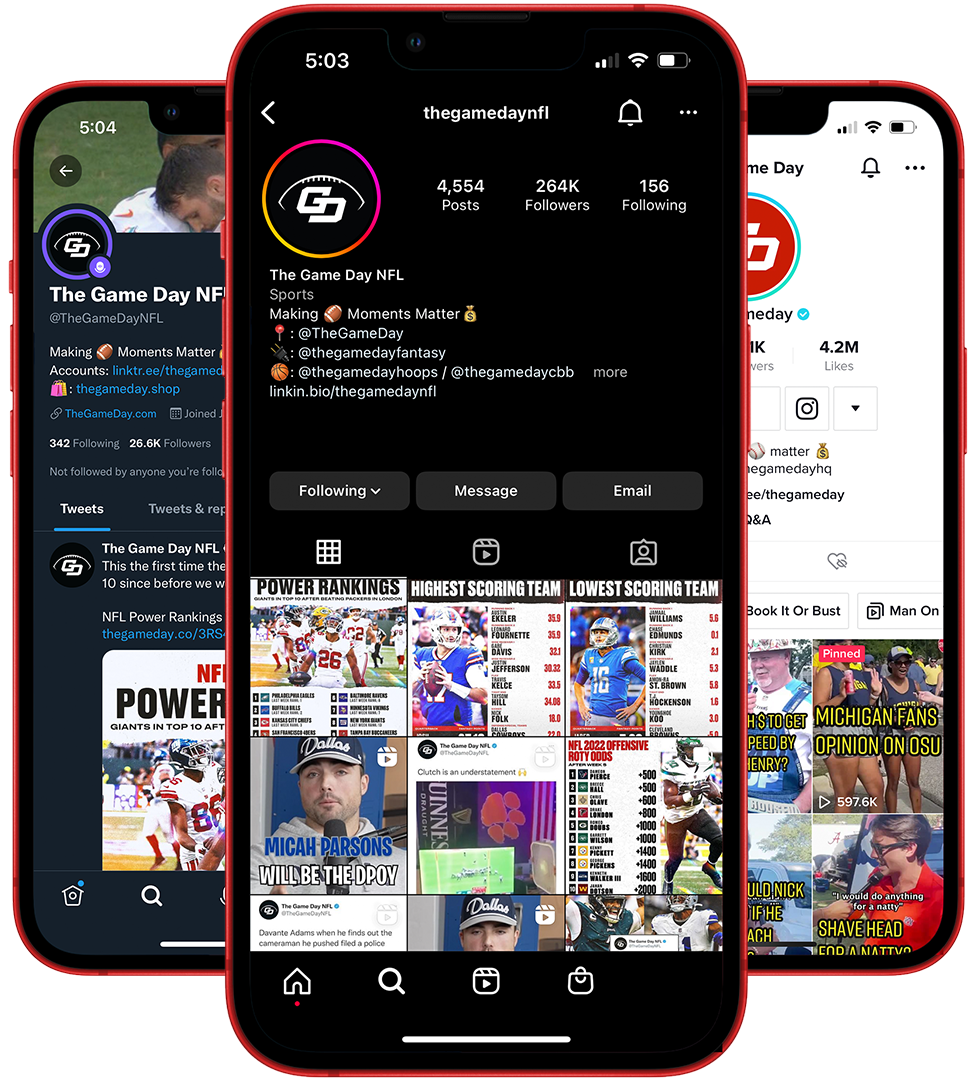
In September 2021, The Game Day announced a sports show hosted by Brandon Perna, the YouTube creator behind That’s Good Sports. Odd Man Sports offered satire. Alongside it came athlete stories, entrepreneurial profiles and trick-shot contests. This was an interesting menu for a company selling access to sports bettors. Before asking people to study a line, it gave them a reason to laugh.
- Sports entertainment brings fans into the network.
- Calculators, picks and comparisons give them a useful next step.
- Affiliate referrals and sponsored production create commercial value.
The distinction matters. A fan watching a funny football clip and a bettor comparing sportsbook offers may be the same person at different moments. The Game Day builds for that movement. Its social feeds supply entertainment; its website supplies picks, rankings, explanations and calculators. Its commercial proposition is to connect those moments without requiring the audience to adopt a wholly new identity.
01The producers arrived before the picks
Launched in 2020, The Game Day brought production experience to a market often introduced through numbers. Matt Heiman, its founder and CEO, had founded Diagonal View, which was sold to Sky. Co-founder and COO Steve Carey had been that company’s creative director, with further experience at Vice Media, Deltatre and BBC Technology. They understood how to package attention before they packaged a betting offer.
The company describes its audience as millennials and Gen Z, spanning casual fans and sports bettors. That positioning helps explain the mixture of formats. A fantasy ranking answers a practical question. A creator’s running joke offers belonging. An athlete interview offers access. Each can bring someone into the same network, even when only one of those visitors wants to place a wager.
Its first-anniversary announcement reported 100 million monthly impressions. Treat that as a dated company claim about exposure across a network, rather than a headcount of customers. An impression is a sighting; a follower is an account; a customer is another proposition altogether. Those distinctions become especially important when a media business sells advertisers the promise of an audience.
 Matt Heiman / Founder & CEO
 Steve Carey / Co-founder & COO
02A creator network with a pay packet
In October 2021, The Game Day announced a Creator Program featuring Jenna Bandy, Frank Michael Smith, Sports Dissected, Rebound Rewind and Laws Nation. The arrangement had a specific financial mechanism: creators would receive monthly remuneration based on channel size, engagement rate and growth. Production support and distribution accompanied the money. Advertisers could buy presenting sponsorships, integrations, placements and promotions across the network.
The inferred lesson: pay for continuing audience relationships, and give creators production support as well as a cheque.
The January 2022 agreement with Trent Attyah, known as BookItWithTrent, took that idea further. It covered original series, live shows and daily content, plus exclusive representation for branded opportunities. His Surgical Stream let bettors pitch their selections on video. The format made participation itself part of the entertainment. A betting conversation could become a programme before it became a transaction.
03The money sits beside the conversation
The Game Day has two audiences to satisfy. Fans want something useful or amusing. Commercial partners want attention that can lead to customers. Its media operation offers social production, original intellectual property and sponsorship integrations. Its affiliate policy says it may receive payment when readers follow links and make a purchase at an operator’s site. Readers can access the publishing and calculator pages without first buying a subscription.
That arrangement creates a question of trust. The company says partners do not influence its editorial content and that rankings are determined by editors regardless of financial relationships. This is the publisher’s stated policy. For a reader, the practical distinction is between an explanation, a recommendation and a paid introduction. All three can sit surprisingly close together on a betting website.
In December 2021, The Game Day announced a $4.5 million Series A. The stated plans included talent, new formats and additional monetisation. That number describes financing raised, not the cost of producing a show or acquiring a bettor. It helps explain the ambition: build enough content and distribution to serve advertisers across more than one sport or platform.
Financing for talent, formats and monetisation.
- 01WatchCreators + entertainment
- 02InvestigatePicks + tools + comparisons
- 03ConnectOperator referrals + sponsors
04A calculator is the sober friend
The most useful products may be the least theatrical. The parlay calculator takes a stake and the odds for several selections, then works out the potential profit and payout. Its accompanying guide explains that every leg must win and warns that combining bets compounds the house advantage. A large number on a screen is more intelligible when someone explains the arithmetic underneath it.
The broader site also offers an odds converter, hedging calculator, betslip builder, sportsbook reviews and fantasy advice. These products address different frictions: unfamiliar notation, difficult payout calculations, competing offers and crowded information. They help readers investigate a decision. They cannot make an uncertain sporting outcome certain. The company’s betting material is intended for adults aged 21 and over who can legally gamble.
Compared with alternatives such as Action Network or Covers for betting research, and Bleacher Report for social sports entertainment, The Game Day’s positioning combines both appetites. The attraction is the short distance between a familiar personality and a practical tool. Whether that combination matters depends on the visitor: someone seeking only a calculation may care very little about the cast.
“We are absolutely inflexible in our editorial autonomy.”
The Game Day / Affiliate policy
05From sportsbook sponsors to a four-point shootout
The BIG3 partnership announced in June 2022 shows what its production business could make beyond sportsbook referrals. The Game Day produced Day in the Life and BIG3 4-Point Battle, with distribution across league, partner and company channels. A league’s distinctive four-point circles became a competition format. That is a rather elegant production choice: take the thing fans already notice and give it its own stage.
The Game Day Casino, announced in December 2021, extended the information-and-referral approach into casino reviews, comparisons and player guides. Heiman presented it as an extension of the sports business and another route for sponsors to reach customers. The available evidence supports expansion, rather than a dramatic reversal of strategy. The site today still puts sports picks and odds at the centre of its offer.
The transferable idea is to pair entertaining distribution with a useful next step. Its limits follow from the same design: platform attention can be fickle, promotional information needs maintenance, and the economics depend on commercially valuable referrals or sponsorships. The Game Day’s archive labels expired offers, a small reminder that yesterday’s enticing button can become today’s editorial chore. The joke draws a crowd. Keeping the crowd’s confidence takes more work.