The drips were supposed to be decoration. At Sloomoo Institute, sculptural strands stretched from floor to ceiling, part of an environment designed to make slime look as inviting as it felt. Visitors had other plans. They climbed them. They swung from them. On opening day, an aesthetic decision became an operational problem. A room full of people who have been encouraged to play makes for a fairly efficient design review.
Karen Robinovitz, Sloomoo's co-founder and co-CEO alongside Sara Schiller, has described the resulting revisions: drips moved eight feet up, marine paint, walls protected with images of slime. Beauty needed to survive enthusiasm. The lesson is wonderfully specific to her current occupation. You can spend years developing an eye and still discover that your customers regard the installation as gym equipment.
It also offers a useful way into a career that has moved through fashion journalism, books, brand consulting and influencer representation. Robinovitz is interested in what people find irresistible. Sometimes that means a voice online. Sometimes it means a painting. In this case, it means a substance whose appeal becomes very difficult to discuss with dignity once you have both hands in it.
Fourteen days to become somebody
Long before slime entered the business plan, Robinovitz was investigating the mechanics of attention. Her reporting career began at Women's Wear Daily and included work for The New York Times, Elle, Harper's Bazaar and Marie Claire. Fashion supplied an education in how an image travels: who notices it, who repeats it, and how a private preference becomes a public signal.
One assignment took that investigation to a deliberately ridiculous extreme. Robinovitz and her friend Melissa de la Cruz were asked to make themselves famous in two weeks. The experiment became their 2003 book, How to Become Famous in Two Weeks or Less. It treated celebrity as something with procedures, props and a guest list. Even the title has the air of a deadline being negotiated with an editor.
The book's publicity described borrowed Harry Winston diamonds, a bodyguard and carefully arranged social occasions. The joke depended on participation. These were writers testing the machinery from inside it, enjoying the absurdity while paying attention to how it worked. Years before influencer representation became her business, Robinovitz was already examining the space between being seen and being known.
Her bibliography also includes The Fashionista Files, written with de la Cruz, and Fête Accompli!, with Lara Shriftman and Elizabeth Harrison. Clothing, parties and fame are all social languages. Writing about them required a feel for detail and an understanding that people buy into a world as readily as they buy an object. Those concerns would remain recognizable when her work moved into other rooms.
The audience had moved
In 2010, Robinovitz co-founded Digital Brand Architects with Raina Penchansky. Bloggers were building audiences that brands wanted to reach, and a business could be built around helping those creators handle the opportunities. Robinovitz became the agency's chief creative officer. The person who had written about attention was now helping other people make a living from it.
Her work included digital strategy for brands such as Tiffany & Co., Tory Burch, Coach and Estée Lauder Companies. That background mattered because representation involves translation. A creator has a particular voice and an audience with particular expectations. A company arrives with a budget and an objective. Someone has to make the introduction without making the resulting work feel like an interruption.
By 2015, she was teaching digital media sessions for the Council of Fashion Designers of America. Instagram and Snapchat drew especially strong reactions. Designers wanted to understand how to present themselves and where to spend their attention. Robinovitz's advice began with having a recognizable voice, then adapting the telling to the platform. A beautiful photograph could only do part of the work.
A snapshot of her working day in 2017 catches the business in motion. DBA represented names including Aimee Song, Camila Coelho and Nicolette Mason. Meetings about campaigns sat alongside discussions of product launches and talent. Between appointments, Robinovitz made time for a John Giorno exhibition. The art interest was already interrupting the calendar, apparently with permission.
A six-month idea refuses to leave
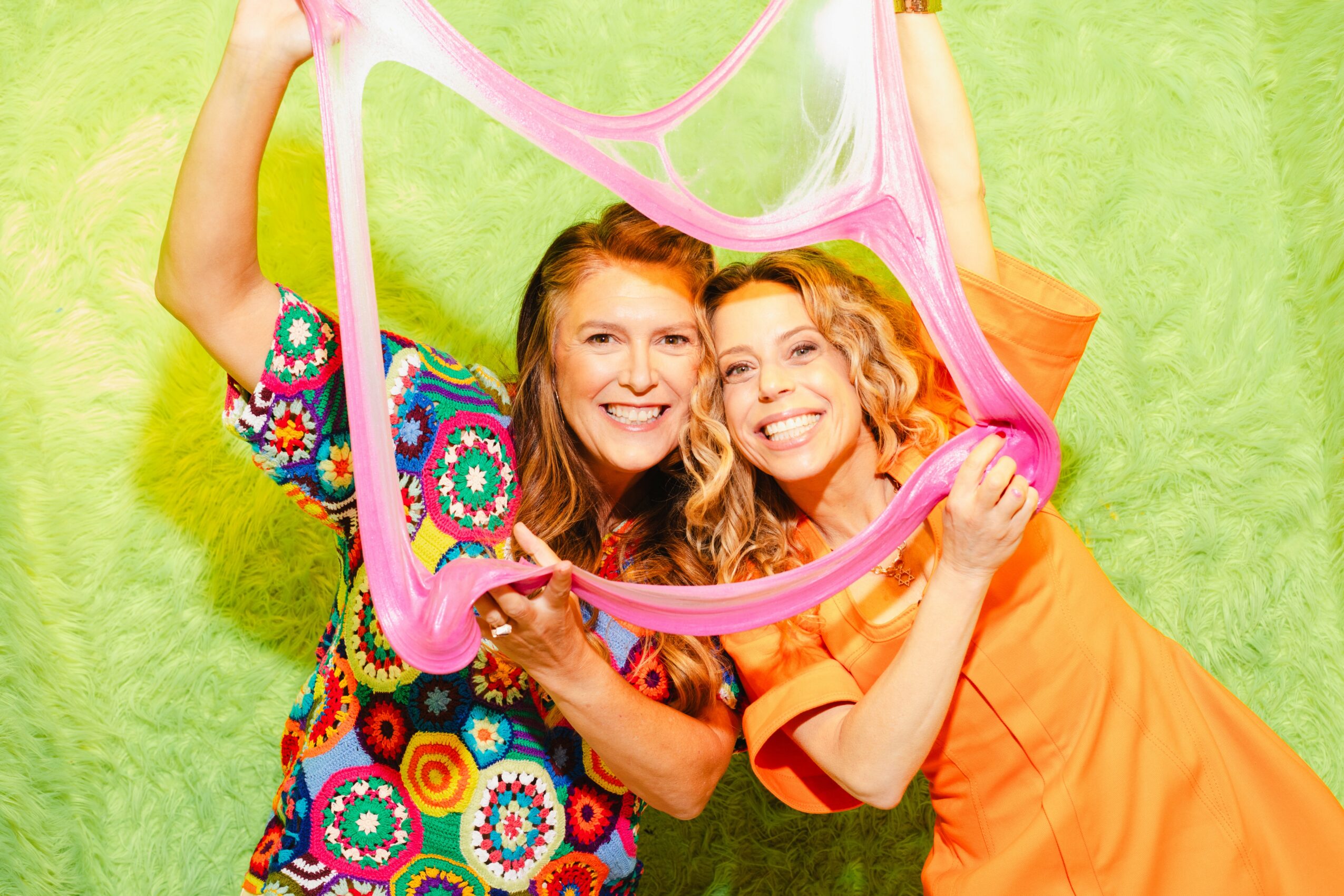
The introduction to slime came through a familiar person in an unfamiliar role. De la Cruz visited with her then ten-year-old daughter, who had brought slime. Robinovitz began playing. Four hours passed. For someone whose professional life had involved watching the movement of attention, losing track of it was a persuasive demonstration. She brought the discovery to Schiller, a friend who shared her interest in contemporary art.
They developed a business plan in 2018 and opened Sloomoo Institute in Manhattan in 2019. The first version was intended as a six-month pop-up. Their backgrounds made an unusual pairing for the project: Robinovitz brought media and marketing experience; Schiller had co-founded a meeting-space business. A place people would deliberately visit needed both an invitation and somewhere worth arriving.
The opening supplied an early complication. A ticketing error sold twice the intended allocation for the first day. Rather than functioning as a tidy test of carefully forecast demand, the launch demanded improvisation. Robinovitz later described that accident as a prompt to think bigger. The temporary experiment began acquiring the commitments of a permanent business.
Expansion meant learning a different vocabulary. Influencer campaigns operate through screens and schedules; a public attraction also has walls, fixtures, training and maintenance. Robinovitz's account of the climbable drips belongs to that second education. The experience has to invite uninhibited behavior while its surroundings remain ready for the next group. A place devoted to mess requires a remarkable amount of order.
The arithmetic beneath the goo
By 2023, Sloomoo had generated $30 million in annual revenue. Roughly 80 percent came from admission and 20 percent from slime sales. That split makes the business easier to understand. The ticket buys time inside a designed environment; the product gives the visit an afterlife on a kitchen table. Neither side is incidental to the other.
In May 2025, the company reported 2024 revenue of just under $40 million, with locations in New York, Atlanta, Chicago, Houston and Los Angeles. Those are dated figures, belonging to particular stages of the company. They nevertheless show how far the idea had traveled from a short run in SoHo. Inc. had included Robinovitz on its 2024 Female Founders list along the way.
Inside the experience, the material becomes a series of choices. Visitors encounter different textures and scents, make custom slime and move through installations developed with architecture firm Method Design. The company's slime-name convention replaces vowels with “oo.” Even the language gives visitors a small part in the fiction. The business asks people to become participants before it asks them to become collectors.
There is art in the linen closet
At home in Brooklyn, Robinovitz's enthusiasm for objects takes a less squishable form. She collects contemporary art, especially work by women. Her rooms have included paintings by Christina Quarles, Emily Mae Smith and Judith Linhares, alongside sculptural furniture and objects. The collection supplies another clue to Sloomoo: humor, vivid color and unusual forms were established preferences before they became features of a public attraction.
She arranges artworks in conversation with one another. An Emily Mae Smith broom looks through binoculars near the entrance; other works establish exchanges across a room. It is a way of living with stories rather than simply storing purchases. A guest can encounter a visual joke before reaching the sofa. The apartment sounds like somewhere an object might demand a proper introduction.
Asked about an unexpected place she had displayed art, Robinovitz supplied a memorable answer: the linen closet. Her dream acquisition was a large Cecily Brown. Her hypothetical dinner-party guests included Frida Kahlo, Andy Warhol, Jean-Michel Basquiat and Yayoi Kusama. The list suggests a lively evening, although seating arrangements would require some care.
Her stated approach to collecting emphasizes connection over market excitement. She has also written about artists, including Kylie Manning and Ivy Haldeman. The journalist remains present inside the entrepreneur: looking closely, developing a taste, finding language for a response. Her ventures keep changing the means of expression while preserving that interest in what an image or object can make someone notice.

“I need childlike wonder in my life.”Karen Robinovitz
Back to the page, with slime attached
In March 2026, another long-standing connection became part of Sloomoo's next chapter. Sloomoo Ink introduced Sloomoo: Making Friends, written by de la Cruz with Mike Johnston. The author who helped Robinovitz investigate fame, and whose daughter brought the original slime, was now helping give the brand a fictional world. Few professional networks close a circle quite so neatly.
The book follows Daisy, a child interested in science and slime, into a story involving a living Sloomoo. The publishing arrangement brings together Sloomoo Ink and Encantos, with Macmillan distribution. Robinovitz wanted the story to stand independently: readers should be able to enjoy it without knowing the physical attraction. That is a useful creative constraint for a company extending its name into another medium.
Four books had been mapped out, with other formats and animation ideas under exploration. A September 2026 podcast appearance returned to the questions of scaling, partnership and building characters beyond the locations. The direction is clear enough without treating every possibility as a finished product. Robinovitz is trying to give people more ways to enter a world she and Schiller have made.
There is a family precedent for beginning another substantial project. Robinovitz has described her mother, a mathematician and computer programmer, starting a business in her fifties and building it into a company with hundreds of employees. She has also spoken about enjoying mentorship herself. Experience, in that account, remains something to put to work and pass along.
The continuity in Robinovitz's career is easier to see from this distance. She has written about social rituals, represented people with distinctive voices, collected objects that reward attention and built rooms where visitors become absorbed in what is in front of them. The current version comes with maintenance questions, ticketing systems and a fictional species. Somewhere in the process, the decorative drips had to move upstairs. The customers were having too much fun.