Shana Davis-Ross’s work can begin with something as modest as a cosmetic case. Roller Rabbit supplied them for a Ponte Firm talent summit. Kit Keenan kept hers. About two years later, a clothing collection arrived, complete with an apron the brand had never previously offered. Somewhere between the gift bag and the finished garment sits the career Davis-Ross has chosen: helping people turn their particular tastes into something with a life beyond a post.
The apron makes a useful introduction. It belonged in the collection because Keenan cooks and entertains; she wanted it there. A small production run followed, and it sold out. The object had a reason to exist. In a business where a famous name can be attached to almost anything, that is a pleasingly demanding standard.
Davis-Ross is the founder and CEO of Ponte Firm, based in Austin, with a working life that reaches into New York’s fashion circles and the expanding business of online talent. Her clients include Keenan, Audrey Peters, Jully Patel and Abigail Lin. The question running through her work is straightforward: what should someone do with the attention they have earned?
A fashion education, followed by a different question
Before she managed creators, Davis-Ross worked inside fashion. Oscar de la Renta and WWD were among her early workplaces; her background also includes Vogue. She attended New York University from 2012 to 2016, and later worked at MAIA Agency in brand development and social strategy. These were jobs close to the machinery that decides how a brand presents itself and who gets invited into its orbit.
That experience matters to the shape of her business. Fashion runs on distinctions that can look tiny from a distance: a choice of fabric, an image, a guest list, a particular person wearing a particular thing. Social media brought that process into public view and gave individuals a more direct relationship with the people watching. Davis-Ross was working where those two worlds met.
She saw room for a management company that would help develop a career while it was still taking shape. Ponte emerged from that observation. Her own account of the opportunity centers on providing sustained guidance alongside commercial introductions. Getting the deal was part of the work. Figuring out where it could lead required a longer conversation.
There is a practical distinction here. A booking can be evaluated when the work is delivered. A career has to accommodate the next ambition, the changing audience and the project whose usefulness may take a while to become apparent. Davis-Ross built her firm around staying involved in those decisions.
“The journey of getting from point A to B is just as important.”
Shana Davis-Ross
The view from behind the camera
In July 2024, Davis-Ross had an unusually public moment herself. Ponte and its roster appeared in The Wall Street Journal, with attention on the influencers associated with New York’s West Village. For someone whose business generally happens behind other people’s pictures, appearing online and in print felt surreal, she wrote afterward.
Her response was revealing. She thanked the team, the clients, the brand partners, friends and family. Then she got to the business. She described the firm’s emphasis on strategy and community, pointed to its annual talent summit and made clear that Ponte was still hiring. A moment of recognition became an explanation of how the company worked.
She also offered numbers, explicitly as her own account of its performance: at that time, 95 percent of new talent came through referrals, and clients’ followings grew at least 40 percent on average during their first year on the roster. These were founder-reported measures, tied to that moment. They show what she wanted the achievement to mean: people recommending the service, and clients gaining ground.
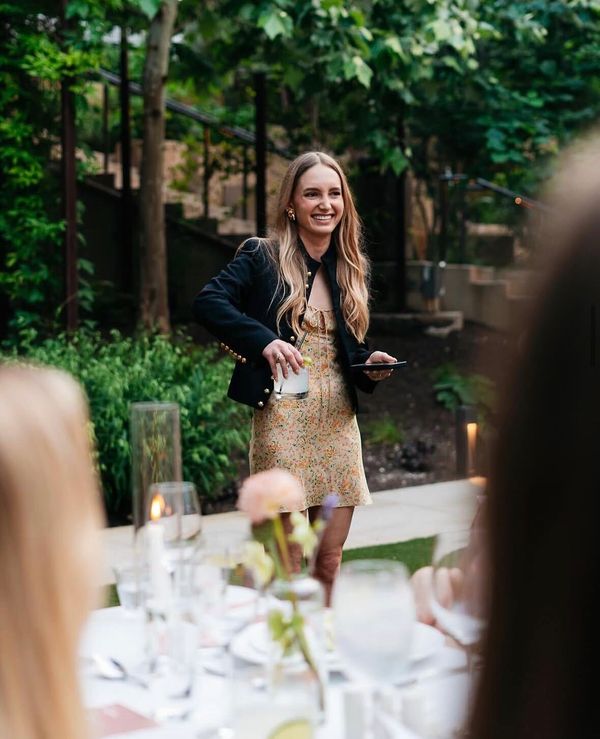
The company’s social world is part of its working infrastructure. A summit gives people whose careers unfold through separate accounts a chance to spend time together. The resulting connections can be commercially useful, as the Roller Rabbit introduction suggests. They also make management something a client can experience in company, away from the solitary arithmetic of an account dashboard.
Personal history, available in stores
Audrey Peters’s collaboration with Olympia Le-Tan offers another view of Davis-Ross’s work. The bag drew on Peters’s childhood summers in St. Tropez. Its development took about a year and a half. Davis-Ross celebrated its sellout and its arrival at retailers including Bergdorf Goodman, Neiman Marcus and Selfridges.
A personal memory had become a design proposition, then a product people could buy. There is a great deal of work hidden inside those transitions. A memory does not arrive with production specifications. A good story still needs an object capable of carrying it.
For Davis-Ross, such projects sit within a broader ambition to help creators develop businesses across products, publishing and entertainment. The appeal is understandable. A collaboration can give someone a new kind of professional responsibility and a reason for an audience to encounter their work in a different setting. It also asks for patience from people whose usual medium rewards immediacy.
The two collections illustrate why a manager has to pay attention to the individual. Peters’s reference point was a summer place. Keenan’s was cooking, hosting and family. Their commercial possibilities came from details particular to them. Any system for representing both has to leave room for those differences.
A number needs a job to do
Davis-Ross has also taken the conversation beyond her own roster. At Marketing Brew’s 2024 influencer event, she appeared alongside Keenan for a session about the workings of a talent management agency. The discussion’s remit included finding talent, negotiating partnerships and keeping creators and brands aligned. Putting a manager and client together makes the subject pleasantly concrete: each has to live with the arrangement the other describes.
Her public appearances have reached other corners of the industry, too. During SXSW in 2024, she joined Soho House Austin’s discussion about the future of digital creators. The panel included YouTube’s Elizabeth Del Valle and creators Marissa Hill, Taryn Lamb and Charles Brockman, alongside Courtney Shields. It placed management in conversation with the platform, the people making the work and the businesses growing around it.
In October 2026, Entrepreneur listed Davis-Ross for a virtual event focused on making money through social media. Its agenda asked attendees to examine what produces sales, how engaged smaller audiences can matter and where to concentrate limited resources. Those are useful questions for a field with so many publicly visible numbers. A counter can tell you how many people arrived; a business still needs to understand what happened afterward.
For an entrepreneur, this is where the conversation becomes less glamorous and more useful. Views, clicks and purchases describe different actions. Choosing which one matters is a decision about the work a business needs done. Davis-Ross’s place in these discussions reflects a career spent connecting creative identity with commercial expectations.
When the platform becomes the question
That connection has to survive changes outside a creator’s control. In March 2024, as businesses considered a possible US TikTok ban, Davis-Ross was already working with clients on other social and marketing channels. Her response rested on a plain observation: people would continue consuming things, even if their route to them changed.
“Eyeballs still exist,” she said at the time. The phrase has the advantage of being difficult to overcomplicate. Behind every account is a person who may watch, read, shop or listen somewhere else. Management has to take that possibility seriously before a platform decision makes it urgent.
Seen through that earlier episode, her interest in careers beyond a single feed has a practical history. An audience relationship can travel into a book, a retail collaboration or another channel. Each requires its own work. Having several places to meet people gives a creator more decisions to make, and gives the manager a larger calendar to understand.
The founder builds a bigger table
By August 2026, Ponte was expanding its own management structure. Jenna Bissonnette joined as managing director in New York. Roy Peters became senior vice president of talent and partnerships in Los Angeles, joined there by director Matthew Bojanic. Jenna Galan joined as a director in New York. In Austin, longtime team member Annie Leggett was promoted to senior talent manager.
The appointments put names and responsibilities behind the next stage of Davis-Ross’s company. More than 100 creators were on the roster. Supporting work across publishing, consumer products, licensing, podcasts and television calls for people who can handle different kinds of opportunities. The founder who helps clients think beyond their next project is making a related decision about her own organization.
There is a personal thread through this professional story. Davis-Ross’s husband, fellow founder Hudson Davis-Ross, has publicly celebrated Ponte’s progress and described their life together as one of shared ambition and risk. In her own writing about leadership, she has emphasized consistency and decisiveness. The language is attentive to the people around the company as well as its results.
That brings the story back to the small object that started it: a cosmetic case kept after an event. Davis-Ross’s business makes room for a connection like that to develop. The finished collection arrives with photographs, a launch date and things to put in a shopping basket. Before any of those, someone has to recognize a promising fit and keep working on it. She has made that interval her profession.