Twenty-six seconds is an agreeable amount of time in which to score twice. Long enough for the announcer to catch up; short enough for the opposition to wonder whether the first goal had properly finished. Against Air Force in September 2002, Oregon State forward Courtney Carter did exactly that, on her way to a hat trick. Years later, recalling the afternoon, she made a point of remembering the passes and the teammates who supplied them.
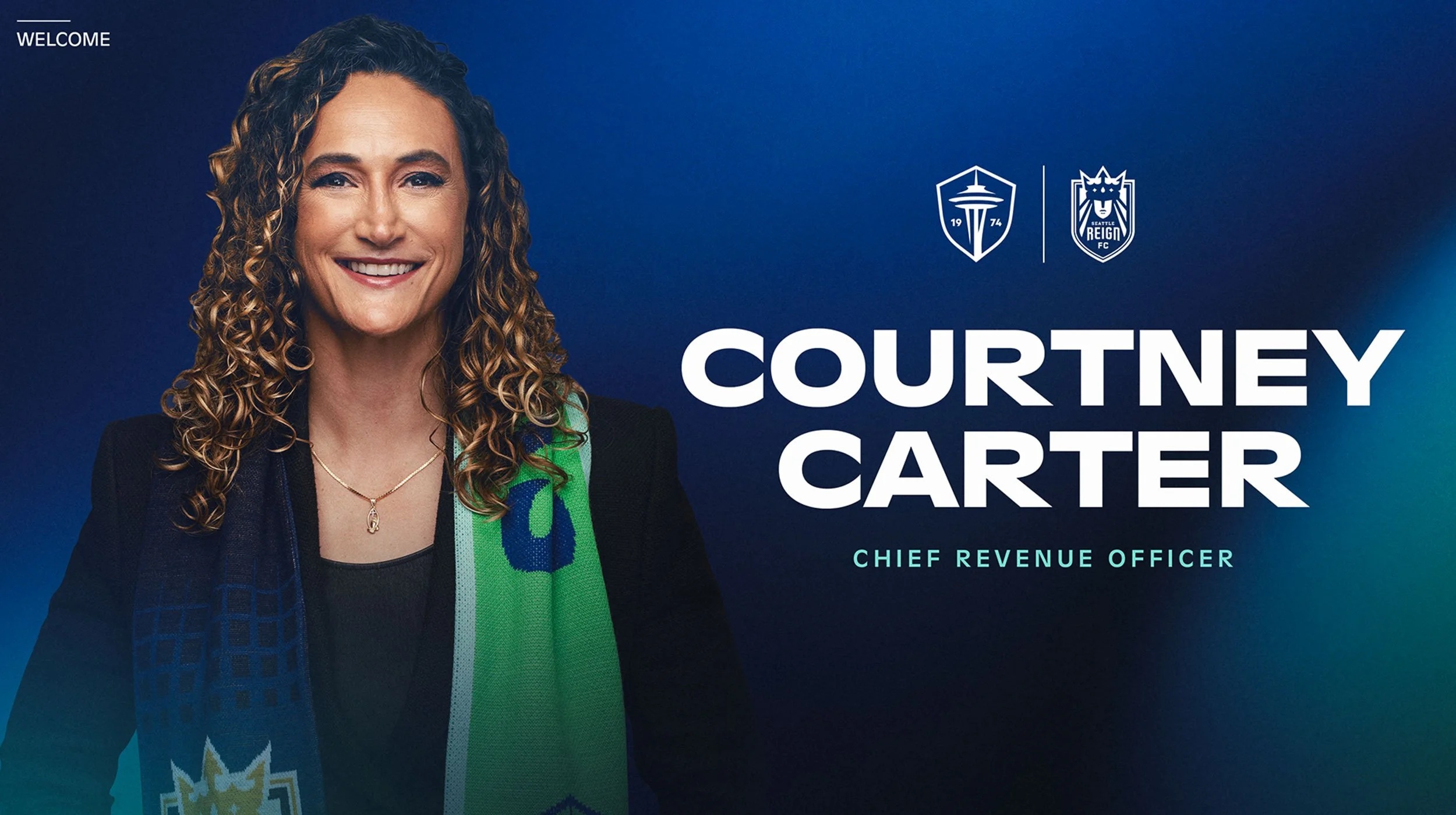
It is a small detail with a long afterlife. Carter’s working career has carried her through sports sponsorships, ESPN, talent representation at Creative Artists Agency, and the company she founded, Carter Media Group. In July 2024, she became chief revenue officer for Seattle Sounders FC and Seattle Reign FC. The former player had returned to the Pacific Northwest with considerable experience in everything that happens around a performance.
A goal is wonderfully easy to recognize. The work that makes an audience care can be harder to isolate. Carter has spent much of her career inside that less tidy business: bringing together people who make things, people who watch them, and people willing to pay for the connection.
A forward with an interest in promotion
The early clues were fairly explicit. At Oregon State, Carter studied business with a marketing focus. Her player biography listed sports and music promotion as possible career interests, alongside reading, music and guitar. Professional life would eventually make room for both halves of that ambition. The teenager imagining a job had, in broad outline, read the room.
She came from Oregon soccer, attending Jesuit High School and playing college soccer in Corvallis. An athletic résumé is usually arranged to emphasize individual distinction. Carter’s own account of her scoring afternoon gave the supporting cast a speaking part. That seems fitting for someone whose subsequent work would repeatedly depend on assembling people with different jobs around one public moment.
The transition into business included an internship with the New York Knicks and Liberty. At Madison Square Garden, sponsorship work meant learning how an arena, its teams and its entertainment properties could matter to advertisers. She then moved into soccer’s commercial business at MLS and Soccer United Marketing. By 2009, Oregon State had recognized her with its Distinguished Young Business Professional award.
These were useful places to learn the difference between loving a sport and finding someone to support it financially. Affection gets the conversation started. A partnership needs a reason to continue.
- SportMSG · MLS / SUM
- MediaESPN
- TalentCAA
- FounderCMG · 2017
- ReturnSeattle · 2024
Different employers. A continuing interest in the people around the performance.
The useful education of changing sides
ESPN added another set of relationships. Carter moved there in 2010 and later became a director in sports management. Her remit brought together sports properties, production and sales. The job required thinking about what could be made as well as what could be sold. An advertiser needed something an audience might voluntarily enjoy.
There was room for personal experimentation, too. While working at ESPN, Carter produced the short film Heart’s Gamble. She had become involved through its writer and lead actor. The project turned a supportive role into a production job, an unusually literal example of discovering what else a relationship might make possible.
There is a practical education in that sequence. Selling a sponsorship teaches you to explain value. Producing a film makes you help deliver it. Working inside a media business exposes the distance between a persuasive proposal and something people can actually watch. A career can accumulate those experiences without resembling a straight ladder.
By the time Carter moved into agency work, the person on the screen had become as interesting a business subject as the company funding it. Television and digital talent, packaging and brand partnerships sat within her work at CAA. The vocabulary changed. The questions about audience and fit travelled comfortably.
When the client proposed a company
In 2017, Liza Koshy asked Carter to become her full-time manager and producing partner. Koshy also encouraged her to build a business of her own. Carter Media Group opened that May. Leaving an agency meant giving up the resources and colleagues that made a large organization useful. The invitation offered a closer working relationship and the chance to shape something independently.
That distinction has consequences. A performer’s next opportunity may involve a show, a brand partnership, a product or a different way of reaching the audience. Someone has to consider how those opportunities fit together. A company built around that work needs a view of the person’s ambitions beyond the next booking.
Carter’s credits on Liza on Demand give the idea a visible result. The comedy, starring Koshy, Kimiko Glenn and Travis Coles, ran on YouTube from 2018 to 2021. Carter served as an executive producer. Representation had become a relationship with an actual production attached: episodes, collaborators, characters and something viewers could choose to spend time with.
“At the end of the day, we’re all creating entertainment on a piece of glass.”
Courtney Carter · 2019
It is a pleasantly deflating description of an industry fond of making its equipment sound profound. The screen matters, of course. So do length, cost and distribution. Carter’s phrasing puts the act of entertaining someone back at the center, where it is harder to hide behind the format.
A roster that needed several shelves
CMG’s historical work crossed comedy, food, sport and culture. The people involved included Matt Bellassai, Ghetto Gastro, Carri Twigg and Selema Masekela. A conventional category could describe part of any one career. It would struggle to describe all of them at once.
That variety showed up in the work. The company’s approach extended into television, audio, books and consumer products. Ghetto Gastro’s projects included appliances and Black Power Kitchen; Masekela’s work included Afrosurf. These are objects and productions people can encounter outside a social feed. A person’s perspective can take more than one commercial form without becoming unrecognizable.
Carter also founded Ally2Action in 2020. Its mission centered on racial-equity education, connection and action. That effort belongs beside the commercial career because it shows another use for her habit of bringing people together: giving an intention an organization and something specific to do.
Her stated working methods sound considerably less elaborate than the industries around them. She advocates polite persistence and direct conversation. The phone remains part of the equipment. A calendar full of meetings can make contact feel abundant; it does not guarantee that anyone has had the conversation that matters.
Two clubs, one return ticket
The Seattle appointment arrived as the Sounders ownership group and Carlyle came together to operate the Reign. Carter was the first hire to work across the combined business enterprise. Her responsibilities included corporate partnerships, ticket sales, service and premium offerings. The job description had plenty of room for both an audience and a balance sheet.
For Carter, the move also returned her to the region where she had learned the game. She brought a player’s history into an executive position, along with years spent working around creators and their audiences. Soccer could now benefit from skills she had developed at some distance from a soccer field.
The work soon had an audible example. In March 2025, the Reign released Stand Up, an anthem performed by Washington musician Brittany Davis. Carter and Ali Joe Williams were credited as producers of the accompanying film, directed by Jason Bergh. Players and supporters participated in the musical project. The people associated with the club helped give it a sound.
An anthem is a particularly revealing piece of club business. You can commission the recording. Getting people to make a song their own is a different proposition. It has to find a place inside a shared experience. Carter’s production background offered something concrete to that assignment.
ADWEEK Sports
Marketing MVP
The match has a waterfront, too
By 2026, the scale of the setting had changed again. Carter led Seattle Soccer Celebration, powered by Lenovo, a World Cup project that included a floating soccer pitch on Elliott Bay. The city’s waterfront became part of the experience. The idea gave a familiar game a setting that could only belong to Seattle.
A floating pitch has the useful quality of being easy to picture and rather less easy to arrange. Partners, event teams, waterfront organizations and the clubs all had roles in bringing it together. The finished image could fit in a photograph. The collaboration behind it could not.
Later that year, Carter discussed another practical audience question at the VenuesNow Conference. She said 64 percent of the Sounders’ Gen Z fans were female and pointed to the clubs’ Hello Kitty capsule collection. Her argument connected that audience composition to retail choices and spaces where people could enjoy time with friends and family.
There is something refreshing about the specificity. An audience can disappear into a demographic label. A shirt someone wants to wear, or a place they want to bring a friend, returns it to ordinary life. The commercial decision becomes easier to understand because it concerns something a person might actually do.
Carter once gave a compact version of her outlook: “Do well whatever you do.” Her work has given that instruction several settings. The next pass, the next production, the next person through the gate: each requires attention to what somebody else needs. A forward eventually learns to read the whole field. Carter has kept finding larger fields to read.