Open the 2022 Just for Laughs artist directory and find Amanda Seales. Beneath the performer’s name, the page separates management from agency representation. Under management: The Carter Media Group, Courtney Carter. Under agency: UTA. It is a small typographical distinction with a whole business hiding inside it. A person can need several kinds of representation at once. The audience sees one name on the poster. Behind it sits a collection of people thinking about what should happen next.
That is a useful way into Carter Media Group. Its business is the career around the performance: management, consulting, brand partnerships and media development. Founded by Courtney Carter in 2017, the Los Angeles company worked with people whose careers could stretch across several shelves in an entertainment directory. A comedian might also be a producer. A culinary collective might have something to offer fashion. A digital performer might belong in a scripted series.
The platform left first
Liza Koshy provides the clearest example. Carter represented her at CAA before establishing CMG. Their relationship spanned Vine’s shutdown in January 2017 and Koshy’s move into longer videos on YouTube. The first thing to disappear in this story was a distribution platform. The performer’s ability to make people laugh survived it.
By July 2017, Koshy’s main YouTube channel had reached 10 million subscribers. Contemporary coverage named CMG as her management and CAA as her agency. The distinction matters: CMG existed within a wider professional team. A subscriber milestone tells us the audience was substantial; it cannot tell us which member of that team deserves what fraction of the credit.
“At the end of the day, we’re all creating entertainment on a piece of glass.”
Courtney Carter, 2019
Carter’s observation makes the screen sound almost comically ordinary. A phone and a television become different pieces of equipment for the same human transaction. Somebody performs; somebody pays attention. The difficult part is changing the performance to suit the equipment without losing what made people care.
A career sequence, not a formula for audience growth.
When a video becomes a production
Liza on Demand made that change tangible. The comedy follows a character taking on odd jobs in Los Angeles, with Koshy starring alongside Kimiko Glenn and Travis Coles. Carter served as an executive producer. A managerial relationship had extended into a project with writers, actors, directors and a production organization. That is a much more specific service than the pleasantly vague promise to help someone build their brand.
There is an economic question underneath the format change. Longer productions require more coordination and resources than a six-second clip. For anyone copying the move, the useful cost exercise starts with the work: writing, rehearsal, filming, editing and distribution. Each needs an owner and a budget. A large existing audience may help a project attract interest, but it does not schedule a shoot or finish an edit.
The buyer’s model changed, too. In 2018, YouTube promoted Liza on Demand as part of its Premium originals offering. In 2019, the platform announced that new original series and specials would become available free with advertising. In 2021, it announced the comedy’s third and final season. Those changes are part of the commercial setting in which a creator’s projects must operate.
Seasons of Liza on Demand.
A finite production, inside a longer career.
The practical implication is to build options into the career plan. A show has a commissioning decision, a release schedule and an ending. The person who makes it still needs somewhere to go afterward. Representation can help connect those separate decisions.
A roster that refuses one shelf
CMG’s documented relationships include Koshy, comedian Matt Bellassai, culinary collective Ghetto Gastro and sports-and-culture personality Selema Masekela. These are historical examples, rather than a promise about who is available for a campaign today. Together, they explain the company’s position more clearly than the broad business-consulting category attached to its LinkedIn page.
The common ground is an identifiable point of view. Food, comedy and sport give people different reasons to gather, yet each can support entertainment and commercial collaborations. CMG’s proposition was to work across those possibilities. A company shopping for talent could use that perspective to develop the idea alongside the person, instead of treating the casting decision as the last empty space in a presentation.
Consider the difference in the questions a buyer might ask. How many people will see this? What can this collaborator contribute? Why would their audience want it? The first question remains useful. The other two make it harder to commission something that feels interchangeable. This is an editorial lesson from the range of CMG’s work, not a claim that every partnership produced a particular return.
The company began with a management gap
Carter’s earlier jobs help explain her range. At ESPN, she worked in sports management and branded content. At CAA, her remit included television and digital talent, packaging and brand partnerships. Those jobs put the performer, the advertiser and the entertainment buyer within the same field of view.
In describing CMG’s beginnings, Carter pointed to emerging talent whose management needs were not being met. A later account of her career also identifies Koshy as someone who encouraged her to start the company. That is a concrete founding trigger: a professional seeing an unmet need, with a client urging her to act on it.
Carter has described her working approach with the phrase “polite persistence” and an emphasis on picking up the phone. It is a refreshingly untechnical detail for a business associated with digital media. Her account puts relationships, advice and personal purpose near the center of the work. For a prospective client, that suggests a useful interview topic: who will actually have the difficult conversations about your next move?
The next field was an actual field
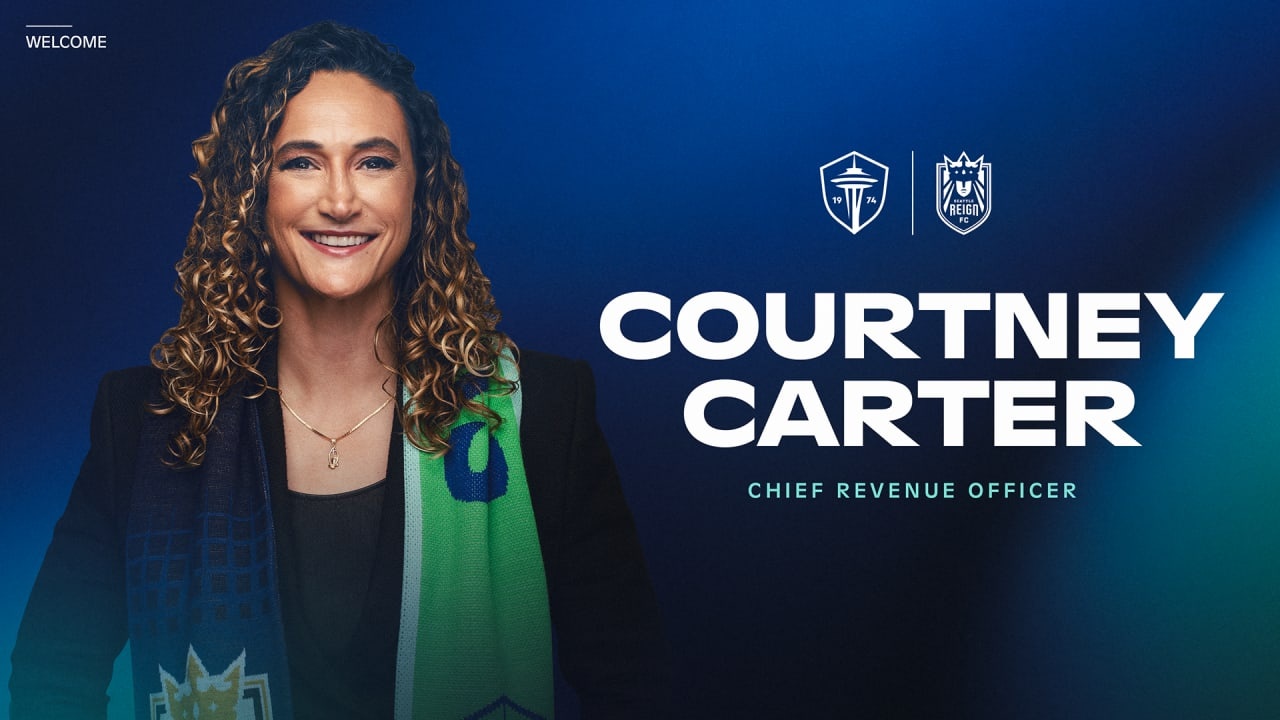
In July 2024, Seattle Sounders FC and Seattle Reign FC appointed Carter chief revenue officer across both clubs. Her responsibilities included partnerships, ticketing and other revenue-generating work. For the former Oregon State soccer player, the move also returned her to a sport and region with personal history.
The distinction between the founder and her company remains important here. Seattle’s commercial projects belong to the clubs. They are a later chapter in Carter’s career, rather than CMG client wins. Her appointment nevertheless helps explain why a talent-management background can matter in another industry: both jobs involve connecting people, audiences and organizations around something they value.
For creators and brands considering this kind of representation, the most useful takeaway is a planning question. What do you want to make that your current arrangement cannot support? It might be a show, a collaboration or a business with a life beyond a posting schedule. If the brief is simply to place one advertisement, a broader development relationship may be more than the assignment requires.
CMG’s history is interesting because the unit of ambition could change. A clip could lead to a series; a recognizable voice could support several kinds of work. The sensible thing to copy is the habit of examining those possibilities before the current format becomes the limit of the career.