The trouble began with a lawn sign that did not yet exist. A friend of Jarred Kessler had lost his job and was considering selling his house. He wanted to know what someone might pay. He did not particularly want the neighborhood to know why he was asking. A conventional listing would turn a private calculation into a public announcement, complete with a small billboard outside the front door.
Kessler saw an opening. What if an owner could test the market quietly, before committing to the rituals of selling? The idea became EasyKnock, which he co-founded with Ben Black in 2016. Its first proposition concerned information and introductions: bring buyers and owners together, including owners whose homes were not formally on the market. The name suggested a polite inquiry. The business would eventually ask homeowners to consider a far more consequential transaction.
By the time EasyKnock became known for residential sale-leasebacks, Kessler was selling a different kind of flexibility. Owners could sell their homes, receive cash and remain in place as tenants. For someone whose wealth sat inside a house while bills waited outside it, the attraction was understandable. Kessler made that mismatch between property wealth and spendable money the subject of his entrepreneurial career.
EasyKnock closed in December 2024. The distance between the original quiet knock and that abrupt ending is the central complication in Kessler’s story. It contains an observant founder, institutional backing, industry recognition and customers whose experiences challenged the promise. His career has continued into advisory work. The obligations attached to the houses continued, too.
Before the spreadsheets, there were scripts
Kessler’s route into finance included an earlier interest in making people laugh. At college, he wrote ideas for television producers; after college, he worked at MTV. His account of those years includes producing ideas on demand and working on shows in Times Square. Before pitching a financial structure, he had practice supplying something an audience might want to watch. Television is an excellent place to discover that an idea still needs somebody willing to put it on air.
He attended Tulane University from 1995 to 1999 and graduated cum laude. His later career passed through Goldman Sachs, Morgan Stanley and Credit Suisse before Cantor Fitzgerald. The sequence put him inside businesses where prices move continuously and access to capital is part of daily work. A house, by comparison, is a stubborn asset: valuable, expensive to transact and exceptionally inconvenient to divide.
His childhood was split between New York City and Long Island. He has described a father who traded and a mother who ran a water-purification business. Small ventures of his own included washing cars and reselling candy. The later interest in entertainment never entirely disappeared. In 2017, while discussing his book, Death of a Real Estate Salesman, he said he wanted to adapt it into a movie. A real estate platform was apparently insufficient occupation for one imagination.
“Grit is resilience.”
Jarred Kessler · 2020
The exit from Wall Street
At Cantor, Kessler rose to lead its equities business. But his departure belongs in the account alongside the title. He resigned in December 2015 after regulatory trouble involving the firm’s sales of unregistered microcap shares. FINRA sanctioned Cantor and separately imposed a $35,000 fine and a three-month suspension in a principal capacity on Kessler for supervisory failures. He settled without admitting or denying the findings.
The regulatory action concerned how a growing microcap liquidation business was supervised. FINRA said Kessler had failed to respond adequately to warning signs and had delegated responsibilities without sufficiently investigating the review process. It was a specific failure of oversight, with specific sanctions. It also formed part of the circumstances in which he left an established financial firm for a startup whose outcome was far less certain.
His own explanation of his changing career emphasized technology, tighter economics in finance and the opportunity to apply what he had learned elsewhere. He had watched technological change alter financial markets. Residential property offered another arena in which established processes might be reorganized. The friend with the unsold house supplied a concrete problem, rather than an abstract invitation to disrupt an industry.
The name stayed. The transaction changed.
In June 2017, Kessler described EasyKnock as a way for buyers and owners to connect directly. He wanted a broader pool of possible transactions and less dependence on the traditional listing process. He also described himself as an investor in startups and mentioned an investment in the digital-art-display business Meural. These were the interests of someone scanning several markets for arrangements that might work differently.
The later sale-leaseback model required more than matching two people. EasyKnock needed capital to buy properties and a structure for what happened after each purchase. Sell and Stay let former owners remain as renters with an option concerning a later repurchase or sale. MoveAbility addressed the awkward interval between selling one home and moving into another. ReLease served owners planning to sell and rent for a period without intending to repurchase.
Each product separated a pair of decisions that normally arrive together: selling a home and leaving it. That separation was the pitch’s practical appeal. It also created a new relationship. Someone who had controlled a property as its owner now occupied it under a lease. The rooms might look identical on the morning after closing; the rights and obligations had changed.
Kessler repeatedly returned to the idea of trapped equity in his writing and interviews. A homeowner could possess an asset while failing a lender’s requirements for borrowing against it. His answer involved a sale. The distinction mattered because the customer’s route back to ownership could depend on obtaining financing later, under circumstances that might remain difficult. The entrance and the exit were different financial problems.
- 01Sell the propertyTitle passes to the buyer; the homeowner receives proceeds under the agreement.
- 02Stay as a tenantThe former owner pays rent under a lease.
- 03Reach the next decisionA later repurchase or sale depends on the option terms and available financing.
Simplified outline of the historical sale-leaseback model. Terms varied by product and agreement.
Capital arrived. So did the awards.
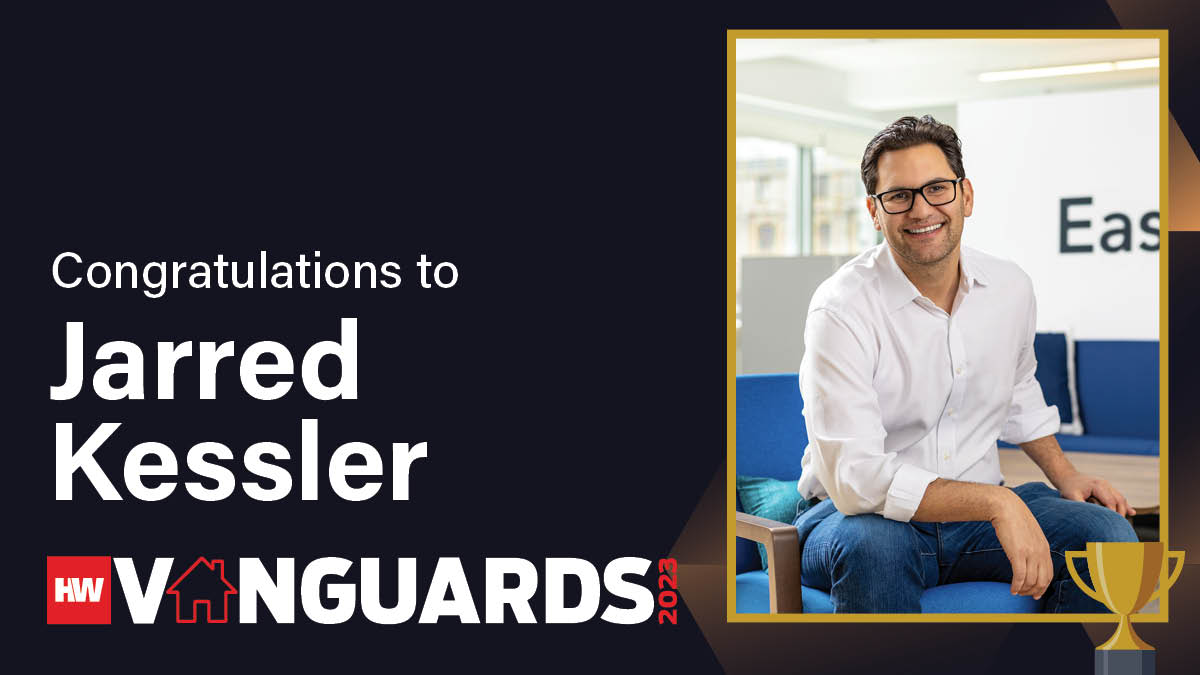
Kessler could persuade people to back the concept. EasyKnock completed a $57 million Series C round in 2022. Its expansion also included FarmlandFinder, extending the sale-leaseback idea to agricultural property. HousingWire recognized him as a Vanguard in 2022 and again in 2023. The second recognition followed the acquisition of Ribbon, a business associated with cash offers and home buying.
In February 2024, EasyKnock announced another $28 million in Series D financing, with Northwestern Mutual Future Ventures among its investors. Its stated ambition had widened to a platform spanning home equity, buying, selling and financing. The preceding year’s acquisitions included assets of Ribbon Home, maintenance platform Onder and co-ownership business Balance Homes. Kessler was building a collection of services around the homeowner, well beyond the initial discreet marketplace.
He described perseverance as central to the work. Asked about success in 2022, he answered, “Having grit above all else.” In an earlier interview, he had called his mother a model of resilience and credited parents who discouraged laziness and shortcuts. Those recollections explain how he presented his appetite for difficult work. They do not measure the results of any particular contract.
What staying put came to mean
The public reckoning was already under way before the last funding announcement. In December 2023, Massachusetts announced an agreement resolving allegations about EasyKnock’s marketing, transactions and compliance with landlord-tenant law. EasyKnock agreed to stop the covered residential sale-leaseback transactions in the state permanently, pay $200,000 and change tenants’ arrangements, including rent adjustments and the return of certain withheld funds.
For Kessler, the founder’s role now included defending a model whose benefits were contested. EasyKnock maintained that its transactions were transparent and had helped customers. Lawsuits and regulatory investigations raised a different account of the costs and consequences. These disputes concerned the substance of the product: what customers understood, what cash they received and what it would take to keep occupying or eventually recover ownership of their homes.
On December 5, 2024, EasyKnock announced that it had closed. Customers received notices about a transition to NESE Property Management. The closure announcement did not explain the cause. The sequence of fundraising, scrutiny and shutdown is clear; it does not, by itself, establish a complete explanation for the company’s decision. A venture can stop operating while the consequences of its transactions remain very much in operation.
Michigan’s investigation continued after the shutdown. In June 2026, an agreement established an $85,000 fund for identified customers and required changes to the handling of ongoing transactions. The state alleged deceptive practices. The respondents, including Kessler individually, denied wrongdoing and made no admission of liability. The agreement also barred the specified companies from new covered property transactions in Michigan.
The follow-through dealt with the unglamorous machinery of remaining in a home: accounting, proceeds, repairs and the terms of a later sale. NESE was servicing the continuing arrangements, and EK Real Estate Fund I owned the Michigan homes. For a former owner living under one of those leases, those details had immediate significance. The startup’s corporate ending supplied no automatic ending to the household’s contract.
- $28 millionSeries D financing announced.
- Doors closedEasyKnock ceased operations; ongoing arrangements continued.
- $85,000 fundMichigan agreement for identified customers; respondents denied wrongdoing.
Financing and settlement amounts describe different events and are not measures of the same thing.
Another kind of introduction
Kessler now presents his work through Momentum Advisors JBK, the advisory business he founded, and Good Group Global. Momentum’s offering includes capital strategy, partnerships, real estate and credit, creator and media infrastructure, embedded finance, and AI and automation. Its emphasis is on helping businesses reach people and execute plans. Introductions, once the premise of the early property marketplace, remain central to his pitch.
His interest in the creator economy brings the media chapter back into view. He has described helping creators obtain the financial and strategic support needed to build businesses around their audiences. The connection to his earlier work is access: finding capital or relationships that an owner, founder or creator does not already possess. His public ambitions continue to concern the space between having something valuable and being able to use it.
Outside business, he lists tennis, film and travel among his interests. He also describes mentoring and teaching at Tulane. These are ordinary details, but useful ones in a career so often expressed through transactions and platforms. They place a person back inside the résumé: a graduate returning to students, a former television worker still interested in film, a founder continuing to look for the next opening.
The test accompanying that next opening is harder than the first introduction. EasyKnock demonstrated Kessler’s ability to identify a frustration and assemble a business around it. Its aftermath makes the longer question unavoidable: how does the arrangement work when the customer reaches the other end? The friend who disliked a lawn sign had wanted room to consider his choices. That wish remains easy to understand. Delivering it, over the full life of a transaction, proved considerably more complicated.
Follow the next chapter
- Jarred Kessler’s website
- Momentum Advisors JBK
- Twitter / X (publicly listed handle)
- The original EasyKnock idea · 2016
- Kessler’s early marketplace interview · 2017
- Television, finance and grit · audio interview
- Home equity · 2022 YouTube interview
- A Minor In Reality · YouTube interview
- HousingWire Vanguard · 2023
- FINRA disciplinary record · PDF
- Massachusetts agreement · 2023
- EasyKnock’s closure · December 2024
- Michigan agreement · June 2026
- Michigan agreement text · PDF