The little robot had a very reasonable job: take the food to the customer. In Berkeley, Felipe Chávez Cortés and his team tried sending one machine all the way from restaurant to doorstep. It worked well enough to expose a problem. The route was inefficient. Their answer was a tricycle carrying meals and smaller robots, which would take over for the last 200 meters. A delivery company had discovered that its robot needed a lift.
That adjustment offers a way into Felipe’s career. He has spent years examining the distance between wanting something and actually receiving it. First came delivery services in Colombia. Then came machines on Californian sidewalks. Now comes Robot.com, the business once known as Kiwibot, with delivery robots, logistics services and a wheeled humanoid in its portfolio. The customer gets lunch. The founder gets another problem to solve.
A customer sends a message
Long before the campus robots, Felipe was giving customers his WhatsApp number. His Colombian startup, Lulo, arranged food and grocery deliveries. People used the number to check their orders and ask what was available. Their requests began to stretch beyond the original service. The early Kiwi offering grew around that demand, with people handling errands through a messaging interface.
The mechanics were decidedly earthly. University students worked in their spare time. Other delivery services helped fulfil requests. More orders brought more logistical complications, and the company considered its own operators. Even with a phone as the interface, somebody had to cross town. Convenience was a promise made by software and kept by a person carrying something.
Felipe had encountered the appeal of building for other people much earlier. At 13, growing up in Colombia, he helped set up Spanish-language World of Warcraft servers. The experience showed him how a modest technical project could be useful to a community. Later, he sold his food-delivery startup and finished college. “Did that check mark for my parents,” he joked. Some milestones require a customer; others require a parent.
Berkeley, one delivery at a time
The Californian chapter began with a useful combination: engineers, hungry students and public streets. Felipe visited a Berkeley student he had hired as a freelance engineer and saw a place where the company could take shape. He moved from Colombia, and the first Berkeley prototype was built in the MLK Student Union. By May 2018, Kiwi had delivered its 10,000th meal.
He joined Berkeley’s Global Founders Program in 2017. SkyDeck became an early institutional backer. A university offered more than a name on an investor list: it put technical talent near people willing to try a new service. The campus supplied customers whose daily needs were ordinary enough to produce useful feedback. A missed lunch is an unusually direct product review.
Getting there required a separate education. Felipe arrived in Silicon Valley with limited English and no established network of contacts. His account of those beginnings includes sleeping in his car in Berkeley before securing an investment. He has discussed how he learned to ask for help and raise money as a foreign hardware founder. The finished delivery robot was only one part of the undertaking. He was also building the relationships that would let it exist.
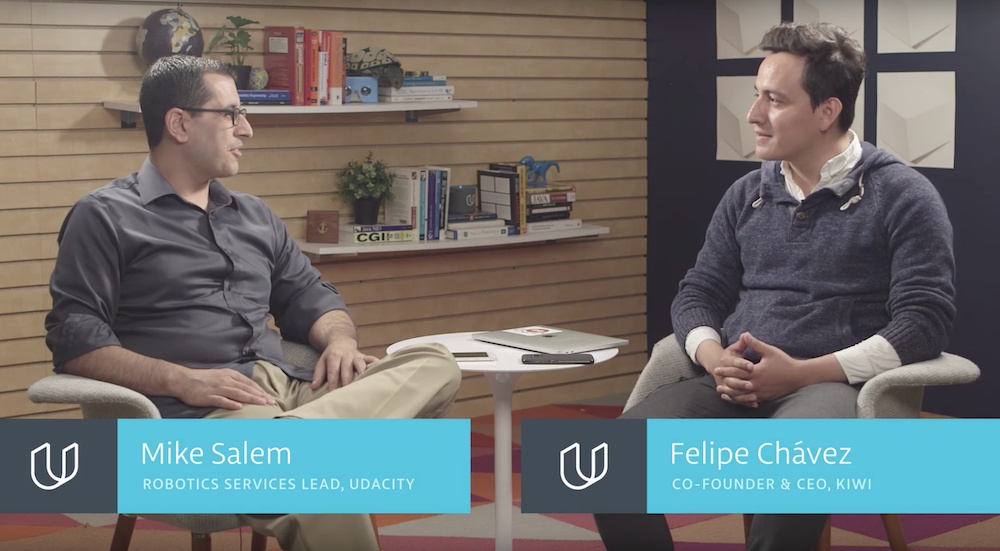
A robot declines to cooperate
In Medellín in 2018, a test machine contributed its own opinion about the proceedings. While a photographer waited for Felipe to finish a meeting, a data scientist tried to move a Kiwibot. It would neither cooperate nor open its compartment. An automated delivery service had encountered an automated refusal. Hardware has a gift for keeping everyone modest.
Felipe had practical reasons for putting development work in Colombia. He wanted local engineers to work on ambitious robotics projects, and he described Medellín’s Ruta N as providing a welcoming place to establish the team. California had surprised him with people willing to help without expecting something in return. He recognized a similar welcome in Medellín. His company’s geography followed both engineering talent and the people prepared to open a door.
Another door was harder to negotiate: the crossing between one side of a street and the other. Early Kiwibots used cameras, sensors and image processing to navigate, while people in Colombia remotely monitored crucial moments. Felipe’s assessment of the difficulty was refreshingly specific.
“The most complex thing is crossing a street.”Felipe Chávez, 2018
That year, MIT Technology Review named him an Innovator Under 35 in Latin America. The recognition highlighted a system in which humans and robots divided the delivery into stages. The human contribution was built into the model. The interesting achievement was arranging those contributions so the package could keep moving.
One delivery, divided into jobs suited to different parts of the journey.
Who pays for the wheels?
By 2021, Felipe’s leadership advice included balancing persistence with the ability to change direction. He also returned repeatedly to the people doing the work: “The team, the team, the team.” His robots might draw the attention, but his advice to a leader concerned colleagues, their mindset and the responsibility of looking after them.
His commercial ambition stayed close to delivery’s economics. He described an “internet of atoms,” in which moving physical goods became more accessible. A low-priced meal with delivery included was his illustration of progress. It is a useful ambition because a diner can judge it without understanding robotics. What did lunch cost, and did it arrive?
The fleet needed its own economic solution. In February 2023, Kiwibot secured a $10 million financing partnership with Kineo Finance. The arrangement allowed Kineo to buy robots at cost and lease them back to Kiwibot. It gave the business another route to financing machines while limiting the dilution associated with raising more equity.
At the time, Kiwibot had completed more than 250,000 deliveries and was operating on 27 US college campuses. Felipe discussed pilots in Saudi Arabia and Dubai, where enclosed communities offered another setting for short-distance delivery. The finance and the locations belonged to the same question: how could a service move beyond its first campus without asking each new robot to carry the entire business on its back?
The name gets bigger
On May 8, 2025, Kiwibot announced its transformation into Robot.com. The company reported passing a million robotic tasks. Its ambitions extended into warehouses and other settings, and the new name gave it room to describe that work. A campus delivery brand had become a narrower description than the founder wanted.
The expansion also emerged from customers’ questions. A delivery robot could reach its destination, but a person still had to prepare and load the order. At a golf-course deployment, that handoff helped expose the next task worth automating. The work immediately beside a successful product became a reason to build another one.
In June 2026, Robot.com commercially launched R-noid, a wheeled humanoid designed for repetitive tasks such as packing orders and moving boxes. The company offered it through a service model, with a stated deployment window of eight to twelve weeks. In the accompanying photographs, the new machine loads a familiar R-kiwi. The family resemblance is in the work: one machine helps another start its route.
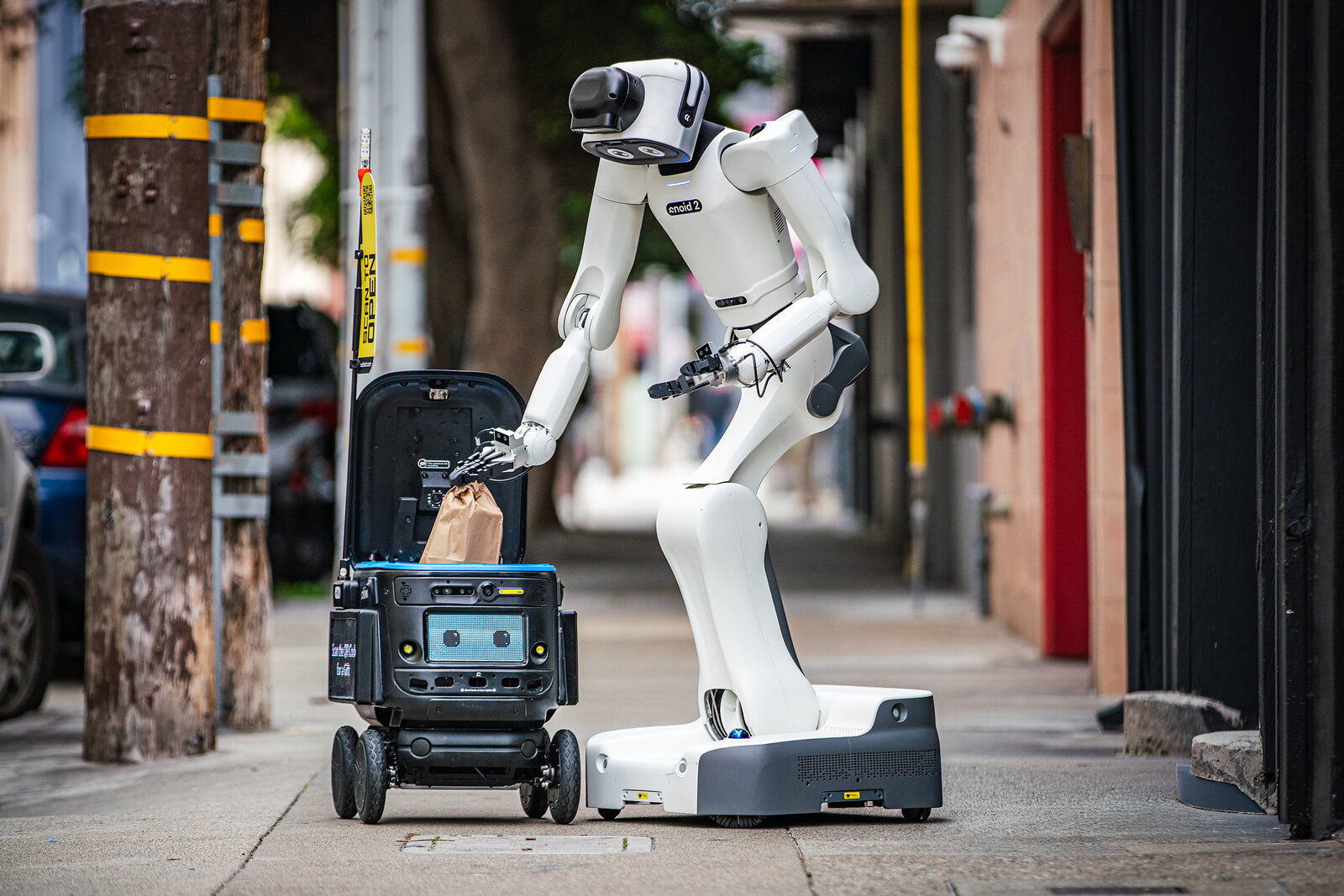
Company-reported figures, April 2026. Tasks cover the wider operation; they are not all food deliveries.
A contract is a longer experiment
By April 2026, Robot.com was also adding experience in governing large operations. Gregory D. Smith, chairman of American Airlines’ board and a former Boeing chief financial officer, joined as a board observer. Felipe described the next phase in terms of discipline, governance and scale. Keeping a distributed fleet useful asks different questions from getting the first prototype to move.
The campus business continued. In August, Robot.com announced a seven-year commercial agreement with Sodexo, extending a relationship that began in 2021 and broadening cooperation to include advertising. In September, Grubhub and Robot.com announced ten additional campuses for the 2026-2027 school year, supported by a three-year agreement extension. Those are calendar commitments, measured in semesters rather than demonstrations.
There is still unfinished terrain. R-dog, unveiled as a concept in August, is intended to tackle stairs, curbs and thresholds that stop a wheeled delivery machine. Commercial deployments are planned for 2027. Different robot types connect through REMI, Robot.com’s fleet-management platform. The portfolio grows, while the old problem persists: the distance between a workable route and the actual door.
A future with room for people
Felipe describes his desired future through solarpunk: people, technology and nature coexisting, with robots forming one part of a wider picture. It is an aspiration that reaches beyond a campus order. His interest in approachable shapes and expressive eyes brings it back to a pedestrian encounter. A robot sharing a pavement has to be something people are willing to have around.
In an October 2026 conversation, he returned to the practical work that follows deployment. Finance the machine. Maintain it. Support the operation. Collect payment. Renew the contract. Advertising can help the economics by giving the same robot another way to earn revenue. Extra capabilities also bring extra costs, which must make sense for the customer’s particular job.
“You need to deploy in order to learn,” he said. That sentence fits the career from Lulo’s customer messages to Berkeley’s delivery route and the machines being introduced today. Felipe keeps finding another handoff, another stretch of ground, another request. The robot gets to the end of its journey. Someone has already noticed the next thing that needs carrying.
Follow the next delivery
Public conversations, company updates and places to follow Felipe.