Imagine walking into a shop where every shelf is neatly arranged and nobody will answer a question. The goods have prices. The displays look expensive. You can admire the premises for as long as you like. Eventually, you leave. Farrakh Azhar saw a version of that arrangement on business websites and decided there ought to be someone behind the counter.
He founded LiveAdmins in 2002. The premise was disarmingly familiar: let a visitor ask for help, and have somebody respond on behalf of the business. His shorthand for it was “Hello, how can I help you?” A sentence so ordinary that it scarcely seems capable of supporting a company. Yet ordinary sentences can carry substantial obligations. Somebody has to be there to say them.
Azhar’s story begins with that observation and follows the work of making it repeatable. The chat window is the small, visible part. Behind it sits a decision about who will represent a business when its customer arrives.
The counter came before the code
The early LiveAdmins had agents and used off-the-shelf software. Its own technology came later. Azhar also described an initial difficulty in getting businesses to understand why live chat was useful. Before selling the service, he had to explain the job.
There is something pleasingly practical about this sequence. A customer-service company can begin by doing customer service. It can discover what its agents need while they are actually trying to help people. Software then has a working environment to answer to: a conversation underway, an unanswered question, a client expecting its business to be represented properly.
Consider what the founding comparison asks of an online business. In a physical shop, asking a question requires very little preparation. You catch someone’s attention. You describe what you need. The assistant can clarify. A website equipped only with pages asks the visitor to do more of the navigation alone. Putting help within reach changes the arrangement.
“Hello, how can I help you?”
Farrakh Azhar, describing the founding idea
LiveAdmins now distinguishes between buying software and buying a managed service. With software, a business supplies the people who answer. With managed chat, LiveAdmins supplies agents to handle those exchanges. The distinction turns a tiny rectangle on a screen into a meaningful management choice. Buying a till and employing a shop assistant come with different responsibilities, even when both occupy the same counter.
An engineer takes a different circuit
Before the websites and the agents, there was electrical engineering. Azhar studied the subject at the Illinois Institute of Technology between 1987 and 1991. His career record then places him at Unisource Systems as a senior consultant from 1994, followed by an AVP role at ABN AMRO in 1998. LiveAdmins followed in 2002.
Those are useful coordinates for understanding the founder: engineering education, consulting, banking, then a company concerned with online conversations. They do not make his eventual business inevitable. Plenty of engineers never become entrepreneurs; plenty of banking careers remain in banking. What matters here is the particular business he chose to start after those earlier roles.
Its premise required understanding how a customer experiences a business at a distance. A firm can spend considerable effort presenting itself online and still leave a visitor unsure what to do next. Azhar’s chosen intervention was assistance at the moment of uncertainty. The visitor could explain the problem in words instead of trying another page.
The dates also put the venture in perspective. A company begun in 2002 has had to carry its service proposition through changing expectations about websites, messaging and automation. Each new tool presents a fresh implementation question. The founder’s original comparison supplies a relatively stable test: can the customer get useful help?
Office hours meet the internet
Azhar dated LiveAdmins’ round-the-clock service to 2004. It is a compact milestone with a large consequence. A website’s availability and a business’s staffing hours need not coincide. Visitors do not have to become interested at a time convenient to the sales department.
For a managed service, the promise stretches across evenings and weekends. The current LiveAdmins offering includes agent training for individual businesses, routing conversations and sending alerts when a lead is captured. These are the details that turn being present into something useful. A greeting delivered to the wrong person, followed by a vague answer, would be a rather elaborate way of remaining unhelpful.
Read this operating model as a series of obligations. Learn enough about the client to represent it. Recognize what the visitor wants. Pass useful information along. Make it possible for the client’s own team to act. The appeal of outsourcing assistance depends on how well those obligations fit together.
Azhar placed the start of continuous service in 2004. The current managed offering still advertises coverage around the clock.
The legal-services offering makes the point concrete. LiveAdmins provides website assistance, connections to a firm’s customer-management system and ways to move a conversation toward a phone call or text. The work is about giving an interested visitor a route into the business. The chat itself is one stage in that route.
This helps explain why the company’s catalogue includes both conversations and connections. A useful answer may lead to another question, an appointment or a follow-up by the client. The original greeting creates an opening. What happens after it determines whether the opening was worth making.
One small feature illustrates the changing setting for his idea. Chat2SMS allows an exchange that begins on a website to continue as a text conversation on a mobile device. The business no longer has to assume that the visitor will stay beside the same open browser tab.
Read as an extension of Azhar’s founding premise, it addresses the customer who has already stepped away from the counter. The question can travel with them. This is a useful way to understand the company’s expanding set of tools: each one tries to keep assistance within reach as the visitor’s circumstances change.
Taking the greeting on the road
A photograph of visitors watching a LiveAdmins demonstration at GITEX 2014 catches the business in a particularly apt setting: people gathered around a screen to see how a conversation works. A product devoted to remote interaction still had to explain itself in a room full of people.
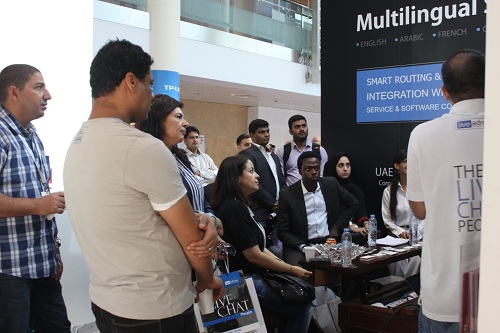
Azhar appears on LiveAdmins DMCC’s GITEX 2019 exhibitor team as chief strategy officer. The listing places him alongside colleagues in client services, training, sales and project management. For the founder of a company associated with Chicago, it is a tangible point on an international business map.
The company’s event relationship continued. In October 2024, LiveAdmins announced that it would provide round-the-clock assistance on the GITEX and Expand North Star websites. Exhibitors and visitors would be able to ask for help while preparing for the events. The company was also presenting its own services at the exhibition.
That arrangement gives the shop-assistant idea another setting. An event website has people with different purposes arriving at different stages of preparation. Some are considering participation; others already have plans and need details. Assistance can serve both. The same greeting has to accommodate more than one reason for being there.
International service also brings language into the picture. LiveAdmins markets multilingual coverage. A translated website can show information in another language; a conversation has to follow the visitor’s next question as well. The operational challenge includes being ready for that second sentence, and the one after it.
Teaching a chatbot when to call a person
The present-day catalogue adds a new participant to Azhar’s original scene. Pebble is LiveAdmins’ AI chatbot, offered for work including common questions, lead capture and appointments. Its published setup process begins with defining objectives and designing a conversation, then moves through testing and deployment. Even an automated assistant needs a brief.
There is a useful distinction between a chatbot’s capabilities and a business’s reason for employing it. The visitor arrives with a purpose. The company needs to decide which exchanges automation should handle and what happens when a question runs beyond that assignment. Giving a bot a name does not settle those decisions.
LiveAdmins announced Hybrid Chat in October 2025, combining Pebble with human agents. The model uses AI for routine interactions and brings in people for conversations requiring more judgment. Rehan Wali, the company’s chief technology officer, and general manager Brian Smith explained the offering in the announcement. The founder’s company had acquired another way to organize the answer.
- 01A visitor asksAI begins the exchange and collects information.
- 02The system routesThe conversation is assessed for a human handoff.
- 03A person joinsAn agent takes over when human help is needed.
The hybrid product page describes passing the conversation to an agent without asking the visitor to restart it. That is the detail to watch in any such arrangement. A customer who has already explained a question has contributed something valuable: context. Keeping that context through a transfer makes the assistance feel continuous.
The company had already made human connection a public topic in 2023, announcing a webinar about customer relationships in an AI-driven environment. Its later hybrid offering gives the subject an operational form. Automation can participate in the service while a person remains available for the parts that need one.
For Azhar’s story, this is a fitting place to return to the counter. The person greeting the visitor may now be joined by software capable of handling part of the exchange. The founder’s opening observation still gives the whole arrangement its purpose. Somewhere on the other side of the screen, a customer is trying to find something out. A business has made itself available. The next sentence has to help.
Continue the conversation
- Farrakh Azhar on LinkedIn ↗
- LiveAdmins website ↗
- The 2017 founding interview ↗
- His Brian Burns conversation: company announcement ↗
- The hybrid service explained ↗
- LiveAdmins company blog ↗
COMPANY CHANNELS