In the beginning, EZ Newswire had a wonderfully simple enemy: the $5,000 press release. Not the document itself, exactly. The expensive part was the procession around it - drafting, redrafting, approvals, distribution fees, and a report that might claim an audience the size of a small nation without proving that anyone had read the page.
Caitlin Kelly and Neel Shah founded the New York company in 2022 and opened its public beta in May 2023. Their proposition fit the moment. A guided form and OpenAI could turn a company's raw facts into a professional announcement. Distribution began at $25, then climbed through $100 and $125 tiers. Around 2,500 organizations had tried the pre-beta version, including agencies, small businesses, Alibaba, and 3M. The founders were not merely offering a cheaper wire. They were asking why corporate news still moved through machinery designed when a wire was, quite literally, a wire.

The bargain bin was only the foyer
Three years later, the price card looks nothing like the launch. Starter is $750 per release. Plus is $1,250. Premium is $1,500. There are no contracts and, according to the company, no surcharges for extra words, images, logos, or links. Enterprise buyers and busy agencies negotiate volume pricing.
The tempting interpretation is that a disruptor discovered the joys of a higher price. The better interpretation is that EZ Newswire discovered what was actually scarce. AI made first drafts abundant. It did not make Reuters distribution abundant. It did not create a direct data integration with Fortune. It did not give a communications director a defensible answer when the chief executive asked, “What happened after we published?”
The first feature opened the door. It did not become the whole house.EZ Newswire's shift, in one line
The product moved toward those harder things. Every current plan includes AP distribution, the company's own newsroom, editorial review, and a network of local and regional sites. The Plus tier adds Fortune, USA Today, a larger regional network, pickup tracking, and AI visibility optimization. Premium adds Reuters, Yahoo Finance, Business Insider, advanced answer-engine reporting, expedited processing, and post-publication edits on Reuters and Fortune.
A receipt for the publicity department
Traditional newswire reports have a peculiar habit: they borrow the publisher's entire monthly audience and present it beside one press release. It is like measuring a restaurant reservation by counting everyone who has ever walked down the street. EZ Newswire's more consequential idea is tucked into a blunt line on its reporting page: “We measure the page, not the publisher.”
For releases on its own site, Reuters, and Fortune, the company says it receives direct, Google Analytics-level data: page views, unique visitors, time on page, device, and country. For other publishers it models readership from domain traffic, search rank, and recency, and labels those numbers as estimates. The distinction is small typography with large consequences. A measured visitor and a modeled visitor are not the same creature.
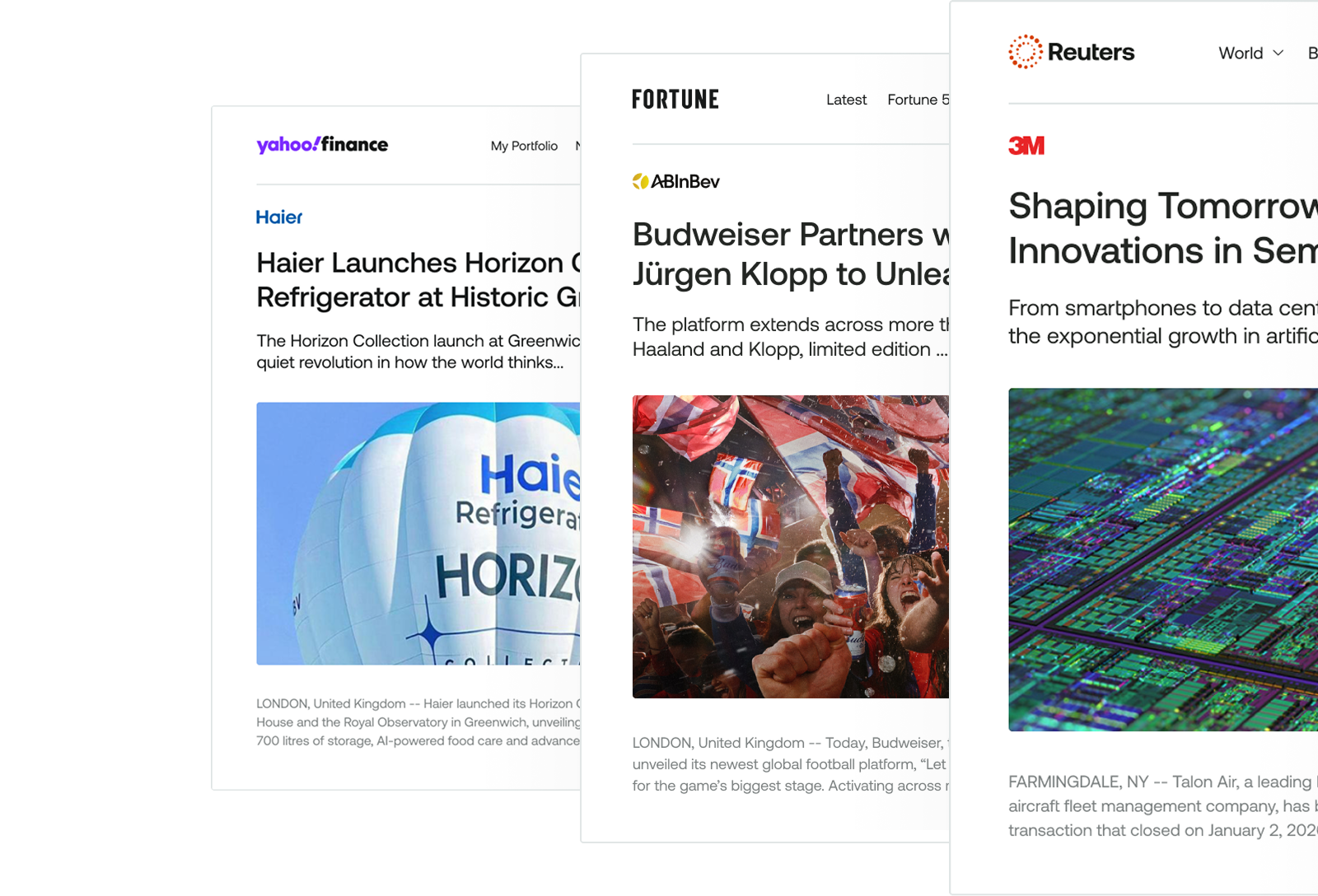
In June 2026, EZ Newswire extended that logic to answer engines. Its system extracts claims, entities, and likely questions from a release, turns them into prompts, and runs those prompts daily across services such as ChatGPT, Perplexity, Gemini, Claude, Copilot, and Google's AI experiences. The dashboard then reports mentions, citations, share of voice, and sentiment. The claim is not that a press release can command an AI model. It is that companies can finally observe whether their announcement becomes part of the model's answer.
The logo on the page is not a reporter
There is an important boundary here, and EZ Newswire now states it clearly. A release published on Yahoo Finance, Reuters, Fortune, Business Insider, USA Today, or AP is syndicated content. It is not an article reported by that publication's newsroom, and it is not an editorial endorsement. The distinction is easy to blur because the publication's name is the visible object being purchased.
Syndication creates a public record, predictable placement, searchable source material, and a set of campaign measurements. It does not manufacture independent reporting, rescue an unnewsworthy announcement, or guarantee that customers will care.
This tells us who the customer is. A startup may need a credible, searchable record of a funding round or product launch. An agency may need dependable turnaround and a clean PDF it can hand to a client. An enterprise team may need approvals, multiple organizations, an API, SSO, and post-publication control. None of them should confuse distribution with earned media. The useful purchase is certainty: this release will go to these destinations, at this known price, with this level of reporting.
The network grew by climbing a partnership ladder. AP was part of the launch. In 2023 came Press Hook, Big Technology, PRophet, The Post and Courier, and The Media Mix. The Reuters deal arrived in September 2024 after a closed beta. A Fortune integration followed in late 2025. Investors include HearstLab, Contour Ventures, The MBA Fund, ValueStream Ventures, and Reformation Partners. The company says its 2025 seed round was twice oversubscribed, although it has not disclosed the amount.
The part worth stealing
EZ Newswire's most portable lesson has little to do with publicity. When a market runs on opaque bundles, identify the ambiguity customers resent most and turn its removal into the product. Here, that meant publishing the price, naming the destinations, eliminating incidental fees, showing live links, separating measured data from estimates, and making the result easy to forward.
The second lesson is less comfortable. A founder's original wedge may become ordinary very quickly. In 2023, generative drafting sounded like the main event. By 2026, almost every communications tool could generate serviceable corporate prose. EZ Newswire moved the center of gravity toward relationships, infrastructure, editorial operations, and data - assets that are slower to copy than a text box connected to a language model.
There are conditions where the model is a poor fit. A local shop with no material announcement may be better served by direct community outreach. A company seeking investigative or independent coverage still needs a reporter and a story worth reporting. A team whose goal is merely backlinks may be disappointed as link attributes and publisher rules change. And a buyer who cannot explain why a specific announcement needs a permanent, distributed record probably does not need to spend $750 on one.
The press release survived radio, television, the social feed, and the blog. It will probably survive the chatbot too. EZ Newswire's wager is that survival will not look like sending the same document to more places. It will look like a controlled publishing workflow whose consequences can be inspected. That is a humbler promise than fame. It is also one a software company can plausibly keep.