There is a number in public relations that behaves a little like the square footage in a real-estate listing. It is technically grounded in something, impressively large, and best approached with caution. The number is potential reach. Put a press release on a famous financial portal, add the portal's monthly audience, repeat across several sites, and soon a modest corporate announcement appears capable of addressing a small continent.
Hector Botero knew this arithmetic from the inside. Before founding iCrowdNewswire, he ran Business Wire operations in Latin America and China and later led international operations at Marketwired Sysomos. His complaint was not that syndication had no value. It was that placement and attention were being sold as though they were the same thing.
“Where is the real ROI of huge shotgun blasts that can easily cost over one thousand dollars?”Hector Botero, introducing ReleaseLive in 2019
The useful heresyPublication is not attention
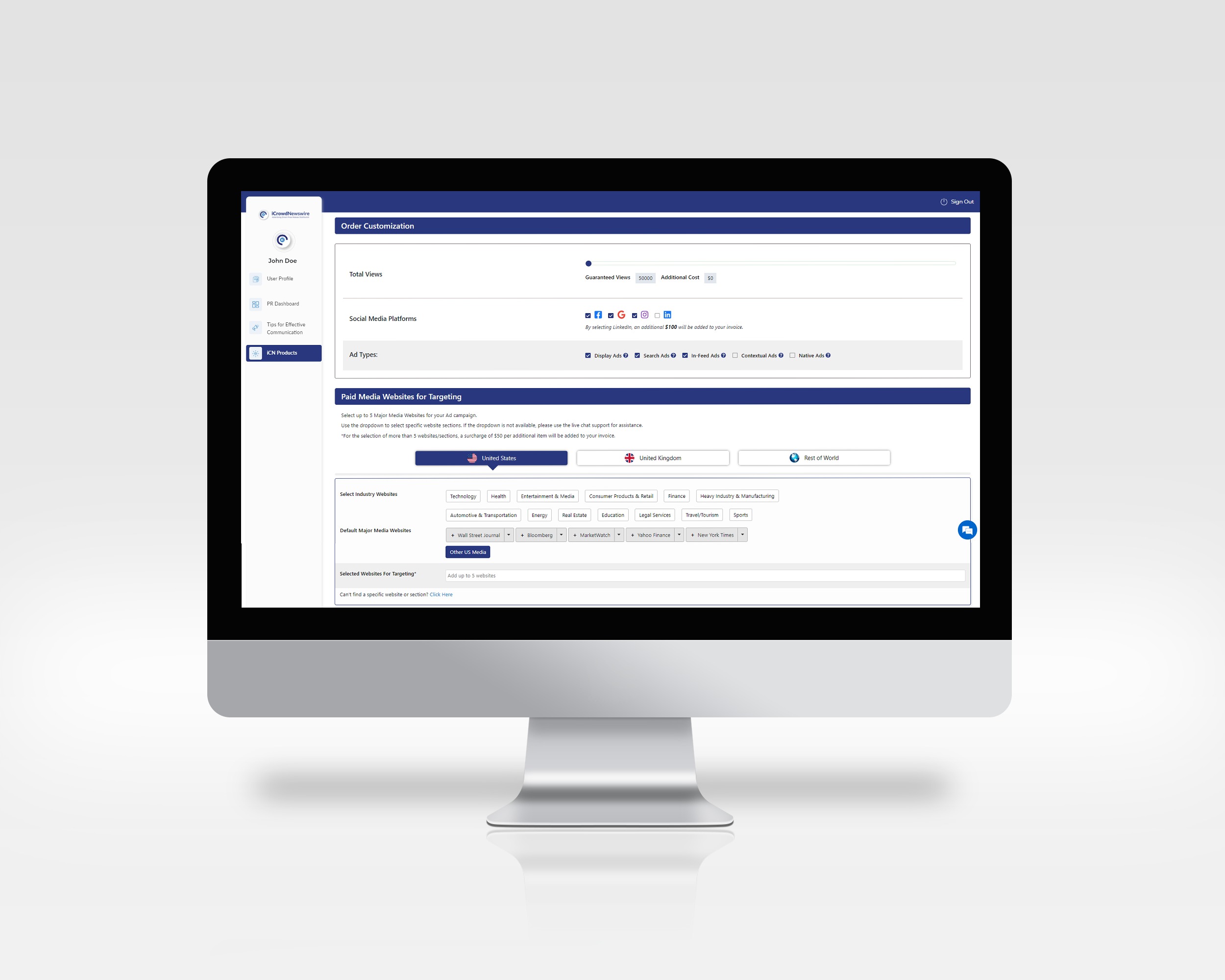
iCrowdNewswire's answer was to bolt the machinery of an advertising campaign onto a press release. A customer still gets familiar wire functions - publication, databases, media pickup and a permanent link. But the release headline also becomes a set of display and social ads. The customer chooses geography, industry and audience. The ads send readers to the full release. A report counts headline views, clicks and audience characteristics.
This distinction sounds fussy until you imagine the person buying the service. A communications director does not merely need to say, “We appeared on sites with a combined monthly audience of 200 million.” She needs to tell a chief executive what the campaign delivered. The first sentence is possibility dressed as performance. The second can fit in a spreadsheet.
What customers actually buyA wire, an ad desk and a receipt
The current flagship is Paid Media Release. Its Premium tier is listed at $599 and includes 25,000 headline views; Super Premium is $899 and starts at 100,000. Both wrap iCrowdNewswire distribution around GlobeNewswire's network, add seven banner sizes, support nine translated versions with website placement, include Google News and provide reporting. The standalone $250 Ad Boost promises 50,000 headline views plus targeting, creative and a Master Distribution Report.
| Offer | Published price | The practical purchase |
|---|---|---|
| Premium | $599 | Wire distribution plus 25,000 targeted headline views |
| Super Premium | $899 | Broader pickup plus at least 100,000 headline views |
| Ad Boost | $250 | 50,000 paid headline views for an existing release |
The buyers are PR agencies, corporate communications teams, startups, public companies and investor-relations staff. Some want a one-off launch. Others buy bulk releases. The company also licenses its system and operating expertise to larger information businesses. That white-label layer matters: iCrowdNewswire is not only a storefront competing for individual press releases. It is infrastructure behind other storefronts.
One announcement, four jobs
The pivotCrowdfunding was the door, not the room
The company opened in 2015 with a product called CrowdRelease. At the time, crowdfunding looked like a new capital market in need of its own communications rail. The first customers were consultants, agencies and small businesses trying to reach investors and consumers without the budget of a public-company communications department.
What failed first was not the platform. It was the narrowness of the premise. The deeper problem was everywhere: releases were being sprayed toward enormous media lists while journalists faced an impossible volume of pitches. In 2017, iCrowdNewswire said it was distributing 1,500 to 2,000 releases on an ordinary day and sometimes 3,000. The company concluded that adding another inbox was less useful than reaching the intended audience directly.
That changed the product. Work with Google's advertising technology began around 2017-18. ReleaseLive followed in 2019 after more than a year of development and testing. The release became a landing page; the headline became creative; targeting became distribution; analytics became proof.
CrowdRelease launches for the crowdfunding market.
ReleaseLive formalizes targeted, measurable distribution.
LexisNexis and iCrowdNewswire launch Nexis Newswire.
Paid Media Release adds GlobeNewswire distribution.
Structured distribution expands toward AI discovery.
The distribution behind the distributionSmall company, borrowed reach
The partnership map explains how a Miami company can offer global reach without pretending to own every pipe. LexisNexis uses the technology for Nexis Newswire. Medianet offers ad-driven distribution in Australia and New Zealand. PA Media sells Release Amplify in the UK. MediaConnect brought the paid-media product to France. NewsVoir covers India; TheNewswire covers Canada; Media OutReach extends into Asia. GlobeNewswire supplies tier-one wire distribution inside iCrowdNewswire's direct packages.
This is the company's sharpest difference from PR Newswire, Business Wire, Accesswire, EIN Presswire and other alternatives. It does not ask customers to choose between classic syndication and direct audience buying. It packages both, charges a flat fee, and lets regional partners sell the same idea under their own relationships.
The release is the document. The product is the route it takes.
The copyable partDefine the audience before you buy the megaphone
A communications team can borrow the method without borrowing the software. First, write the audience in ordinary nouns: Florida commercial-property owners, French luxury buyers, Australian health reporters. Second, make the headline work as a tiny advertisement. Third, send the click somewhere useful - not automatically to a 900-word wall of ceremonial language. Fourth, separate outputs from outcomes. Placements and impressions are outputs; qualified visits, inquiries and independent coverage are outcomes.
Finally, choose one announcement worth amplifying. iCrowdNewswire's own recent guidance makes the point with refreshing bluntness: paid promotion does not fix a weak offer, much as paid traffic does not repair a landing page nobody wants. Ad Boost makes sense when the announcement has “signal strength” - a launch, finding, event or change with a specific audience and a reason to act now.
The condition nobody should skip
Guaranteed impressions are not guaranteed affection, leads or editorial coverage. The approach is a poor fit when the news is routine, the audience is undefined, the landing page is weak, or the goal is an authentic journalist's judgment rather than paid visibility.
Where the bet goes nextFrom search results to generated answers
In 2025, the company added what it calls AI distribution channels. The pitch is that structured metadata, schema and machine-readable publishing can help releases appear in the information streams used by generative search systems. It is a logical extension of the original argument. First the release had to be published. Then it had to be seen. Now it must be legible to the systems that increasingly summarize the web.
The evidence standard should remain the same one Botero applied to potential reach: ask what can actually be observed. AI discovery is younger and murkier than ad reporting. Brands should measure citations and referral patterns where possible, resist promises that exceed the instrumentation, and remember that duplicated distribution does not automatically become authority.
Still, the through-line is unusually clean. iCrowdNewswire began by naming a new kind of release for a new kind of capital formation. It changed its mind when the larger constraint became obvious. The scarce thing was never another place to put an announcement. It was attention - aimed, purchased, and counted without pretending that counting is the same as caring.