Eytan Avigdor’s early Twitter tool reached a rather physical limit to online popularity: the servers stopped cooperating. A tweet about Twtrland had brought attention, press coverage followed, and by April 2012 he was describing 300,000 unique visitors a month. “Our servers crashed,” he said. In the startup scrapbook, some milestones arrive with a ribbon. This one arrived with an outage.
The problem he had set out to solve was modest. He wanted to understand someone before deciding whether to follow them. Existing analytics services offered plenty of information, but the information was hard to use. “I just wanted something simple,” he explained. That preference would take him from an early Twitter utility to Klear, an influencer marketing business, and eventually to product leadership inside Meltwater.
Attention was the raw material. Judgement was the work. Over the years, the decision would change from choosing an account to follow to choosing a creator to pay. The distance between those two clicks is the story of his company.
A familiar face across the desk
Avigdor’s early collaborator was his identical twin, Noam. Both studied computer science at the Technion and worked at Intel. The family connection later extended into Klear’s founding team: the company’s acquisition announcement named Eytan, Noam and their brother Guy as its three founders.
His own professional path also included Pipl, where he worked as a senior software engineer, and Normal People, where he developed for iOS. Public professional records place his Technion studies between 2007 and 2010. Those details put an engineering career behind the eventual chief executive title. Before running a company that interpreted other people’s online activity, he had worked on software itself.
The early product and the later business have slightly different starting dates. Twtrland’s public launch was in 2011; Klear’s company founding year was given as 2012. They describe consecutive stages of an idea becoming an organisation.
“I just wanted something simple.”
Eytan Avigdor, on the original problem
The customer on the other side of the profile
By March 2014, Twtrland was offering a version for businesses at $99.99 a month. The audience for Avigdor’s product was changing. A person deciding whom to follow could make a quick personal choice. A marketer needed to understand groups of people, segment an audience and identify useful connections.
The business product combined social profiles with information about conversations. Avigdor described a position between influence platforms and social analytics services. It was an attempt to bring knowledge about an individual together with what was happening around them. The commercial question was becoming more specific: which people matter for the audience a business wants to reach?
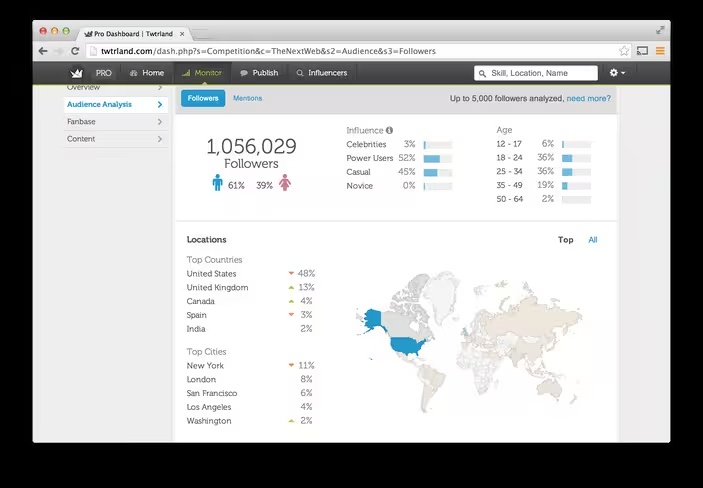
Then the name became a constraint. In 2015, Twtrland became Klear, with Facebook and Instagram joining Twitter in its analysis. An announced $1.5 million funding round included AltaIR, GIG and TMT. The old name had specified a network; the new one could accompany a broader product.
A rename is a small event on a timeline. Here it records a substantial change in the unit of work. Avigdor’s company was following people across platforms, instead of letting the platform define the boundary of the company.
A research paper in the founder’s file
There is a less expected entry in Avigdor’s career than a funding round: a four-page conference paper. In 2018, he co-authored Measuring Influence on Instagram: A Network-Oblivious Approach with Noam Segev and Noam Avigdor. It appeared at SIGIR, the international conference on information retrieval.
The research examined how to score and rank influential Instagram users. It considered user statistics and regression models, addressing why approaches based on the network graph of other social services were a poor fit for Instagram. In plain language, a method useful on one network could not simply be carried over and expected to answer the same question.
That is a useful complication in a business built around the word influence. The word sounds intuitive until somebody asks for a measurement. Then definitions, available data and the behaviour of a particular platform begin to matter. Avigdor’s name on the paper places him inside that technical discussion, alongside the commercial work of selling a product.
- 2011Twtrland’s public launch
- 2015A broader product becomes Klear
- 2018Instagram influence research at SIGIR
- 2021Meltwater acquisition agreement
- 2026Influencer product work at Meltwater
The research year also brought a distribution relationship. In October 2018, Klear announced a referral partnership with Hootsuite. Avigdor described demand from Hootsuite’s enterprise customers for influencer marketing software. Klear supplied discovery, relationship management and measurement, while Hootsuite supplied social scheduling, monitoring and engagement tools.
The announcement described deeper integration as a future ambition. For Avigdor, it placed the company alongside another part of a marketer’s working day. Klear could help choose the people involved in a campaign; the surrounding social management work already had its own tools. Bringing those activities closer together was becoming a recurring business proposition.
The glamour has an administrative department
Discovery alone could not carry an entire campaign. In March 2019, Klear launched Connect to bring more of the relationship into the product. Its tools included campaign briefs, integrated chat, content collaboration, bulk messages, contracts and payment verification. Creators could authenticate their Instagram accounts to enable Stories tracking.
Avigdor explained the launch through the daily difficulty of managing campaigns, especially several at once. The product was intended to let marketers manage the process from beginning to end in one place. This was a different expression of the original usability problem. The confusing object was now a collection of ongoing jobs and conversations.
The sponsored post is the visible artefact. The agreement about what to post, when to deliver it and how to account for it requires its own machinery. Connect put that machinery closer to the person responsible for keeping the campaign moving.
Link tracking added another practical layer in 2019. Klear’s new capability connected campaign analysis with website visits and purchases. Avigdor described the manual effort of examining influencers and pieces of content separately. The task was to assemble evidence of what a campaign had done without making a marketer reconstruct the whole thing by hand.
His comments on Chinese commerce that May pointed to the same connection from another direction. He discussed how integrated social payments made creators important to direct sales in China, while Instagram presented more difficulty for brands seeking direct purchases. The path from a recommendation to a transaction depended partly on the platform carrying it.
In September 2020, Tipalti announced its Klear partnership, adding mass-payment capabilities for customers running influencer campaigns. Avigdor framed the addition around customer needs and more efficient campaign management. A product that began by helping people make introductions had reached the business of making sure money could follow them.
The buyer had already been a partner
When Meltwater announced its agreement to acquire Klear on April 14, 2021, the companies were already acquainted. Their commercial partnership had begun in 2017. Four years of working together preceded the transaction; this was a relationship with a working history.
Avigdor was Klear’s CEO at the announcement. The stated consideration was $17.8 million in cash and earn-out. Klear had recorded $7.6 million in revenue for 2020. Excluding the earn-out, Meltwater described the cash purchase price as 1.4 times that revenue. The distinction matters: the announced total contained a contingent component.
Cash + earn-out / April 2021
Full year / 2020
Two company figures with different meanings: a deal’s announced consideration and a year’s revenue.
His explanation of the combination joined influencer relationships to Meltwater’s experience with media relationships. Klear helped customers identify relevant people, manage the relationship and measure its effect. The activities had become close enough that combining the companies made practical sense. The company was headquartered in Israel, with a presence in the United States and United Kingdom.
The name on the door moves again
The acquisition did not immediately remove the Klear name from the customer’s daily routine. In March 2024, the company announced that its communications and website would move to Meltwater. From April 1, Klear website visitors would be redirected, while customers and creators retained their existing workspace and credentials.
For a founder’s story, that is a quieter milestone than the sale. It is the point at which a once-independent company’s public address becomes part of its parent’s. The work continues even as the sign changes.
By November 2025, Meltwater identified Avigdor as Senior Director of its Influencer Marketing Product. In an announcement about the company’s IDC MarketScape recognition, he described a roadmap bringing generative and agentic AI into marketers’ work. The emphasis was execution: helping teams act faster and make decisions at scale.
The brief gets the first word
In September 2026, Avigdor appeared with Neil Brennan in a discussion of AI across influencer discovery and campaign work. He was identified as Head of Product for Meltwater Influencer Marketing, leading the team building AI Discovery and influencer tools available through the Meltwater MCP.
The discovery workflow starts with a brief written in ordinary language. Instead of relying only on how a creator labels themselves, the product examines what they publish. Traditional checks on audience, engagement and recency follow the match. Avigdor’s explanation makes the content itself more central to finding the person.
An October discussion extended that attention into vetting. It separated the creator’s own posts, what other people publish about them and the audience they reach. Brand-specific criteria guided the review; evidence accompanied the flags. “The team still decides,” Avigdor said.
That sentence leaves a human being at the far end of the software. A search result needs judgement. A promising creator needs a conversation. An automated check supplies material for a decision someone must own.
The original Twitter question survives in this larger setting. A profile offers an introduction. The useful work begins when somebody looks closer.
Continue the conversation
- Eytan Avigdor on LinkedIn
- The early Twtrland interview
- The 2014 business product
- Read the Instagram research paper
- Klear Connect’s launch
- The Tipalti partnership
- The 2021 acquisition announcement
- Klear’s move to Meltwater
- AI discovery and campaign work, September 2026
- Creator vetting, October 2026
- Meltwater Influencer Marketing