At 15, Gaby Diamant entered an investing competition and finished 29th among more than 10,000 participants. A respectable result, especially for someone whose professional career was still waiting for him to finish school. He remembers it as confirmation that he wanted to spend his life close to the markets. Years later, the competition has changed. The question occupying him now is how many other people can understand what they are looking at.
Diamant is the co-founder and chief executive of BridgeWise, a business that puts AI investment analysis into the services of banks, brokerages and other financial institutions. Its ambition involves a peculiar imbalance: people can encounter an extraordinary amount of financial information and still struggle to decide what any of it means. A screen full of numbers can leave its owner feeling rather poorly informed.
Twenty-ninth, and interested
His education gave that early interest a framework. Diamant studied economics and management at the Technion, then took an MBA in accounting and finance at Tel Aviv University. His professional profile also records a student investment and finance club he helped establish. Apparently, studying the subject left enough appetite to organise more of it.
He began his finance career at IBI Investment House. In his telling, early access to an investment-adviser internship helped him move into the industry sooner than many of his peers. Later work on an investment committee brought responsibility for a portfolio approaching $50 million. The glamour of finance had to coexist with decisions affecting somebody else’s money.
Formal company disclosures identify him as Gabriel Diamant, a licensed investment consultant. The name Gaby is the one attached to the founder interviews and conference appearances. Both belong to a career that has moved between financial practice and the business of building tools for it.
A useful introduction to the wrong pitch
Before BridgeWise came polished diamonds. An earlier venture developed an algorithm for pricing them, and his podcast biography describes its eventual sale. Diamonds make an interesting rehearsal for financial technology: an attractive object is still an awkward thing to value. A market can be full of expertise while remaining difficult for an outsider to read.
The people involved in the next business did not arrive through a neat round of executive recruitment. Mor Hazan, now BridgeWise’s co-founder and chief product officer, has been Diamant’s close friend since childhood. Diamant met twin brothers Dor and Or Eligula after pitching a startup idea to their father. That venture’s timing was wrong. The introduction proved more durable.
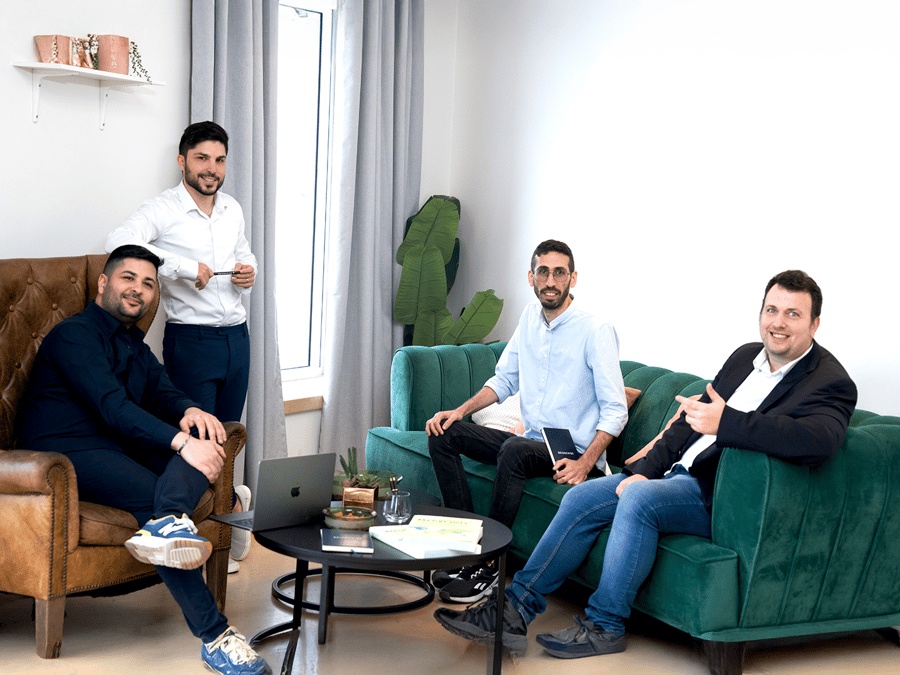
The four eventually teamed up, and BridgeWise was founded in 2019. Dor became chief business officer; Or became chief operating officer. The company’s origin includes the sort of connections that vanish inside an organisation chart: friendship stretching back to childhood, brothers working together, and a pitch whose useful consequence was meeting the people in the room.
The missing explanation
The analytical core of BridgeWise originally powered a market-neutral hedge fund. That history matters because it puts the investment problem ahead of the conversational interface. The technology began with analysing investments; the business expanded into delivering that analysis to institutions and their customers. The company was previously called Deshe Analytics before adopting the BridgeWise name in 2023.
Diamant’s diagnosis of the research market was blunt. In 2024, he argued that analyst coverage reached only about a fifth of companies globally, with gaps particularly apparent outside the United States. That was his assessment of the opportunity. Plenty of securities could be bought without attracting much accessible analysis.
Language added another obstruction. He described demand for Portuguese and Hebrew alongside English, with Brazil already an important market and Japan attracting his attention. Research delivered in a reader’s own language could make an investment intelligible without first requiring the reader to become comfortable with English financial prose. Even native speakers occasionally deserve that courtesy.
“We are actually acting as an analyst.”
Gaby Diamant, 2024
He used that description to distinguish BridgeWise’s work from the aggregation of other analysts’ views. The company was producing its own assessments. That choice carries a corresponding obligation: the reasoning has to be available for examination. A recommendation that arrives quickly still leaves the investor entitled to ask how it was reached.
A number needs a route to the reader.
- 01Financial dataCompany and security information
- 02Investment analysisAssessment, scoring and reasoning
- 03Local-language explanationReports and conversational access
- 04The investor’s platformDelivered through financial institutions
The people behind the distribution
In April 2024, BridgeWise announced a $21 million funding round, taking its announced capital raised to $35 million. SIX Group led the round, with Group 11 and L4 Venture Builder participating. The identities were part of the logic. Financial infrastructure businesses could bring relationships and market knowledge as well as capital.
The company had established its Asia Pacific headquarters in Singapore in November 2023 and opened an office in Tokyo. Those locations gave the language argument a practical address. Reaching investors in different countries meant building relationships with the institutions that already served them, then fitting the analysis into those institutions’ services.
New funding in the SIX-led round
Diamant returned to that distribution theme when welcoming a partnership with brokerage infrastructure provider Alpaca in March 2026. His public announcement linked BridgeWise’s analysis with the infrastructure brokerages use to serve customers. It is a less theatrical route to an investor than persuading everyone to download a new app, but a potentially useful one: arrive where the customer already looks.

A recommendation needs to show its working
Inside the company, Diamant describes product development as a shared exercise among technology, research and commercial teams. Compliance and transparency enter those conversations early. His account of leadership gives substantial room to structure, collaboration and the work of keeping different functions involved in the same decision.
He also treats explainability as a condition of adoption. Financial institutions need to examine the logic behind an output. Individual investors need enough understanding to decide whether to trust it. The reasoning therefore has two audiences, and neither is well served by a sentence that merely sounds authoritative.
His public predictions for 2026 followed the same concern. He expected trust and compliance to shape which AI products could succeed in sensitive, regulated sectors. He was cautious about promises of artificial general intelligence and argued that specialist models had room to earn their place. For a founder selling financial AI, that is also a commercial thesis: depth in a particular field can be worth paying for.
The company’s product range reflects that focus on investments. StockWise, FundWise and FixedWise address different assets, while Bridget gives users a conversational way to reach the analysis. In Diamant’s account, the direction is toward greater interaction and guidance. The challenge is keeping the explanation as serious as the interface is convenient.
Now the conversation is part of the data
In February 2026, BridgeWise acquired Chicago-based Context Analytics. The acquisition added a business devoted to processing unstructured financial information. Alongside the familiar contents of financial datasets came the material people produce around them: documents, news and online discussion.
Diamant’s description of the combined work is practical. Long filings can become machine-readable information. A change in social discussion can become a quantitative sentiment signal, accompanied by context about what people are discussing. The work includes filtering bots and other unwanted material. The market has always had gossip; software now has to decide what deserves a column in the dataset.
Podcasts extend that problem into longer conversations. The company’s audio feed transcribes episodes, identifies companies and turns relevant mentions into structured outputs and summaries. A portfolio manager seeking an explanation and a quantitative investor seeking a signal may want different things from the same underlying material. Serving both requires choices about how the information is delivered.
During a June 2025 television interview, Diamant had already described a future in which an investor could discuss a portfolio and express an intention through a conversational interface. It was a vision of where the technology might go. The later acquisition broadened the information that could feed such conversations.
The next question is public
By October 2026, another possibility had entered the story: a flotation on the Tel Aviv Stock Exchange. The reported discussions were preliminary. The amount to be raised, valuation and timetable were undecided, and the company said it had made no final decision. For now, the possible IPO belongs among the questions surrounding the business.
It would put Diamant in a different relationship with the market that interested him as a teenager. He has moved from studying securities to running a company that analyses them; becoming a public-company chief executive would add another set of people asking to understand his numbers.
Asked about his own role model, he chose his wife, a Technion graduate and shipping-company CFO, describing the determination behind her career. Asked for advice to someone starting out, he favoured seeking experienced help. His account of progress leaves room for the people who provide an opening, a partnership or an example.
“Ask for a lot of help.”
Gaby Diamant, 2026
That is a modest instruction from someone building software to answer investment questions at scale. It fits the story. The competition result got him interested. Education supplied tools. Other people opened doors. At BridgeWise, he is still working on the explanation.