On July 27, 2025, Rakuten Securities gave its account holders something deceptively ordinary: another way to look at a stock. Alongside familiar trading tools came AI-generated ratings, target prices and financial comparisons. The research came from BridgeWise. Investors did not have to discover a new destination. They could stay where their money already lived.
- BridgeWise sells investment intelligence to banks, brokers and exchanges.
- Its tools explain stocks, funds and market events in multiple languages.
- The commercial wager is that useful research makes existing investment platforms more useful.
Within the first 24 hours, customers reportedly generated more than three million AI reports. That is a splendid appetite for reading. It is also a measure of attention, rather than a demonstration that anyone earned better returns. Keeping those two ideas separate makes the company more interesting. BridgeWise is tackling the awkward space between possessing an investment account and knowing what to do with it.
The missing analyst, multiplied by thousands
Consider the stock exchange’s predicament. It knows its listed companies exist. Investors abroad may struggle to understand them. In March 2024, JPX Market Innovation & Research launched a proof of concept called JPX Market Explorer using BridgeWise technology. The Tokyo Stock Exchange had more than 3,900 listed companies; overseas investors wanted more English information. Human analyst coverage could not reach every corner.
The proposed remedy was specific: business descriptions, earnings summaries, financial analysis and comparisons with peers, delivered in Japanese and ten additional languages. A small company could become legible to someone who could neither read its original filings nor summon an analyst. BridgeWise’s original problem was a shortage of intelligible information amid a quite magnificent surplus of documents.
Two twins, two old friends
The founding story has fewer strangers than most startup biographies. CEO Gaby Diamant and product chief Mor Hazan have been friends since childhood. Dor and Or Eligula, the business and operations co-founders, are twins. Diamant says he met them after pitching an earlier startup idea to their father. The timing was wrong for that venture. The introduction proved more durable than the pitch.
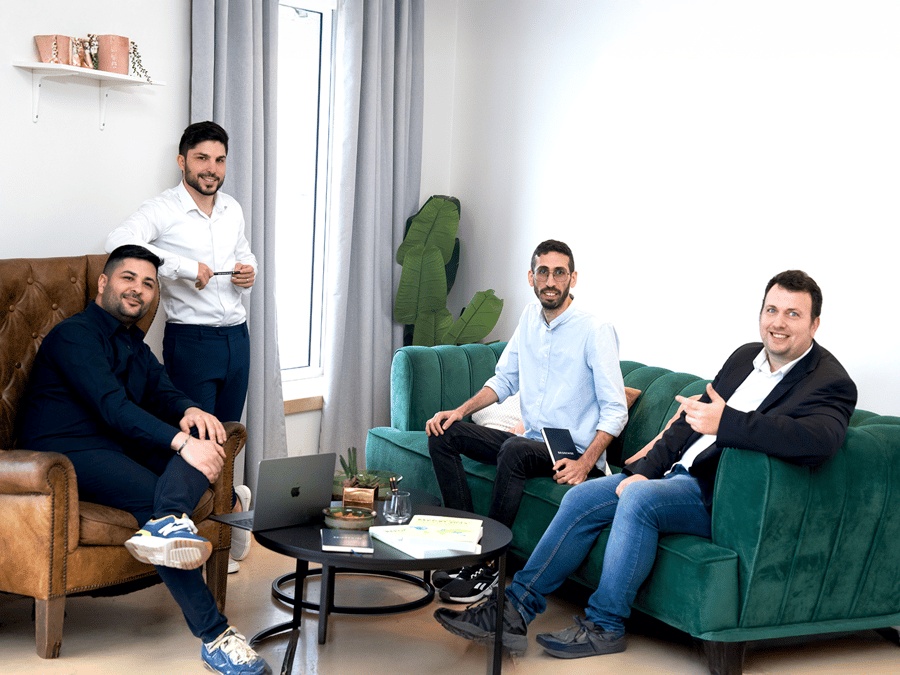
The four founded the business in 2019. It was previously called Deshe Analytics. Their explanation for building it is refreshingly practical: even professionals were having trouble processing growing volumes of financial data. In a 2026 interview, the founders identified pandemic market volatility as an unexpected early test. That account describes a pressure test, not a documented product failure or a tidy conversion story.
The fund, the stock, the conversation
StockWise turns company financials into ratings and explanations, with tools for news, earnings calls and ESG analysis. Its product page describes recommendations built from 280 fundamental data points. Rakuten’s launch notice makes the workflow tangible: compare a company’s finances with its industry, inspect a target price, and see scores updated within 24 to 48 hours of financial results becoming public.
FundWise changes the unit of inspection. An ETF’s name can suggest diversification while concealing concentration. The product offers analysis of underlying holdings, fund comparisons and performance context across more than 12,000 ETFs and mutual funds. The useful question becomes: what do I actually own, and how does this collection compare with another one?
Bridget adds conversation. It can combine BridgeWise’s research with the institution’s APIs, documents and support material. An investor might ask about a company, then about the platform’s own procedures. BridgeWise describes a proprietary investment-focused language model. Its distinction from a general chatbot rests on financial specialization, institutional configuration and explanations tied to its research.
The less glamorous details matter. One anonymous broker case study describes responses adapted to nine regulatory environments and five investor segments. Public support documentation includes bulk exports of Bridget questions and answers for audit and compliance archiving. A convincing conversation must also leave a record. In finance, a charming answer without operational controls is an unfinished product.
The institution buys. The investor reads.
BridgeWise describes its business as institutional SaaS. Banks, exchanges, wealth managers and trading platforms purchase the software; their investors encounter the tools. Rakuten announced free access for account holders. The economic attraction for a broker is plain: research, support and discovery can sit beside the transaction. Alternatives include analyst reports, established research terminals and general AI assistants, each serving overlapping needs.
“We didn’t just buy a product, we built the solution together with BridgeWise.”
Sangik Chon · Rakuten Securities
The financing follows that institutional route. In April 2024, BridgeWise announced a $21 million round led by SIX Group, with Group 11 and L4 Venture Builder participating. It put cumulative funding at $35 million then. Emirates NBD’s participation was announced alongside the Dubai expansion in 2025. Those figures describe investment in the company; they are not a price list for deploying its software.
There is a lesson here for another founder: put the explanation inside an existing decision, then do the integration work that makes it fit. BridgeWise’s documentation offers APIs and embedded widgets. Distribution brings scale, but it also brings the institution’s data, interface and rules. A demonstration that impresses in isolation still has to survive someone else’s platform.
More of the market, inside the same window
In February 2026, BridgeWise acquired Chicago-based Context Analytics, adding expertise in unstructured financial data. An X partnership followed in April for social-sentiment intelligence. June brought a GMO Coin partnership beginning with SignalWise alerts on foreign-exchange and cryptocurrency platforms. The expansion reflects a sensible complication: company accounts describe a business, while news and market conversations help explain the price around it.
That larger picture remains conditional. Stale inputs can spoil fresh prose. Local permissions shape which recommendations an institution can show. BridgeWise’s own disclaimer warns that chatbot answers may be incorrect or outdated and positions analysis as decision support. The company’s most useful promise is therefore quite concrete: help an investor ask a better question, examine the reasoning and understand the next screen. The investor still has a decision to make.