On May 12, 2022, TIFIN announced a $109 million funding round. A month later, it was cutting jobs. For anyone accustomed to reading venture funding as a scoreboard, the sequence looked peculiar. Surely this was when a young company was supposed to accelerate. Instead, 21 US employees lost their jobs, and nine senior executives took 20 percent pay cuts.
- TIFIN builds financial AI for firms, advisors and individual investors.
- Its 2026 platform connects work across operations, investments and growth.
- The business depends on specialist data, industry partners and useful integrations.
The detail that makes the episode instructive is the arithmetic. WealthManagement.com reported an internal email putting TIFIN’s annualized costs at roughly $74 million before reductions, against $30 million in annualized revenue. Costs fell to about $64 million. A company official said revenue had not declined; the cuts were preparation for tougher conditions. Capital had arrived. The need to make the business work remained.
First, find the friction
Vinay Nair, a former Wharton finance professor, founded TIFIN in late 2018. Its mission sounds broad: better wealth outcomes for more people. Its actual work is more particular. It builds and operates financial technology businesses that attack awkward steps between a person, a financial professional and an investment decision.
Consider 55ip, the tax-smart investment technology business that joined TIFIN’s portfolio in 2019. Its appeal lay in helping advisors manage tax transitions and investment strategies at scale. J.P. Morgan Asset Management agreed to acquire it in December 2020. The transaction offered an early demonstration of TIFIN’s method: develop a financial capability that a large institution has reason to adopt.

The method also created a communication problem. In a September 2023 interview, Nair admitted, “I do think TIFIN Wealth is an awful name.” People assumed it ran an advisor’s workstation. He described something focused on growth, combining proposals, financial assessments, marketing and data science. Even the founder had to explain where the product began and ended.
Follow one working day
To understand today’s company, follow the work. An advisor preparing for a client conversation needs portfolio information, relevant research and a sense of what deserves attention. Someone must assemble those pieces. Afterwards, insights need to become follow-ups, tasks or another conversation. A clever answer solves only one part of that chain.
In April 2026, TIFIN announced the consolidation of its AI businesses into TIFIN.AI, a platform coordinating agents across operations, investments and growth. It supports advisors, their support teams and end clients. Harshendu Bindal, its CEO, said it already served more than 10 enterprise wealth clients. That is a company-reported adoption figure, rather than evidence of investment performance.
“AI has been applied in pockets, but the work still sits across disconnected systems.”Vinay Nair / April 2026
The sequence matters. TIFIN.AI originally appeared in 2023 as an initiative, funded with J.P. Morgan, to develop another cohort of financial AI companies. By 2026, the emphasis had shifted toward coordination. The company’s public explanation identifies disconnected systems as the problem. The product response is shared context, rules and sequenced tasks across workflows.
Value depends on the connection between the steps.
The partner is part of the product
FactSet makes that proposition concrete. Its June 2026 partnership with TIFIN.AI initially covers meeting preparation and intelligence across an advisor’s client book. The proposed tools assemble summaries, portfolio insights and talking points, and help prioritize outreach. FactSet also made a strategic investment in TIFIN.AI.
The architecture is revealing: TIFIN.AI’s engine operates inside FactSet’s infrastructure, keeping client portfolio data there. FactSet supplies financial intelligence and an established working environment; TIFIN contributes agent workflows. For a prospective buyer, this makes data location and integration part of the purchasing decision alongside the quality of the generated answer.
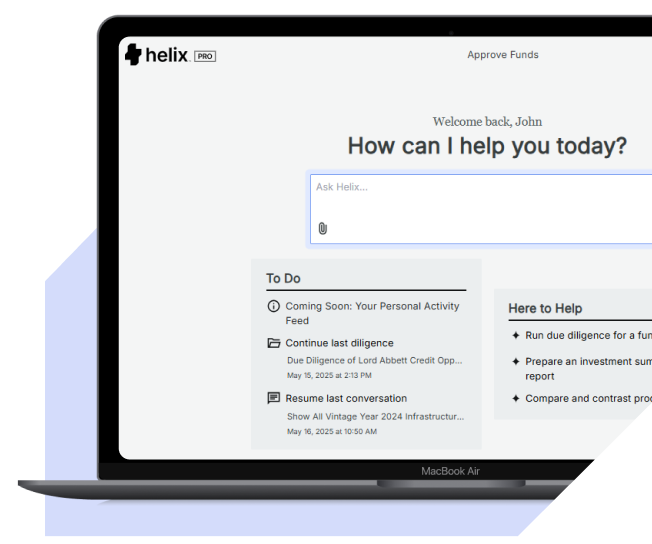
Helix illustrates the same logic in private markets. Developed with Hamilton Lane, it combines a conversational interface with specialist data. Advisors can compare funds, analyze uploaded documents and prepare reports. The partnership supplies something harder to conjure than a chat window: relevant information and domain expertise.
Different doors, different buyers
TIFIN’s other businesses enter through different doors. AMP helps asset managers and financial providers identify distribution opportunities and prioritize engagement. @Work connects workplace benefits and retirement information with financial guidance. Give provides digital philanthropic tools, including donor-advised-fund technology. Magnifi serves individuals who want investment research and a clearer view across linked accounts.
The workplace route is particularly useful for understanding distribution. A 2025 multi-year agreement integrates @Work into HUB International’s FinPath wellness platform, routing participants toward financial coaches and services. Rather than persuading every employee to discover a standalone app, TIFIN reaches people through an existing workplace relationship.
The commercial model follows those differences. Helix advertises monthly single-seat subscriptions and tailored enterprise arrangements. Magnifi advertises free access and a $99 annual premium plan. Historically, TIFIN Wealth’s published price was $299 monthly in September 2023. Those are separate products and dates, rather than one price for everything carrying the TIFIN name.
Series D raised in May 2022.
$842m valuation at that round.
Copy the sequence. Check the seams.
TIFIN competes for budgets that can also go to advisor assistants, existing software providers or internal development. Its argument is breadth with coordination: work across several functions, connected to financial data and existing systems. The practical lesson for another builder is to choose a bounded task, secure the information needed to do it and find a distribution partner already close to the user.
That approach depends on permissions, usable records and people willing to change routines. Without those, another assistant can become another place to copy and paste. A buyer can test the proposition with one meeting-preparation workflow: compare preparation time, check the underlying evidence and see whether the next action reaches the right person. TIFIN’s ambition becomes credible at precisely that scale: one completed handoff.