agentic-workflows
(19)
The City Hall AI Nobody Approved
Public workers were using AI before their agencies had rules for it. Darwin AI built a way to see the tools, set guardrails and, in one Kentucky city, turn that caution into a two-minute fire schedule.
Dify Gives AI Workflows a Place to Grow Up
The open-source favorite turns prompts, company knowledge, tools, and human approvals into visible machinery. It is a convincing shortcut to production - provided your team is ready to own the plumbing it reveals.

Geoff Smith Makes Messy Marketing Systems Legible
Across loyalty, email, employee engagement and B2B data, Geoff Smith has kept returning to the same difficult job: turning a crowded system into something people can understand and use.
Wizeline Quit Selling Software. Now It Teaches Enterprises How to Ship It
Wizeline began with a dashboard that told product managers what to build. Its more valuable discovery was that big companies needed help doing the building - and now it is betting the same lesson can drag enterprise AI out of pilot purgatory.

Casey O'Grady Is Teaching an AI Law Firm to Pick Up the Phone
The Harvard-trained lawyer left consulting, started Blueshoe in a Boston-area coffee shop, and kept changing the product until one stubborn problem came into focus: legal help moves much slower than the question that starts it.
Ambria (YC W24)
Ambria is a San Francisco startup building AI agents for the industrial world - production-ready agents that automate back-office operations across manufacturing and distribution. Founded by UIUC classmates Praneeth Guduguntla and Arman Rafati, the company went through Y Combinator's Winter 2024 batch, where it first launched as Glimmer, an AI search engine for massive PDFs, before turning its document-reasoning expertise toward the paperwork-heavy back offices of industrial companies.
Avallon AI
Avallon AI is a New York-based Y Combinator (Spring 2025) startup building AI agents that automate insurance claims operations from intake to resolution. Its agents answer phones, chase down employers and providers, read medical reports, and enter data directly into claims systems - work that traditionally consumes weeks of adjuster time. Avallon sells to insurance carriers, MGAs, and third-party administrators (TPAs), and raised a $4.6M seed round led by Frontline Ventures in November 2025.

Leadbay
Leadbay is a Y Combinator (F25) B2B sales startup building a domain-specific AI model that discovers and qualifies small-to-mid-sized business leads that traditional platforms like LinkedIn, ZoomInfo, Apollo, and Clay can't find. Trained on market data, a company's own CRM/ERP history, and reps' instincts, Leadbay learns a team's Ideal Customer Profile and predicts who will buy next - delivering qualified leads directly inside agentic workflows and AI apps like Claude, ChatGPT, and Copilot. Customers in data-scarce industries such as construction, hospitality, manufacturing, and B2B services report roughly 3-5x more qualified prospects. The company raised a $4.3M seed round led by Y Combinator in May 2026 and is based in San Francisco.
Lev
Lev is a New York-based software company building an AI-native platform for commercial real estate (CRE). Founded in 2019 by Yaakov Zar, it started as a tech-enabled financing marketplace connecting property sponsors and brokers with thousands of lenders, then evolved into a purpose-built system of apps, AI agents, and data that helps CRE professionals manage relationships, deals, documents, and lender outreach. Lev combines one of the industry's largest sources of real-time lender and market data with agentic automation that ingests calls, emails, and unstructured files to move deals forward faster.

E2B
E2B is an open-source cloud runtime that gives AI agents secure, isolated environments to execute code and use real-world tools. Built on Firecracker microVMs that boot in under 200 milliseconds, E2B lets developers and enterprises spin up disposable Linux sandboxes where AI-generated code runs without touching production systems. Founded in 2023 by Czech engineers Vasek Mlejnsky and Tomas Valenta, the company raised a $21M Series A led by Insight Partners in July 2025 and reports adoption across roughly 88% of the Fortune 100, including Perplexity, Hugging Face, Groq and Manus.
Orkes
Orkes is an enterprise workflow orchestration company built by the creators of Netflix's open-source Conductor engine. It offers a fully managed, cloud-hosted platform that lets developers build, run, and scale durable workflows across microservices, APIs, and - increasingly - AI agents, giving companies a reliable way to put long-running, event-driven, and agentic processes into production without reinventing the underlying orchestration plumbing.

StackOne
StackOne is a London-based integration platform that gives B2B SaaS companies and AI agent builders a single unified API to connect to hundreds of enterprise systems - from HR and CRM to ticketing, messaging and identity. Combining a proprietary tool-calling LLM with a real-time, privacy-first engine, it offers 200+ pre-built connectors and thousands of ready-made actions so agents can reliably and securely take actions inside the software businesses already use. Founded in 2023 by Romain Sestier and Guillaume Lebedel, the company raised a $20M Series A led by GV (Google Ventures) in May 2025 and has surpassed 1 billion API calls.

Axiomatic AI
Axiomatic AI is a Cambridge, Massachusetts deep-tech company building AI that engineers can actually trust. It pairs frontier language models with formal mathematical and physics-based verification so that the reasoning behind a design decision can be checked, proven, and traced. Its first commercial focus is photonics and semiconductor engineering - fields where simulations are sophisticated but fragmented and a fabrication error is expensive. Founded in 2024 by a group of MIT and ICFO physicists and led by former White House quantum-policy lead Jake Taylor, the company raised an $18M seed in March 2026 to build what it calls the intelligence infrastructure for verified science and engineering.

Sandstone
Sandstone is an AI-native operating system for in-house legal teams. It unifies a company's legal data, workflows, and business context into a single system that lives inside the tools teams already use - Slack, email, Salesforce, Jira - and deploys AI agents to handle intake, triage, drafting, and redlining. Founded in 2025 by ex-McKinsey and practicing-lawyer trio Nick Fleisher, Jarryd Strydom, and Liam Germain, the New York company launched publicly in January 2026 with a $10M Sequoia-led seed and followed with a $30M Series A led by Lightspeed five months later.

Jake Taylor
Jake Taylor is a physicist turned founder and the CEO of Axiomatic AI, a Cambridge, Massachusetts startup building 'Axiomatic Intelligence' - AI that combines frontier models with formal mathematical and physics-based verification so engineers can design and prove out hardware like semiconductors and photonic chips. Before Axiomatic, Taylor spent 16 years at NIST as a Fellow and ran the first U.S. effort to coordinate quantum science, serving as the inaugural Assistant Director for Quantum Information Science at the White House Office of Science and Technology Policy, where he architected the National Quantum Initiative. He holds a PhD in physics from Harvard, has authored more than 200 publications, and his honors range from the Presidential Early Career Award to the Service to America Medal. In March 2026 he led Axiomatic to an $18M seed round.

Verix
Verix is a Santa Clara-based software company that builds Tovana, an AI-powered commercial optimization platform for pharmaceutical and life sciences companies. Tovana unifies fragmented commercial data - prescription records, lab results, demographics, and digital marketing signals - and layers predictive modeling, GenAI, and automation on top so brand and field teams can decide the next best action, find the right patients, target the right physicians, and forecast more accurately. Its no-code architecture and pre-built connectors let most deployments go live in 4-8 weeks, and the platform is used by global drugmakers including Bayer, Novartis, GSK, Roche, and Kyowa Kirin.

Tony Rosinol
Tony (Antoni) Rosinol is the co-founder and CEO of StackAI, the no-code platform that lets enterprises build, deploy, and govern custom AI agents. An MIT PhD in computer vision and SLAM, he created the open-source Kimera robotics system before pivoting from teaching robots to see the world to teaching agents to run the back office. He started StackAI with fellow MIT PhD Bernard Aceituno out of Y Combinator's Winter 2023 batch, raised nearly $20M, and in May 2026 sold the company to Asana for $75M, where the founders now build toward an operating system for human-agent teams.
Avantos
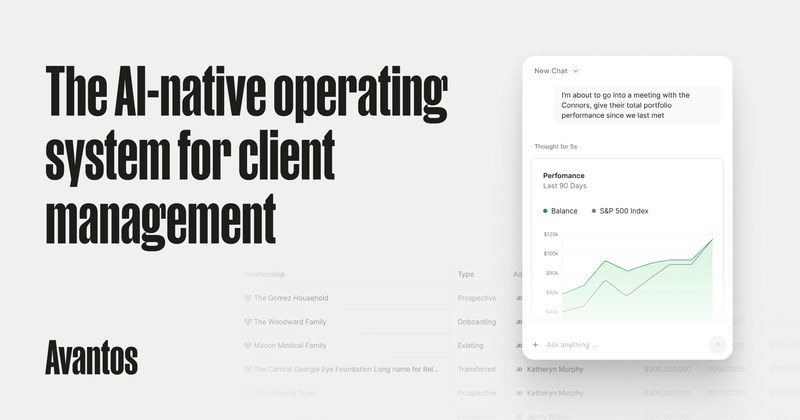
Avantos is an AI-native operating system for client management in financial services. Built on a knowledge graph that connects client data, products, teams, and work, its AI agents power onboarding, servicing, and growth while fitting into existing tech stacks. Founded in 2024 in New York by Bassam Chaptini and Rabih Ramadi, the company launched with Mercer Advisors and raised a $25M Series A led by Bessemer Venture Partners in February 2026, bringing total funding to $35M.
Unframe
Unframe is a managed AI delivery platform for enterprises that turns critical business operations into production-ready AI workflows in days, not quarters. Built by the former Noname Security team, the company packages agent orchestration, a knowledge fabric, data connectivity and modular building blocks into a single OS for production AI - and bills only for outcomes that ship.