Breaking
VERIX builds Tovana, the AI decision engine for pharma commercial teams Clients include Bayer, Novartis, GSK & Roche Revenue up ~78% YoY to ~$9.5M in 2024 Most deployments live in 4-8 weeks via no-code architecture Acquired start-up.ai in 2023; founder became CTO GenAI Database Explorer launched 2024 - ask your data in plain English VERIX builds Tovana, the AI decision engine for pharma commercial teams Clients include Bayer, Novartis, GSK & Roche Revenue up ~78% YoY to ~$9.5M in 2024 Most deployments live in 4-8 weeks via no-code architecture Acquired start-up.ai in 2023; founder became CTO GenAI Database Explorer launched 2024 - ask your data in plain English
Company Profile / Pharma AI

Verix.

The quiet platform deciding which doctor your drug rep calls next.

Santa Clara, CA Founded 2004 Life Sciences AI ~63 people
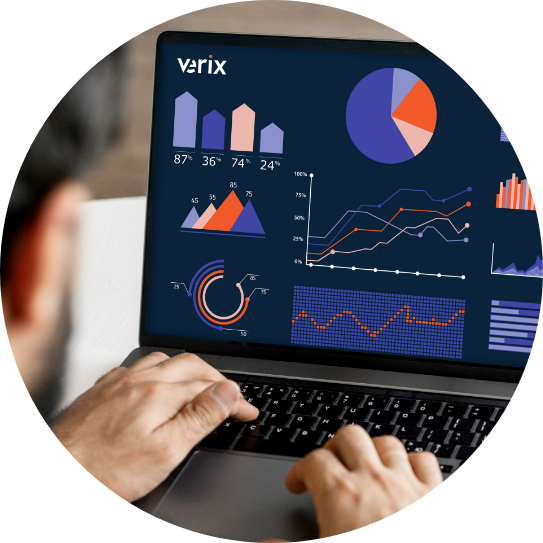
The Verix Tovana platform displayed on a laptop dashboard
A laptop, a dashboard, and a few billion dollars of drug sales riding on the next click. The Tovana platform, in its natural habitat.
Who they are now

The brand team has 11 minutes and one decision to make.

A sales rep in a Novartis territory opens a screen before a 9 a.m. call. It does not show a spreadsheet. It shows a recommendation.

That screen is Tovana, and the company behind it is Verix - a roughly 60-person outfit in Santa Clara that most patients will never hear of, yet whose software quietly shapes how some of the world's biggest drugmakers go to market. Bayer runs on it. So do Novartis, GSK, Roche and Kyowa Kirin.

Verix calls Tovana a "commercial optimization platform." Stripped of the jargon, it is a decision engine: it eats pharma's most fragmented data - anonymized prescriptions, lab results, demographics, digital ad signals - and hands back an answer to a deceptively simple question. Who is the next patient, and who decides whether they get this drug?

Verix exists to solve for every sale in an increasingly specialized world.

- The company's stated mission
The problem they saw

Specialty drugs broke the old playbook.

For decades, pharma sold by volume. Big primary-care drugs, big sales forces, blunt instruments. You did not need to find the patient - the patient was everywhere.

Then medicine got specific. Rare diseases. Narrow indications. Therapies meant for a few thousand people in the whole country, not a few million. The blunt instruments stopped working, because in a specialized world every single sale matters, and missing the right physician is no longer a rounding error - it is the whole quarter.

The data existed to fix this. It just lived in a dozen incompatible systems, refreshed too slowly to act on, and required a data scientist to interrogate. Most commercial teams were, in effect, driving while looking in the mirror.

The industry's open secret: pharma spends billions on commercial operations, and a startling share of it is educated guessing dressed up as strategy.

You can have all the data in the world and still be late to the only decision that counted.

- The tension Verix was built around
The founder's bet

A workforce-optimization veteran picks a harder problem.

Verix's founder and CEO, Doron Aspitz, had done this dance before. He previously co-founded and ran Blue Pumpkin Software, where the problem was optimizing the right thing at the right time - call centers, schedules, capacity. Pharma commercial was the same shape of problem, scaled up and made life-or-death.

The bet was unfashionable when he made it: that the bottleneck in pharma was not more data or more reps, but a unified foundation that could turn raw signal into a recommendation a human could act on before the moment passed. Not a dashboard to admire. A decision to take.

It is the kind of bet that sounds obvious in 2026 and sounded like a research project earlier. Verix spent years building the unglamorous part - the data plumbing - so the glamorous part could work at all.

Adding the start-up.ai team to Verix was a natural decision for us.

- Doron Aspitz, CEO, on the 2023 acquisition that brought his CTO in-house
The receipts

A timeline, minus the hype.

2004

Verix is founded

Doron Aspitz starts the company in Silicon Valley with a focus on business analytics for specialized markets.

Through 2019

$12.7M raised

Backing including Viola Ventures funds the long build of the data foundation, capped by a convertible note in August 2019.

June 2023

Acquires start-up.ai

The AI/ML startup joins Verix's AI lab. Co-founder Shahar Cohen becomes CTO - "the perfect place for implementing technology we have spent years developing."

March 2024

GenAI Database Explorer ships

Users can now query commercial pharma data in plain English - LLM convenience, database-grounded accuracy.

2024

Revenue reaches ~$9.5M

Up from ~$5.4M a year earlier - roughly 78% growth on a team of about 50.

The product

Tovana: one foundation, many decisions.

Tovana - the name borrows a Hebrew word for insight - rests on three pillars: a unified Data Foundation, AI and Predictive Modeling, and analysis you can actually read. It is modular but unified, which is the whole trick: every use case draws from the same data and intelligence layer instead of yet another silo.

The unfashionable detail that customers love: it is no-code, with pre-built connectors, so most deployments go live in 4-8 weeks rather than the multi-year slog enterprise pharma software is famous for.

Decide

Next Best Action

Tells field and marketing teams the single most effective move to make next, across every channel.

Find

Patient Finder

Surfaces likely patients and pathways from anonymized data, so the right therapy reaches the right person.

Target

Dynamic Targeting & Segmentation

HCP targeting that re-sorts itself as the data changes, instead of a static list from last quarter.

Ask

GenAI Database Explorer

Natural-language questions in, accurate database-grounded answers out - no SQL, no data team in the loop.

It provides an exploration experience like an AI chatbot, while only giving accurate answers based on our database.

- Shahar Cohen, CTO
The proof

Small team. Famous logos. Real growth.

The skeptic's question writes itself: does a 60-person company actually run inside Big Pharma? The client list says yes. Tovana is in production at Bayer, Novartis, GSK, Roche, Kyowa Kirin and Ironshore - companies that do not adopt unproven software for their commercial engines.

BayerNovartisGSKRocheKyowa KirinIronshore
$9.5M
2024 revenue
~78%
YoY growth
4-8
weeks to go-live
$12.7M
total raised

Revenue, doing the unglamorous thing: going up.

Annual revenue, reported estimates (USD millions)
$5.4M
2023
$9.5M
2024

Two bars, one story: a roughly 78% jump on a headcount that barely moved. Efficiency, not hype.

The math worth noticing: revenue per employee climbed because the product got smarter, not because the company got bigger. That is the bet paying off.
The mission

Make every commercial decision a predicted one.

Verix's larger ambition is not to sell more dashboards. It is to move pharma commercial work from guesswork to prediction - to a place where targeting, forecasting, and engagement decisions all flow from one trustworthy data foundation rather than a committee's best hunch.

The 2023 acquisition of start-up.ai and the 2024 launch of natural-language querying point the same direction: pull the data scientist out of the critical path, and let the person making the decision ask the question themselves. The expertise stops being a gatekeeper and becomes a tool.

Our GenAI Database Explorer empowers users to easily access valuable information and generate insights catering to their own business needs.

- Doron Aspitz, CEO
Why it matters tomorrow

Medicine keeps getting more specific. So does the math.

Every year, the drugs get narrower and the patients harder to find. That is good news for medicine and brutal news for anyone still selling by volume. The companies that win the specialized era will be the ones that can find the few who need a therapy - and reach the few who prescribe it - faster than the competition.

Verix is not the only player betting on this. IQVIA, Veeva, ZS, Aktana and Komodo Health all circle the same problem. What sets Verix apart is the unglamorous foundation it spent two decades laying, and a no-code shape that gets it working in weeks. In an industry that measures projects in years, that is its own kind of edge.

The 9 a.m. call, revisited

Back to that rep, that screen, those 11 minutes.

The decision is already made. The screen just told them which one.

That is the whole point of Verix. Not to admire the data, not to file the report - but to compress the distance between a billion fragmented signals and the one move that matters, down to a single, confident recommendation. In a world where every sale counts, that is not a feature. It is the job.