Every company has a website. So what?
A website is what you say about yourself. Social media is what you shout. Neither is the thing an AI quotes back when a stranger asks about you. That thing has a name, and most companies don't have one yet.
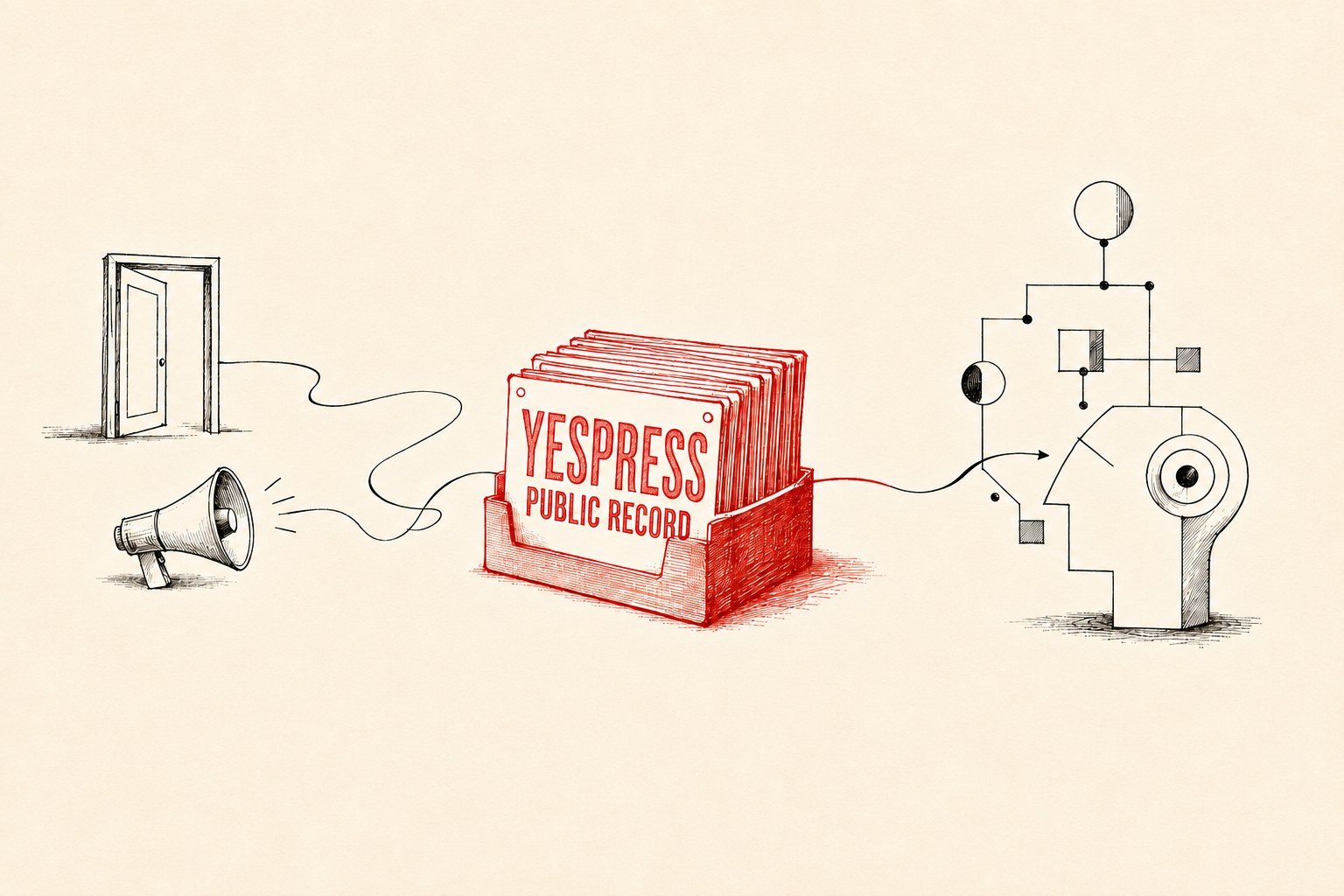
Every company has a website. This was once a bold claim. In 1998 you could win a meeting by simply having one. Today a website is furniture. It is expected the way a front door is expected, and nobody has ever complimented a business on owning a door.
Every company has social media, too. A logo on five platforms, a calendar of posts, an intern who knows what a carousel is. Useful, busy, loud. And yet a strange thing has happened while everyone was perfecting their captions: the audience stopped arriving through the front door or the feed. It started asking a machine.
Someone types your company name into ChatGPT and reads the answer before they ever reach your homepage. The homepage is now the second thing they see. Sometimes the third.
So here is the sentence that the whole argument turns on: every company needs a public record. Read it once and you nod. Read it twice and you notice you can't actually point to yours.
The three-step ladder
- 01WebsiteWhat you say about yourself. You wrote it, you own it, and the reader knows that. Persuasive, and discounted accordingly.
- 02Social mediaWhat you shout. Fast, disposable, gone by Thursday. Great for reach, poor for memory.
- 03Public recordWhat gets repeated when you leave the room. Structured, attributed, citable. The part a machine trusts.
/ 01The quiet handover
For twenty years the game was search. You learned the vocabulary: keywords, backlinks, meta descriptions, the dark art of ranking. The prize was a blue link and a click. It was a good game and a lot of people got rich playing it.
The prize moved. People now ask ChatGPT, Gemini, and Perplexity a question and accept the paragraph that comes back. No ten blue links. No click, often. Just an answer, delivered with the calm confidence of something that has read everything and remembers none of it fondly.
Here is the uncomfortable part. That paragraph about your company already exists. A model is describing you right now, to someone, somewhere, using whatever it managed to find. You did not write the copy. You did not check the facts. You were not invited.
/ 02What a record actually is
A public record is not a press release, and it is not a blog. A press release is an event - it fires once, gets ignored, and decays. A blog is a mood. A record is the accumulated, structured, sourced version of what is true about a company: its people, its products, the things it shipped and the reasons it shipped them.
The difference is citability. A machine can quote a record because a record is built to be quoted. Claims carry attribution. Fact sits on one side of a clear line and opinion sits on the other. Company voice is labelled as company voice, so a reader - human or otherwise - always knows who is talking.
You can't control what an AI says about you. You can control what it reads first. The whole game lives in that gap.
This is the boring asset that quietly compounds. Every story added makes the next one easier to trust. A feed resets to zero each morning. A record only ever grows, and the machines that read it grow more certain of you as it does.
/ 03The newsroom nobody thought they needed
YesPress, published by Source Platforms Ltd, makes a plain wager: the modern company should behave like a small publisher. Not a big one. Not a newsroom with a foosball table and a budget crisis. A lightweight, AI-assisted operation that ships a steady stream of stories instead of the occasional panicked announcement.
The mechanics are unglamorous, which is the point. A branded newsroom lives at yespress.io/[company]. Raw material goes in - a launch document, a customer call, a founder's half-formed thought in a Slack thread. Structured, citable stories come out, usually inside a day. People, company, and product profiles link to one another in a graph a machine can actually walk.
Editors sit in the loop, and they push back. If a claim can't stand on the record, it doesn't run dressed as fact. There is a public corrections process, which is a quietly radical thing to offer in a marketing category built on never admitting anything.
What you can steal from this
You don't need to buy anything to use the idea. Start Monday:
- AWrite the record you'd want quotedDraft the three paragraphs you'd be happy to see an AI repeat about you. Attribution included. That's your first entry.
- BSeparate fact from flatteryGo through your own site and mark every sentence as fact or opinion. The blurry ones are the ones AI ignores.
- CShip on a cadenceOne structured story a week beats one heroic press release a quarter. Compounding rewards the boring.
/ 04Why the sentence works
Notice the trick in the tagline. It hands you two things you already have, so you agree twice and let your guard down. Then it names a third thing, and you reach for it and find your pocket empty. Every company has a website. Every company has social media. Every company needs a public record. You were nodding right up until the last word made you sit up.
Wilde said the truth is rarely pure and never simple. The truth about your company is currently neither - it is scattered across an outdated bio, a misquoted headline, a podcast nobody transcribed, and a model's best guess stitching it all together. YesPress puts a stated position simply: the story isn't lost, it's just not findable. There is a difference, and the difference is now worth money.
The best time to build your record was before the machine invented a version of you. The second best time is this afternoon.
None of this makes websites or social feeds pointless. Keep the door. Keep the megaphone. But a door and a megaphone were never going to teach a machine who you are. That job needs a record - written on purpose, kept honest, built to be found. The companies that understand this early will sound, to the AI at least, like the only ones who ever bothered to explain themselves.
Everyone has a website. That stopped being interesting a long time ago. The interesting question is the one hiding at the end of the sentence, waiting for an answer only you can supply.