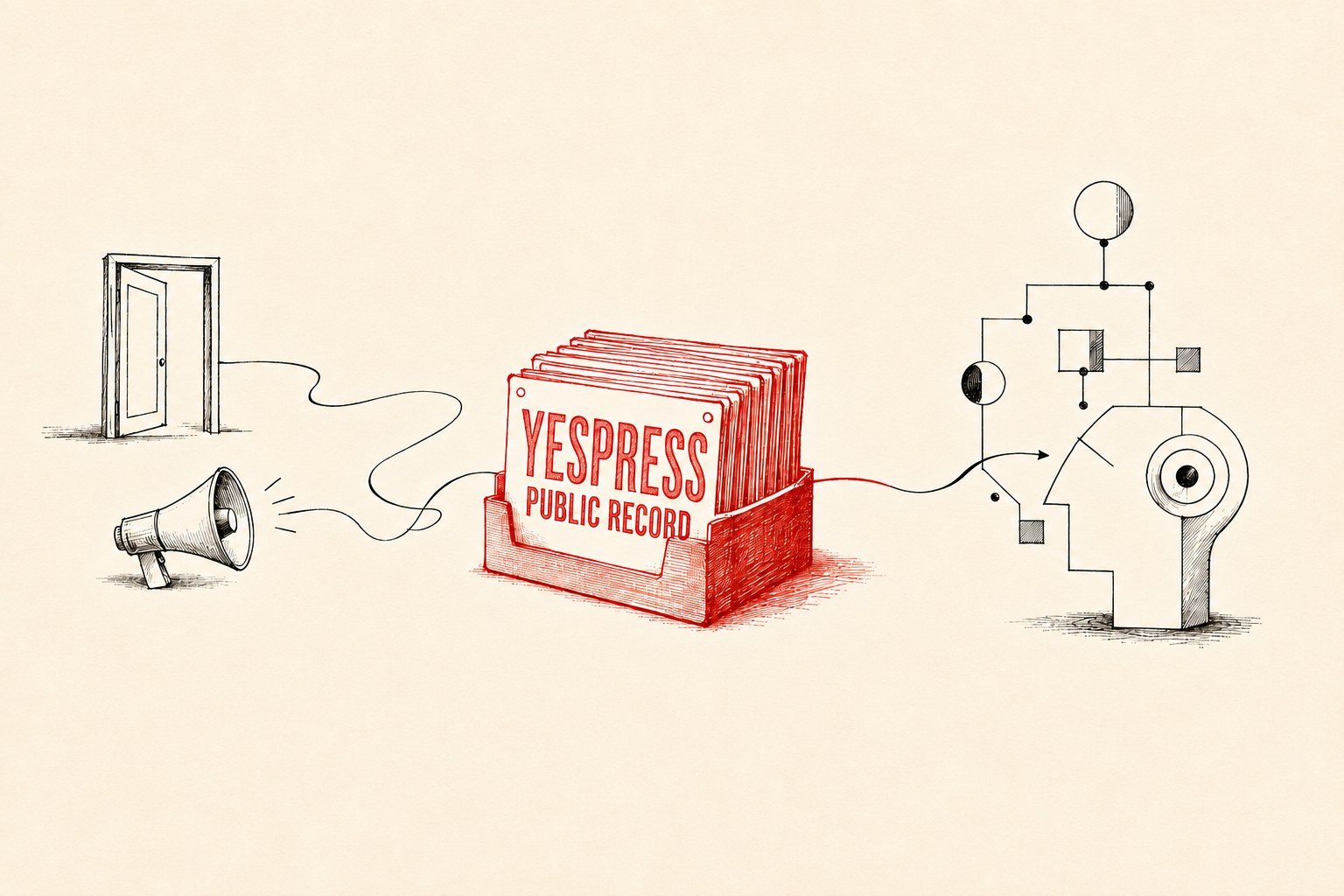
YesPress is an AI-native publishing platform that builds one authoritative, claimable page for the people, companies, and products shaping how we work, build, and live. Its tagline - 'Remarkable People, Exceptional Stories!' - frames long-read profiles and deep dives, while its companion Newsroom product lets founders, executives, and organizations keep a continuously updated, correctable record that AI systems and search engines surface accurately. Operated by UK-registered Source Platforms Ltd, YesPress positions itself at the intersection of editorial storytelling and generative-engine optimization.

"Every company has a website. Every company has social media. Every company needs a public record." is the thesis behind YesPress, an editorial engine built for the age of answer engines. The argument is simple: a website is what you say about yourself, social media is what you shout, but a public record is the structured, citable source material that AI systems like ChatGPT, Gemini, and Perplexity actually learn from and quote back. YesPress builds that record - an always-on newsroom publishing company, people, and product stories under the company's own name, kept honest by editors and a public corrections process.
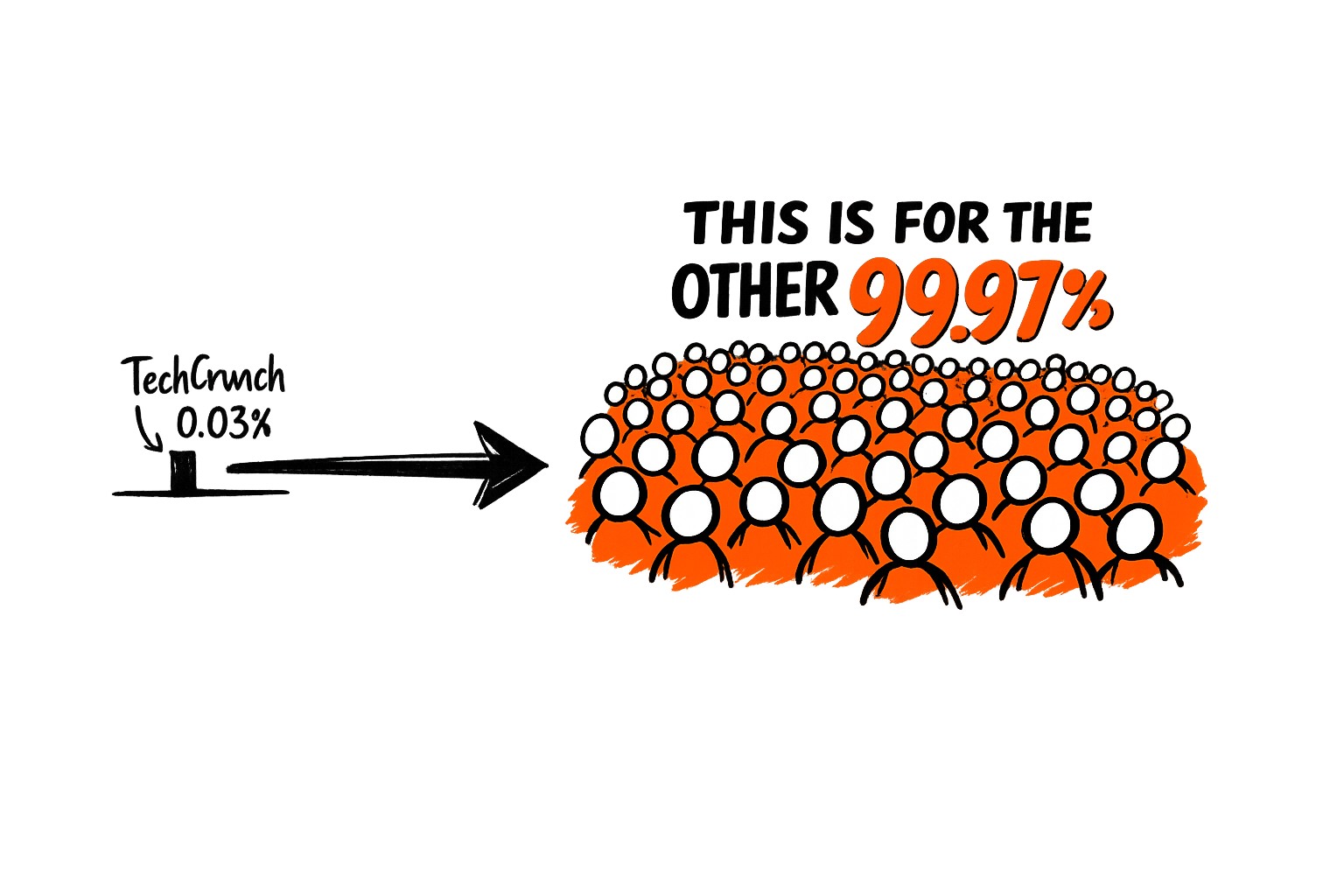
An argument about the gap between getting covered and being known. TechCrunch runs a finite front page and turns away nearly everyone who pitches it, yet its stories now feed the AI systems that answer questions about the technology economy. The piece separates the editorial question - will a reporter find us interesting today - from the retrieval question - does enough structured, freshly dated material about us exist for a machine to find. It makes the case that press coverage is a moment while a continuously published public record is memory, and that a YesPress Newsroom is the second thing: an always-on, structured record of launches, hires and expertise that compounds on the days no reporter writes back.

Fashion discovery is moving from search engines to answer engines. When shoppers ask ChatGPT, Gemini, Claude or Perplexity for the best minimalist label or the most sustainable brand, the names that surface are not the biggest ad spenders but the brands with the most public, structured knowledge for AI to cite. This YesPress Newsroom analysis lays out what large language models look for, why many direct-to-consumer fashion brands underperform despite strong paid-social businesses, and how an always-on newsroom turns internal expertise into compounding, citable assets.

YesPress gives any company the always-on newsroom that the world's biggest brands use to stay visible to AI answer engines. Rather than measuring what AI says about a company, YesPress builds the public source material that ChatGPT and other systems learn from and cite — without requiring a fifty-person comms team. Through constant publishing, citation, and retrieval, visibility compounds over time.

YesPress is an editorial engine built for the age of answer engines. It gives a company its own always-on newsroom, publishing structured stories under the company's own name so that ChatGPT, Gemini, and Perplexity have an authoritative public record to cite. The pitch is blunt: your next customer starts with an AI assistant, not your homepage, and AI can only recommend what it can understand. YesPress turns launches, wins, and expertise into machine-readable stories, shipped within 24 hours with entity markup, then tracks which engines quote them.

YesPress's Editorial Standards & Methodology page explains how the company publishes verifiable, structured stories about companies. It distinguishes Company Newsroom stories (company-bylined, drawn from submitted material) from YesPress Newsroom stories (independently reported, not for sale), and lays out the sourcing rules that keep both primary-source clean: attribution as the rule, a firm line between fact and evaluation, company voice labeled as such, and editors who push back on claims that can't stand on the record. It describes an AI-native production line with editors in the loop, a connected entity graph for machine-readable retrieval, and a public corrections process.
A field guide to Generative Engine Optimization (GEO): the practice of structuring your content and earned-media footprint so ChatGPT, Perplexity, and Gemini cite your startup as a source. It explains why citations equal retrieval trust, the platform-specific mechanics, a step-by-step playbook, and the single biggest mistake founders make — publishing only when they raise. It closes with YesPress as the engine that runs GEO on a continuous schedule.
YesPress is an AI newsroom: a publishing engine that turns a company's raw material into structured, citable stories published on a branded newsroom of its own, so generative engines like ChatGPT, Perplexity, and Gemini understand and retrieve the company when it matters. Where traditional PR chases headlines and GEO dashboards measure visibility, YesPress publishes the source material AI actually reads — consistently — so visibility compounds through citation and trust.
Two companies staring at the same problem from opposite ends of the pipe. Peec AI is an analytics platform that watches how brands show up inside ChatGPT, Perplexity, Gemini and Claude, and scores them on visibility, position and sentiment. YesPress is a content operation that manufactures the citable, structured stories that make brands show up in the first place. One measures. One publishes. Together they describe the emerging discipline that marketers are calling Generative Engine Optimization.

A field report on the quiet reason mid-sized companies vanish from AI answers: not quality, not product, not people, but publishing cadence. Salesforce and Microsoft publish daily. Most companies publish quarterly. The models cite what exists, and the rest becomes a guess.
YesPress Newsroom, powered by Story Engine, publishes the stories that build authority, earn trust, and increase a company's visibility inside AI answers - the recommendations, comparisons, and explanations that millions of people now ask chatbots for before they ever visit a website or run a Google search.
This YesPress story reframes AI visibility not as a search-engine optimization tactic but as the ongoing work of building a public company. The core argument: AI describes your business the way an independent investment analyst would—by assembling a picture from whatever public evidence exists. Most companies generate enormous amounts of information internally but publish almost none of it, leaving AI with little to work with. The fix isn't optimization; it's evidence. YesPress Newsroom, powered by Story Engine, treats a continuously growing public record as infrastructure rather than PR, capturing the product updates, customer breakthroughs, and executive insights that would otherwise never leave the building.
For two decades companies built newsrooms so journalists could find press releases, bios, and logos. Now the primary reader is artificial intelligence. When customers, investors, and analysts ask ChatGPT, Gemini, Claude, or Perplexity about a company, the answer is assembled from whatever public record exists. Companies that publish constantly get learned, cited, and retrieved; companies that stay quiet get filled in by the AI's best guess. YesPress positions itself as the publishing engine that turns every announcement, customer story, and milestone into authoritative newsroom content, founding a new discipline it calls AI Reputation & Knowledge Management.
A manifesto arguing that the next era of marketing is won not by ranking higher but by being the company AI understands best. It reframes constant publishing as the act of teaching AI systems who you are: every story becomes a citable source, every citation increases trust, and every increase in trust makes AI more likely to retrieve you. The piece introduces the YesPress Newsroom as an always-on publishing engine that gives startups the same compounding institutional-knowledge advantage that Microsoft, Salesforce, OpenAI, NVIDIA and Stripe already enjoy.

A head-to-head look at two companies fighting the same war from opposite trenches. Profound is the instrument panel — it measures how ChatGPT, Gemini, Claude and Perplexity talk about your brand. YesPress is the printing press — it manufactures the citable, on-the-record stories those engines actually quote. One tells you the score; the other puts points on the board. For scaleups, B2B startups, enterprise sales teams and employer-branding leaders, the two are less rivals than a dashboard and an engine bolted into the same machine.

YesPress Newsroom gives growth-stage companies the same always-on publishing engine that Fortune 500 firms run — without the massive comms team. It turns launches, hires, partnerships, transcripts, and founder interviews into editorial stories engineered to be cited by journalists, analysts, and AI answer engines like ChatGPT, Perplexity, and Google AI Overviews. Plans start free to claim, with full newsrooms from $750/month.