There is a moment, familiar to anyone who has run a marketing team in the last eighteen months, when someone opens ChatGPT in a meeting, asks it a question about your industry, and your brand is not in the answer. The room goes quiet. Then a chart appears on a laptop screen. Then a press release gets filed. Between the chart and the press release, two companies have quietly built businesses.
Peec.ai, based in Berlin, is the chart. YesPress is the press release. Neither is a chatbot. Neither claims to be the future of search. Both are trying to solve the very specific, very unglamorous problem of what a brand does when the front page of the internet stops being blue links and starts being a paragraph written by a model that does not usually cite its sources.
This is a comparison. It is also, in a small way, an argument that a comparison is the wrong frame. The most interesting thing about YesPress and Peec.ai is not which one wins. It is that the two ends of a pipeline have shown up at roughly the same time, and marketers who care about being in the answer are quietly buying both.
Cast of TwoThe Analytics Company and the Newsroom
The chart-maker
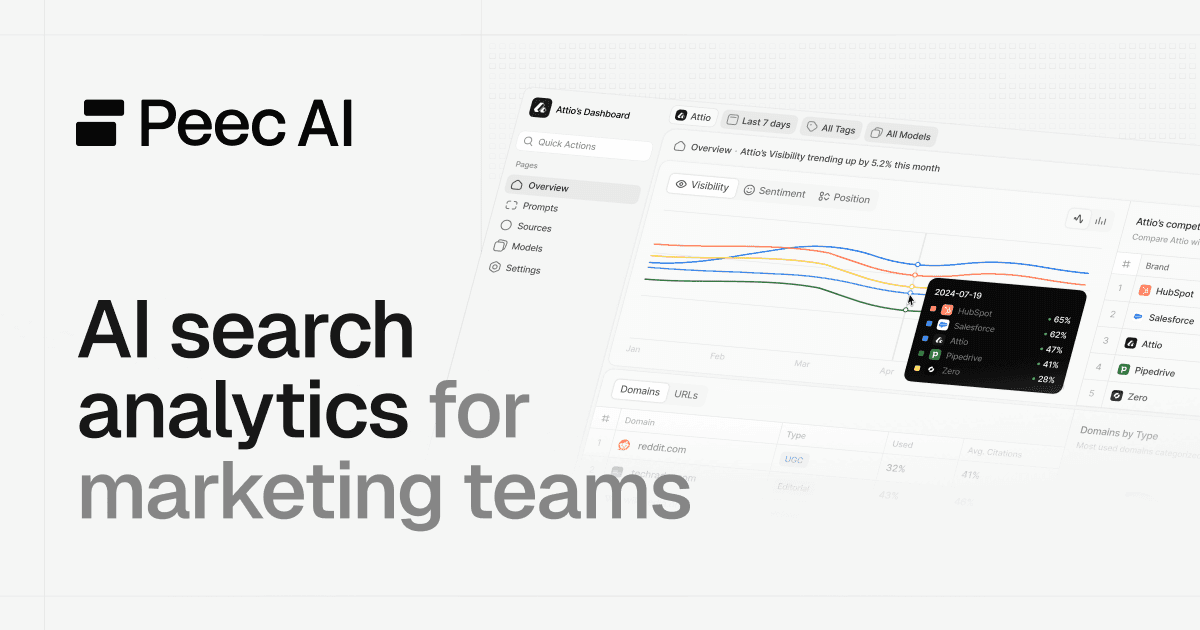
An AI search analytics platform. It runs your prompts across ChatGPT, Perplexity, Gemini, Claude and Copilot every day, watches how the answers change over time, and scores your brand on three things: visibility (are you in the answer at all), position (where in the answer) and sentiment (is the answer friendly).
- Founders: Daniel Drabo, Tobias Siwonia, Marius Meiners.
- Origin: Antler Berlin, Winter 2024 cohort.
- Series A: $21M led by Singular; Antler, Combination VC, identity.vc, S20 participating.
- Product extensions: Peec MCP, AI Shopping Analytics, exports to Looker Studio and CSV.
The story-maker
A content platform that runs a newsroom for a brand the way large enterprises like Salesforce and Microsoft run theirs, without the team. It takes raw material (transcripts, interviews, case studies) and turns it into AI-optimized, citable stories within twenty-four hours. A human editor sits at the end of the pipeline. The output is structured for retrieval.
- What a newsroom holds: press releases, brand assets, executive bios, company updates.
- Express: free claimable profile. Scaleup: $750/mo, 10 articles. Business: $2,500/mo, 40 articles.
- Enterprise: dedicated editorial team, full-organization coverage.
- Pitch line: publish, get cited, get retrieved.
"You cannot optimize what you cannot measure. You cannot measure what nobody publishes. Peec.ai does the first. YesPress does the second. That is a stack, not a fight."
Field notes, this newsroomWhy This Category ExistsThe Very Short History of GEO
Generative Engine Optimization is the acronym marketers use when they do not want to say "SEO for chatbots" out loud. It is not quite the same thing. Traditional SEO rewards backlinks, keyword density, and structured schema on pages that humans might click. GEO rewards being the source that an answer engine chooses to quote. The engine does not always link out. The user does not always know your name. You still have to be in the paragraph.
The problem, as anyone who has tried it in the last year knows, is that being in the paragraph is not a knob you can turn. AI answers vary day to day, model to model, prompt to prompt. If a marketing team wants to know whether their new positioning is landing inside Perplexity, they need two things. They need something publishing the positioning in a structured, citable, retrievable way. And they need something reading the paragraph back to them and turning it into a number.
Peec.ai is the number. YesPress is the structure. They are not, strictly, competing for the same budget line. They are competing for adjacent budget lines that a year ago did not exist at all.
TimelineEighteen Months of Category Creation
Drabo, Siwonia and Meiners meet in Antler Berlin. The word GEO is not yet common.
Peec.ai closes a €1.8M pre-seed. The pitch: measure the AI answer.
Peec.ai closes a €5.2M seed led by 20VC. Less than four weeks after the pre-seed.
Coverage reports €7M raised. The category has a shape.
Reports of a further €18M round. Demand for AI brand visibility tools grows.
Series A closes at $21M, led by Singular. YesPress ships stories for Vercel, FourKites, Handshake, WitnessAI, x1, Simplify.
Peec.ai reports $10M ARR sixteen months after launch. The market is officially awake.
Two companies, two ends of the pipe, one field guide.
ChoosingHow to Pick, If You Have to Pick
The honest answer is that most serious brands will use both. But the useful answer, for a marketing lead trying to justify a line item this quarter, is that the choice depends on which part of the loop is broken.
Use Peec.ai when the problem is diagnosis.
You suspect you are being under-mentioned by ChatGPT. You want to know how you compare to three named competitors. You want a dashboard, an export, and a chart that trends over time. You want to send a screenshot to your CMO on Friday. This is the measurement job, and Peec.ai is the current market-leading answer for it.
Use YesPress when the problem is supply.
You have no newsroom, or the one you have is a WordPress blog updated twice a year. You need executive bios that read like they were written for humans and structured for retrieval. You need press releases about hires, launches, wins, that a model can find, quote and attribute. The Express tier is free and closer to a claimable Crunchbase profile than a CMS. The Business tier ships forty articles a month, which is a small newsroom.
Use both when the loop needs to close.
Publish through YesPress. Measure through Peec.ai. Adjust. Publish again. This is not a novel workflow. It is the same content-and-analytics loop that SEO teams have run for twenty years, aimed at a new set of answer engines. The interesting thing is only that the tooling for the new loop is finally arriving.
"Every generation of the web produces a measurement company and a publishing company. Google gave us Analytics and WordPress. AI search is giving us Peec.ai and YesPress. That the two showed up in the same eighteen months is not coincidence, it is category maturity in fast-forward."
The Argument, brieflyThe QuirksThree Things Worth Knowing
Peec.ai closed its seed round less than four weeks after its pre-seed. That is not usually a sign of orderly capital markets. It is a sign of a category that was already awake before the founders had picked a name for it.
YesPress does not pitch itself as a blog service. It pitches itself as the newsroom that Salesforce and Microsoft run, minus the department. The distinction matters, because a blog is for humans and a newsroom is for retrieval.
The category acronym, GEO, did not have wide currency in early 2024. It now has a $21M analytics leader, a newsroom-as-a-service layer, and enough startups to sustain a comparison chart at Ahrefs.
FAQThe Questions People Actually Ask
Are YesPress and Peec.ai competitors?
No. Peec.ai measures how brands appear inside AI search answers. YesPress publishes the citable stories those answers retrieve. They sit at opposite ends of the same Generative Engine Optimization pipeline.
What is Generative Engine Optimization?
GEO is the practice of getting cited by large language models like ChatGPT, Perplexity, Claude and Gemini. It has a publishing side (YesPress-shaped) and a measurement side (Peec.ai-shaped). It is not the same as SEO, though the muscle memory transfers.
How much has Peec.ai raised, and from whom?
Roughly $29M across three rounds. A €1.8M pre-seed in April 2025, a €5.2M seed led by 20VC weeks later, and a $21M Series A led by Singular, with participation from Antler, Combination VC, identity.vc and S20.
What does a YesPress newsroom actually contain?
Press releases, brand assets, executive bios, and company updates, modeled on the newsrooms that large enterprises like Salesforce and Microsoft run in-house. A human editor handles quality. Turnaround is 24 hours from raw material to published story.
Who founded Peec.ai?
Daniel Drabo, Tobias Siwonia, and Marius Meiners. They met in Antler's Berlin Winter 2024 cohort, united by an interest in the future of search and product discovery.