The machine that started Eventide was not meant to make a new sound. It was meant to save one man from rolling his chair. In 1970, recording engineer Stephen Katz worked in the Sound Exchange, a Manhattan studio so tight that its Ampex MM1000 tape machine could not be operated comfortably without an assistant. Katz asked his friend Richard Factor for an autolocator - a device that could return two-inch tape to a chosen point. Factor built one. An Ampex salesman saw it, the manufacturer agreed to resell it, and Eventide had a business before it had much of a plan.
The company probably moved about 100 of those controllers. That is not a unicorn origin story; it is better. One expensive irritation, one buyer with distribution, one technical founder willing to solder. Orville Greene, the studio owner and patent attorney, financed the early work. Katz supplied the problem. Factor supplied the circuitry. The three founded what became Eventide Inc., now based in Little Ferry, New Jersey.
Eventide Audio today makes digital effects for three very different surfaces: the rack in a professional studio, the floor beneath a performer and the screen inside a computer. Its H9000 processor offers more than 1,600 customizable algorithms for $7,999. The H90 compresses 74 algorithms into an $899 pedal. Blackhole, a reverb once buried inside a rack processor, is a native plug-in advertised at $99 and often sold for less. Different customers, different budgets, same intellectual inventory: code that changes pitch, time, space, tone and dynamics.
First, the bad machine
Factor had tried pitch changing before Eventide. In 1969, while working for a defense contractor, he collected rejected integrated circuits - parts too costly for a hobbyist to buy - and assembled a voice-bandwidth pitch shifter. He later called it primitive and terrible sounding. It worked, technically. It failed as a product because the components and audio quality were nowhere near ready for an independent company.
That failure matters because Eventide did not improve its way out of the problem through grit alone. Factor dropped it. The economics had to change. Random-access memory arrived; digital audio became barely possible; engineer Tony Agnello joined in 1973. The lesson is not “never quit.” It is “know which constraint belongs to you.” Eventide could refine an algorithm. It could not personally drag semiconductor prices down.
Those empty boxes were not quite vaporware and not quite products. They were questions posed with front panels. Show visitors liked the phaser. Factor went home and built it. The resulting Instant Phaser replaced the awkward hand pressure engineers used on tape reels to create flanging-like movement. Meanwhile, a commission from Maryland Public Broadcasting pushed Eventide toward a two-channel digital delay.
studio job
hardware
becomes a sound
to a new format
A delay line priced like a car
The DDL 1745 used about 100 shift registers and roughly 100,000 transistors to hold 200 milliseconds of audio. It had incandescent lamps because commercial LEDs were not yet available. In 1972 it listed for $3,800 - roughly the cost of a new car, and more than $20,000 in later purchasing power. Studios bought it because tape delay consumed machines, space and assistant time. At the 1973 Watkins Glen festival, Eventide units delayed feeds to remote speaker towers so their amplified sound arrived with the sound traveling through open air from the stage. Utility paid the bill.
Then musicians bent the brief. Engineers used delay not only for double tracking and reverb pre-delay but for comb filtering and unfamiliar movement. Agnello’s H910 Harmonizer, commercially available in 1975 for about $1,600, added pitch change and feedback. Producer Tony Visconti put its dropped-pitch treatment on Dennis Davis’s drums for David Bowie’s Low. A device designed around correction became a machine for glorious damage.
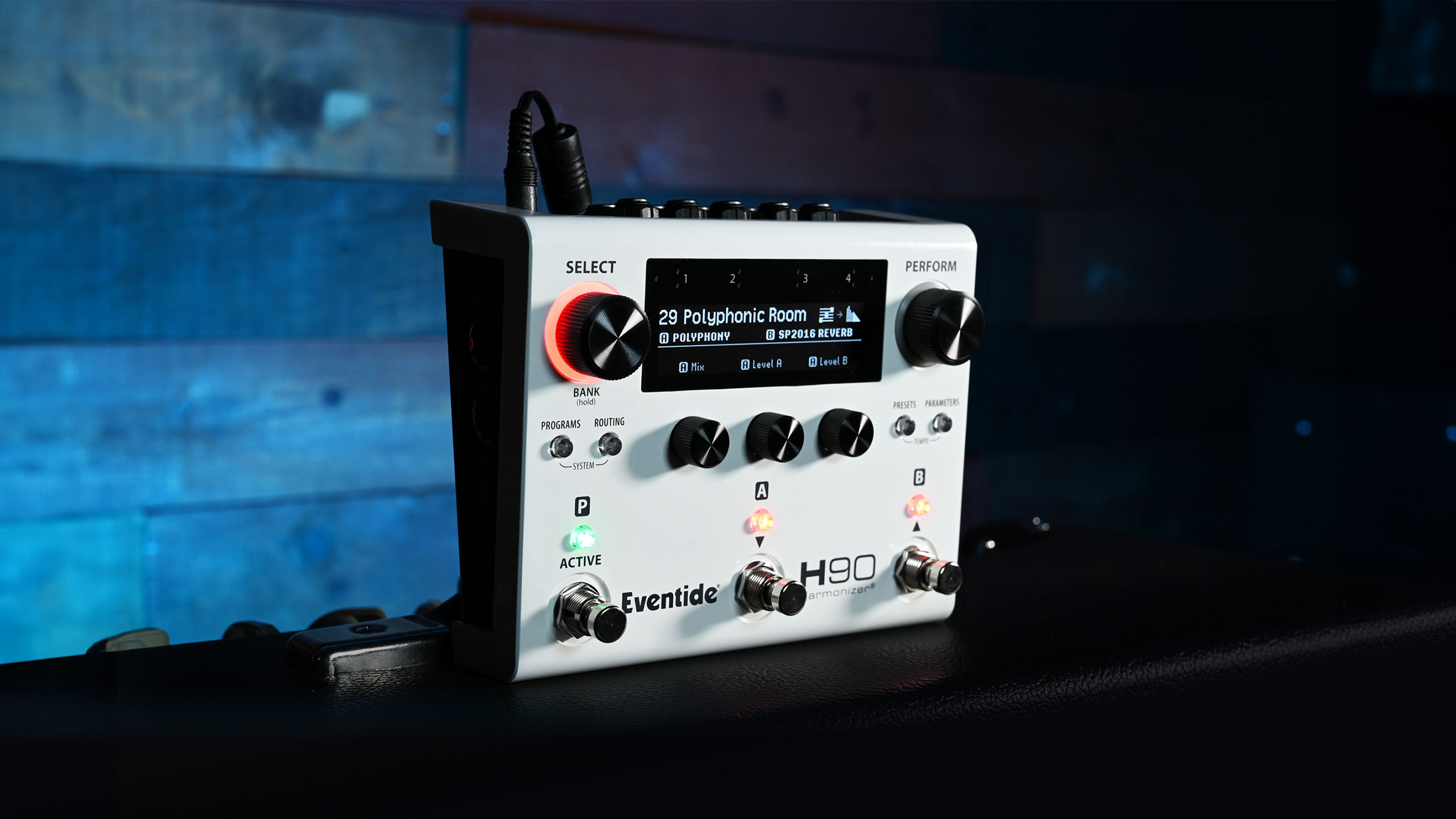
The H90 puts five decades of Eventide effects under a musician’s shoes. A distinguished place for 74 algorithms, and a hazardous one for coffee.
The product is the migration path
Eventide’s distinguishing advantage is not that it alone can make delay, reverb or pitch effects. Strymon, Universal Audio, Line 6 and Source Audio compete for pedalboard space. Soundtoys, FabFilter, Valhalla DSP, iZotope and Waves crowd the plug-in menu. Lexicon and Bricasti remain studio references. Eventide’s edge is historical continuity: it can carry a recognizable idea from scarce hardware into every container that follows.
Blackhole illustrates the route. It began as a preset in the DSP4000, moved into the H8000 and Space pedal, then became a dedicated pedal, desktop plug-in and iOS app. The sound does not imitate a plausible room. Its long, harmonically rich tails create spaces that physics never approved. That is useful for a guitarist building an ambient wash, a producer widening keyboard layers or a sound designer turning a drum hit into weather.
The newer Temperance Pro takes a different swing at reverb. Instead of treating a space as one wash, it models thousands of resonators and lets the user emphasize or suppress them with the 12-note chromatic scale. A mixer can make a tail sympathetic to the song’s harmony rather than merely shorter, darker or brighter. SplitEQ similarly separates transient and tonal material before equalization. These products reveal Eventide’s actual expertise: not “effects,” broadly, but interfaces that make difficult signal processing playable.
One library, four wallets
That ladder is the business model in miniature. Eventide sells perpetual plug-in licenses and an all-access software subscription, direct-to-consumer pedals and accessories, and expensive processors through direct sales and authorized dealers. Its wider corporate sibling, Eventide Communications, sells recording systems for public safety, utilities and air-traffic operations. Those markets are less visible than a Bowie anecdote, but diversification helped the company through periods when studio hardware slowed.
Small management, long memory
Factor has described Eventide’s culture as research-heavy, low on conventional management and high on individual responsibility. Hardware is prototyped and manufactured in two converted warehouses in Little Ferry; one carries hundreds of kilowatts of solar panels. The model suits engineers who can own a problem end to end and a private company willing to nurture algorithms for decades. It is less portable to a team of inexperienced generalists, a category with commodity margins, or work that depends on tightly coordinated handoffs. Autonomy only compounds when the people and the quality bar are unusually good.
The company also knows when to invite another sensibility. Eventide and Third Man Hardware developed the Knife Drop, a $299 combination of sub-octave fuzz and analog synth behavior, with presets created alongside Jack White. Newfangled Audio, founded by former Eventide DSP engineer Dan Gillespie, develops plug-ins that Eventide distributes. In February 2026, Eventide released a modernized $29 edition of composer-programmer Laurie Spiegel’s Music Mouse, the 1980s instrument that maps cursor movement to harmony, melody and arpeggios.
That last release is more than archival housekeeping. It says Eventide still believes an interface can suggest a way of making music. In June 2026, the H9 Harmonizer Gen 2 arrived at $599 with all 74 H90 algorithms, more than 1,000 presets and compatibility with presets from the original H9. Preserving a musician’s old sounds while replacing the computational floor beneath them is an underrated form of customer service.
What another builder can borrow
- Start with an expensive workflow problem, not a broad market slogan. Katz needed tape to return to a mark without another employee.
- Show the interface early enough to measure desire. Eventide’s empty AES boxes made potential customers react to a concrete proposition.
- Watch for productive misuse. A utility for delay became comb filtering; pitch control became the sound of a drum record.
- Preserve the difficult layer. Eventide keeps moving algorithms and presets into new hardware instead of rebuilding its identity with every format.
There are conditions attached. This strategy works when the underlying craft stays valuable across generations and when customers can recognize its character. It is weaker for products whose advantage comes mainly from temporary distribution, regulated access or a one-time hardware quirk that software cannot translate. It also requires patience. Eventide’s payoff came through compounding technical memory, not an overnight launch curve.
The company’s own old mission statement is refreshingly free of incense: keep making “neat, innovative stuff,” and perhaps make a few bucks. That is Eventide in one line. The autolocator saved labor. The delay replaced a tape machine. The Harmonizer solved pitch and invited trouble. Fifty-five years on, the machines are faster and the boxes are smaller, but the move has not changed: remove a constraint, then leave enough knobs for somebody to make a beautiful mistake.