The Woburn Pedal Nerds Who Turned a Spare DSP Chip Into a Cult
A six-person shop of chip engineers and sound obsessives spent 20 years making effects pedals that other companies would later copy. Then Ernie Ball came knocking.
Around 2005, an engineer at the semiconductor firm Analog Devices was staring at a chip that wasn't meant for him. It was a version of the company's Sigma DSP - digital signal processing silicon built to sit inside consumer audio gear - and Roger Smith had a hunch it could do something its designers never intended: become the brain of a guitar effects pedal. He was right. That hunch, worked on nights and weekends with a handful of colleagues, became Source Audio.
Twenty years later, the company that grew out of it is small enough to fit in one building at 120 Cummings Park in Woburn, Massachusetts, and influential enough that its pedals show up on stages and recordings tied to David Gilmour, U2, John Mayer, Phish and Victor Wooten. In July 2026, Ernie Ball - the string maker that has been coiling guitar strings for more than 60 years - announced it had agreed to buy the whole thing.
This is the story of how a group of chip designers and sound obsessives built a cult brand by doing one slightly stubborn thing over and over: shipping ideas a little before the rest of the industry was ready for them.
01 / The IdeaEngineers who happened to play guitar
Source Audio was founded in 2006 by four people who mostly came from two Massachusetts institutions: Analog Devices, the chip giant, and Kurzweil Music Systems, the synthesizer pioneer. Roger Smith became president. Jesse Remignanti, a young ADI engineer with a background in accelerometer technology, ran engineering. Bob Chidlaw, a renowned sound designer who had helped build Kurzweil's K2000 synth, took the role of chief scientist. C. Hunter Boll, who had spent two decades at the private-equity firm Thomas H. Lee Partners, handled the business side.
The technical bet was specific. Working with Analog Devices, the team helped shape the SA601 - a specialized Sigma DSP processor - into the engine that would sit inside their pedals. Where most boutique effects makers were soldering analog circuits, Source Audio was writing code for a chip and treating a stompbox like a small computer.
Their first product proved the point almost too well. It wasn't a pedal at all. The Hot Hand was a motion-sensing ring you wore on your finger; wave your hand and you could sweep a wah or a filter through the air, no foot required. It was strange, it was clever, and it set the company's entire thesis in motion: the sound and the way you control it should both be reinventable.
02 / The CatalogA family of sounds that keep combining
The early years ran through the Soundblox and Soundblox Pro lines, which debuted at NAMM in 2008 with multi-band distortion and, soon after, presets, graphic EQ, MIDI and a push into bass effects. But the run most players know began in 2016, when the Nemesis Delay arrived and, in the company's own telling, became an instant hit. It did the thing Source Audio does best: put faithful emulations of classic tape and analog delays next to sounds that don't exist in the analog world, all in one editable box.
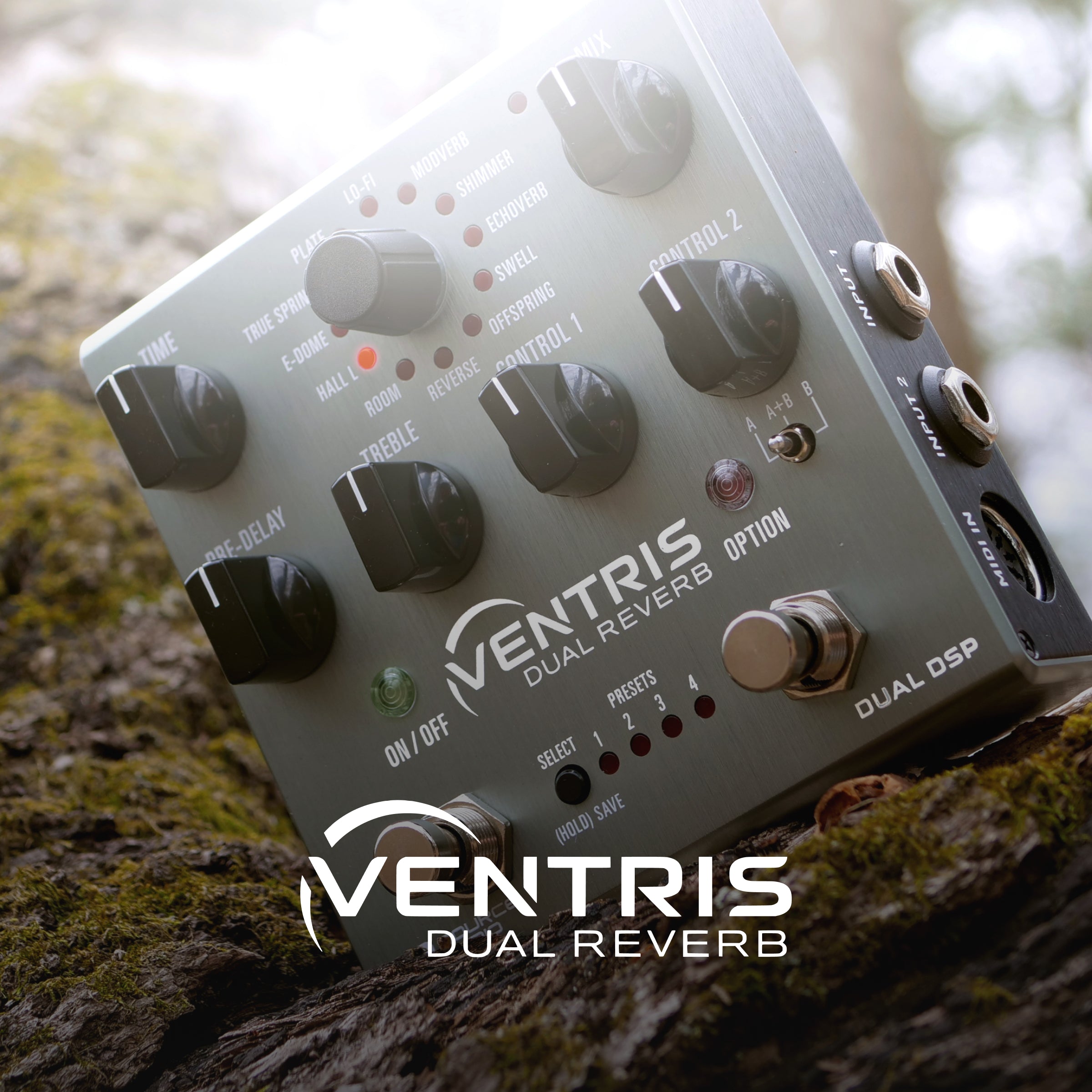
From there the catalog reads like a family tree. The Ventris Dual Reverb (2017) used two processors to run two reverbs at once. The C4 Synth (2019) turned a guitar or bass into a modular-style synthesizer and quietly became, as the company puts it, standard issue for modern bassists. The Collider (2019) simply merged the Nemesis delay engine and the Ventris reverb engine into a single pedal. The EQ2 (2020) offered a 10-band parametric stereo equalizer with 128 presets. In 2025 the Encounter shipped with Chidlaw's Hypersphere Reverb, described as the sound of a room with no walls, ceiling or floor.
03 / The MoatThe app is the real product
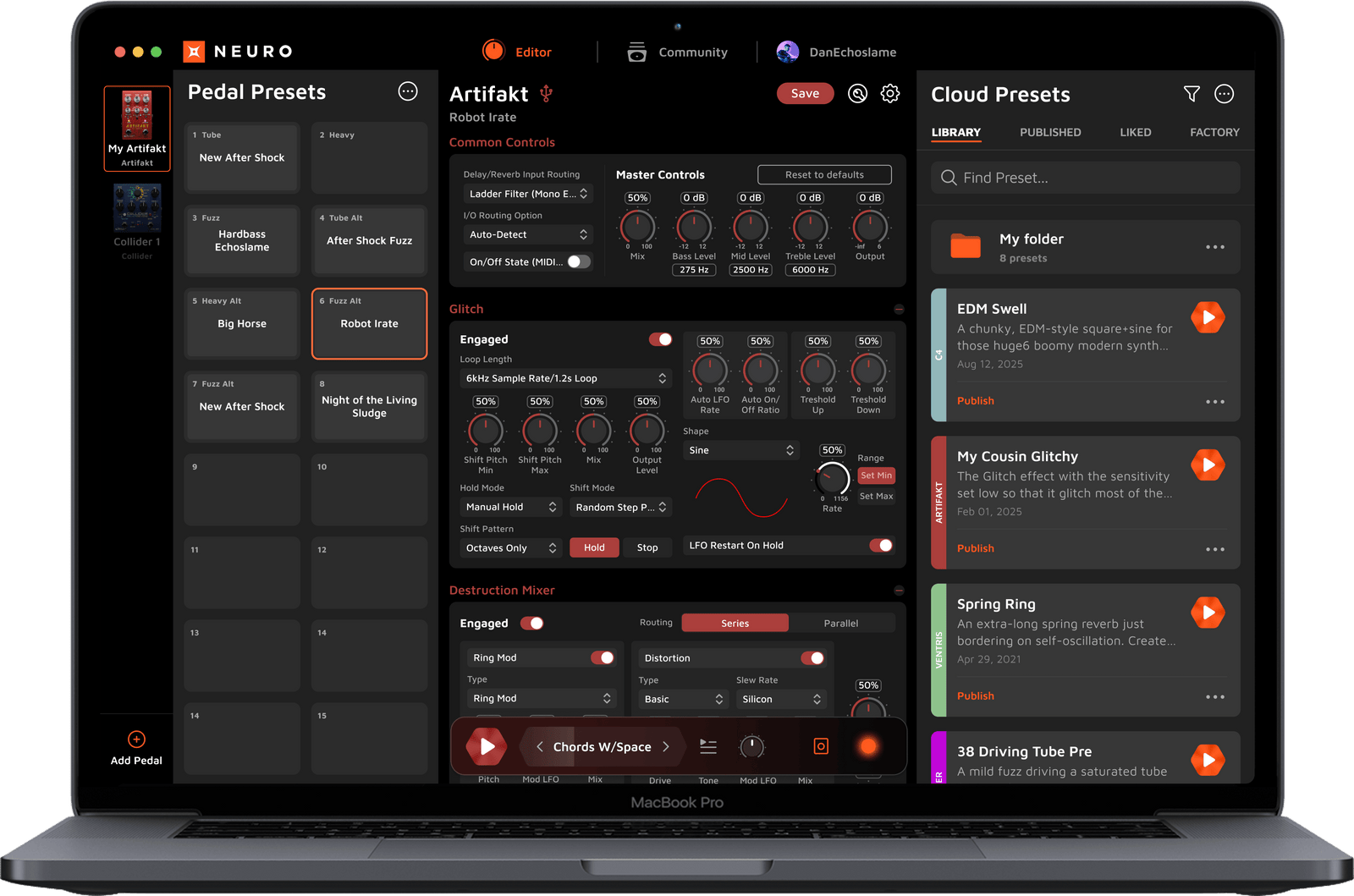
Here is the part worth stealing if you build anything physical. A Source Audio pedal is not a fixed object. Plug it into the free Neuro app - on a phone or a computer - and you can dig far past the four or five knobs on the enclosure, remap controls, manage 128 presets over MIDI, and download or share preset packs made by other players and artists. The pedal you bought in 2019 keeps changing.
Neuro launched as an editor in 2015, got a complete top-to-bottom rewrite as Neuro 3 in 2024, and in 2025 added SoundCheck - a feature that lets you design presets inside the mobile app with no pedal plugged in at all. For a small hardware company, the software ecosystem is the quiet moat: it turns a metal box into a platform, and it keeps customers inside that platform for years.
Illustrative - relative breadth of the catalog, not unit sales.
04 / The BusinessSmall on purpose, direct and dealer both
Source Audio never ran the venture-scale playbook. Public records point to a single seed round - roughly $1.2 million, raised around 2013 - and a team that stayed in the single-to-low-double digits. Estimated annual revenue sits near $4 million. The company sells directly to players through its own Shopify storefront and business-to-business through a global network of dealers and distributors like Sweetwater, with the free Neuro software binding the two together.
That combination - premium hardware, a direct channel, a wide dealer base, and a sticky app - is how six people out-shipped ideas against competitors many times their size. The company's peers in the modern digital-effects world include Strymon, Eventide, Chase Bliss, Empress and Meris. Source Audio's edge was rarely price. It was being first, and being deep.
What you can actually do with it
- Stack delay and reverb from one pedal instead of two (Collider).
- Run two independent reverbs in series, parallel or split stereo (Ventris).
- Turn a bass into a four-voice synthesizer on a pedalboard (C4).
- Edit deep parameters and manage 128 presets from your phone (Neuro 3).
- Download artist and community preset packs, or build your own with SoundCheck.
05 / The SaleWhy a string company bought a DSP lab
On July 8, 2026, Ernie Ball announced a definitive agreement to acquire Source Audio. On the surface it's a mismatch - one company makes strings, the other writes DSP firmware. Underneath, it's tidy. Ernie Ball gets a respected, innovation-led effects platform to expand beyond strings and accessories. Source Audio gets global distribution, deeper artist relationships and manufacturing scale, while continuing to operate independently under its own name. Financial terms were not disclosed.
Roger Smith framed it as continuity rather than exit: the deal, he said, gives the company "the scale, support, and reach to keep growing while preserving the spirit of what we built." For a shop whose founding move was betting on a chip nobody else saw, being acquired for the platform they built - rather than the balance sheet - is a fitting last chapter to the independent era.

06 / The TakeawayShip the "too early" idea
The through-line of Source Audio's 20 years is a pattern more founders could copy: find the sound - or the feature, or the interface - that nobody is making yet, ship it before the market asks, and let a software layer keep it alive long after the hardware leaves the factory. It doesn't work if you're chasing the lowest price, and it doesn't work without genuine technical taste behind it. It worked here because the people writing the firmware also happened to care, deeply, about how a delay decays.
The Ventris ran two reverbs at once when that looked excessive. The C4 turned a bass into a synth before that was a category. Both are now normal. That is the whole company, compressed: right, a little early, for two decades - long enough for a legacy brand to pay for the privilege of continuing it.