Roger Smith’s first invitation to the guitar world came with a ring. Put it on, move your hand, and an effects pedal would respond. The gesture was wonderfully direct. Persuading musicians to make room for it turned out to involve rather more movement.
Hot Hand, introduced in 2006, belonged to a company built by people who understood what modern audio chips could do. Smith had come from Analog Devices. His colleague Jesse Remignanti brought engineering skills and an idea for using motion sensors to control effects. Together, they offered players another way to shape a note.
There was a catch, familiar to anyone who has ever tried to replace somebody else’s favorite object. A guitarist’s equipment carries memories as well as signals. A new device has to sound useful, feel usable, and survive comparison with the thing already underfoot. A ring had quite a lot to explain.
A ring with an audience problem
In the early years, Source Audio’s unusual controllers attracted interest without producing the sales the team had hoped for. The first Hot Hand needed a wire to connect it to the pedal. A wireless version followed, giving players more freedom to move. The basic proposition remained delightfully physical: your hand could become part of the effect.
Smith’s recollection of that period has the tone of someone who accepts invention’s awkward schedule. Looking back in 2026, he described his commitment to innovation and his acceptance of arriving early. His willingness to release unfamiliar ideas is part of the appeal of his career. It also explains why the career requires patience.
The guitar is a practical place to test that patience. Its players can be adventurous about music while feeling quite attached to how their equipment works. Even a convincing new sound has to compete for floor space. The pedalboard is a small property market with unusually sentimental tenants.
“I’ve been maniacally obsessed with innovation since day one.”
Roger Smith, 2026
The chip business follows him out
Before Source Audio, Smith spent nearly two decades at Analog Devices, including responsibility for audio and video products. Leaving meant changing his relationship with technology he already knew. The former employer became a supplier and collaborator. The connection gave his new business access to expertise that usually sits well upstream of a guitarist’s shopping decisions.
Smith and Analog Devices engineer Thomas Irrgang presented the SA601, a system-on-chip developed jointly by the two companies for musical-instrument effects. Its purpose was to bring the analog and digital signal chain together. Under the knobs and switches, there was a serious semiconductor relationship.
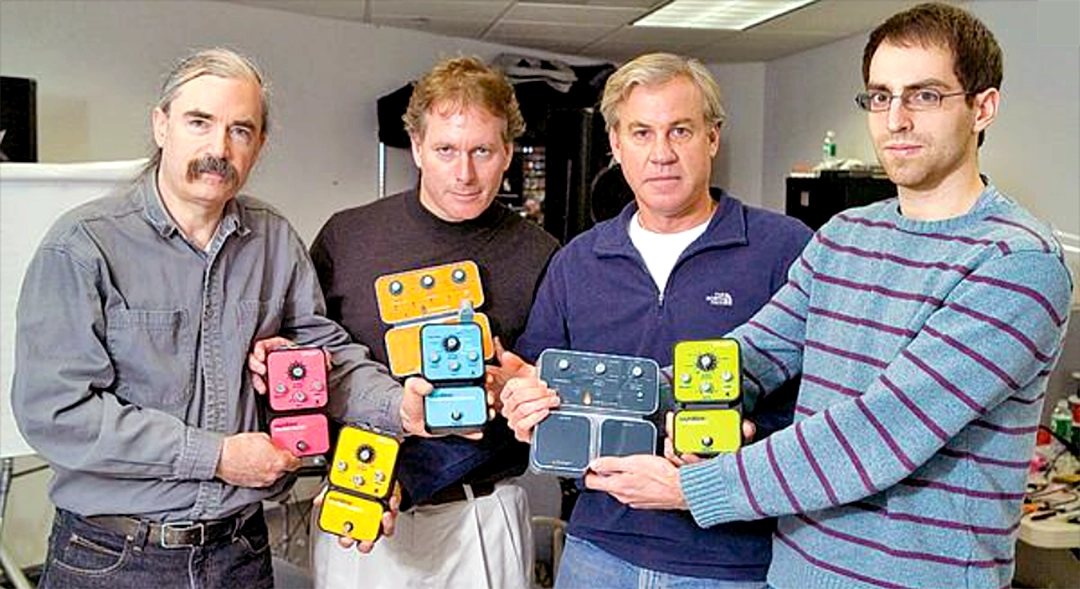
Smith also assembled people whose skills complemented his own. He called longtime friend Hunter Boll, whose background was in private equity, to join as a business partner. Bob Chidlaw brought experience from Kurzweil and a sound designer’s ear. Remignanti worked across hardware and the interface a player would actually encounter.
The division of labor matters. A compelling algorithm still needs controls. A set of controls still needs someone to decide what belongs on the outside of the box. Smith’s company put those questions within talking distance of one another, rather than expecting the musician to resolve them at the end.
Bass players find an opening
Smith’s view of the market included an explicit concern for bass players. In 2017, he described bass effects as an underserved category. The company had good bassists in and around the team, including Chidlaw, Will Cady and Nathan Navarro. Their experience gave the discussion a useful anchor in actual playing.
Navarro supplied a particularly vivid example. While studying at Berklee, he worked with Remignanti on a setup involving Hot Hand and other effects. With his band Pinn Panelle, he used the controller in a performance of Skrillex’s “Scary Monsters and Nice Sprites.” The ring helped put an electronic wobble into a live-band performance.
The video drew attention and demand. More revealing than any view count is the direction of the discovery. A musician had a sound in mind. An engineer helped him reach it. The resulting performance showed other musicians a reason to care about the device. The application did some of the explaining that the invention alone could not.
Smith’s comments about development leave room for exactly this sort of exchange. In 2011, he described ideas coming from engineers, customers and artists. He also singled out the wireless ring as a difficult build: it had to be light and small, reach far enough, and work internationally. Behind a casual wave sat a rather exacting list.
The useful art of taking a hint
Source Audio’s history includes a less glamorous achievement than inventing a controller: changing the boxes. Early designs drew objections about size and appearance. Later generations moved toward compact metal enclosures and more familiar layouts. An engineer’s idea of possibility had to meet a player’s idea of something they would happily use.
By 2016, Smith was talking openly about the distinction between the semiconductor business and the pedal business. Loading up features did not settle the question of whether a product worked for a musician. “It’s a more complicated world,” he said. There is something pleasing about an audio-chip veteran discovering that complication can look like a simple stompbox.
The Nemesis Delay became an example he liked discussing. Asked about a favorite in 2017, he chose it, emphasizing its compact housing, straightforward operation and additional editing through the Neuro app. A player could approach the physical pedal first, then choose how far to investigate its other possibilities.
That arrangement reflects a useful courtesy. People come to equipment with different appetites for adjustment. One wants to play immediately; another enjoys spending an evening refining a preset. Asking both to use the same amount of complexity would be an odd way to serve either.
Listening became an explicit part of Smith’s public explanation of development. In 2019, he discussed the importance of gear-forum conversations and musician feedback. The founder’s job included hearing the request inside a complaint. In a business devoted to making sounds, that is a fitting managerial skill.
Hot Hand makes its public debut.
Nemesis Delay arrives.
Source Audio joins the Ernie Ball family.
The long route to a small box
For Smith, patience also belonged inside the engineering process. In his account of the Atlas Compressor, he traced compression work back to 2007. Some of that early work reached the Multiwave. A dedicated compression pedal demanded further research into the behavior of the circuits they wanted to reproduce.
He credited Chidlaw, Remignanti and Christopher Venter for the work behind Atlas. The specificity is characteristic of his public explanations: products emerge from named collaborators, with different problems to solve. A company can put one name on its door while owing its sound to several people’s judgment.
Smith appears alongside the engineers in the official Atlas introduction video. He also recorded a discussion of monophonic and polyphonic tracking for the C4 Synth. These are subjects that reward explanation. His willingness to get into the details gives the customer another way into the instrument, beyond the list of things printed on its box.
Still going out to hear the band
The personal motive becomes easier to hear when Smith writes about a concert. In June 2022, he described seeing Billy Strings at Manhattan’s Pier 17, with Trey Anastasio joining during the second set. His attention moved between the arrangements, the playing and the audience’s response.
He had learned about Strings through Source Audio’s warehouse manager, Matt, after the guitarist needed help with a Nemesis Delay. Smith later met him at the Sinclair in Cambridge. In the essay, a support connection becomes part of a listener’s history with an artist.
His delight is in the movement between musical styles and the precision of the band. It is an especially revealing piece of writing from someone who sells tools for changing sound. He listens for what the changes accomplish. The equipment has a place in the account, but the performance supplies the reason to keep paying attention.
Here the company’s range makes human sense. Delay, reverb and equalization may be product categories in a catalog. At a concert, they contribute to the experience that made a listener want another song. Smith’s technical career and his evenings in the audience meet at that point.
An experiment earns a longer runway
Smith’s responsibilities have changed with the business. When Ray Maxwell was appointed CEO in 2022, Smith remained involved as chairman, with product development and the community among his interests. His explanation divided the company’s progress into phases: early experiments, a broader sound library, and the possibility of putting that work into further formats.
In July 2026, the Ernie Ball acquisition announcement identified Smith as CEO and co-founder. It also assigned him a practical role in the transition, working with Brian Ball and the Ernie Ball team on products, suppliers and customer engagement.
For Smith, the attraction included wider reach and support while preserving the character of the company. Source Audio continues under its own brand. The promise gives the original experiment more room to travel, carrying along the relationships and accumulated decisions that made it useful.
The distance from an audio chip to a musician’s hands is longer than it looks. It passes through engineering, appearances, expectations and the occasional unexpected performance. Smith’s story follows that whole route. The ring was an invitation. The years afterward were spent listening to the replies.
Keep listening
Explore the work, hear the explanations, and follow the next release.