Bill Putnam Jr. grew up in a house where a loudspeaker experiment could colonize the front yard. His father hauled in a 45-foot trailer, pressed it into service as a makeshift anechoic chamber, and sent test signals out into the neighborhood. Other families had garden ornaments. The Putnams had frequency response.
It is a useful place to begin a story about inheritance. Bill Putnam Sr. founded Universal Audio in 1958 and built equipment that became part of the working vocabulary of recording studios. His son inherited a name, a technical education at home, and an awkward question: what do you add to something people already want preserved?
Putnam Jr.’s answer has occupied much of his working life. With his brother Jim, he re-established Universal Audio in 1999. He wanted to bring the character of analog recording equipment into digital tools. To do that, he first had to discover just how stubbornly a box of old components could resist being understood.
The radio before the record
Before audio came radio. At about ten, Putnam received a Radio Shack Globe Patrol shortwave receiver kit. He and his father put an antenna in a tree. When they switched the set on, a voice from the BBC came through. Years later, he still remembered the tools as well as the sound: the soldering iron, the screwdriver, the unlikely arrival of a distant person through something he had helped assemble.
The episode explains his enthusiasm more clearly than a job title does. Technology offered a way to make an experience happen. A circuit could close the distance between a California garden and a voice across the ocean. Music would eventually give that fascination a more particular destination.
His father’s circle also made musicians part of ordinary family life. Putnam has recalled meeting Duke Ellington as a child. The names sound imposing on a page; to a child, they arrived without the explanatory museum label. Only later could he appreciate the company he had been keeping.
A detour with the Grateful Dead
The route back to the family business included a departure from college and time following the Grateful Dead around the country. Putnam came away with a renewed sense of what music could do to a gathering of people. He also saw a band whose interest in sound extended into technical experimentation.
That combination mattered. There was the performance, and there were the means of making the performance reach the audience. He could be useful in the space between them. His interest sharpened around manipulating audio digitally, joining his own technical ambitions to the musical world he had known through his father.
He has been cheerfully modest about his qualifications as a player. In one conversation he described his engineering enthusiasm as compensation for his musicianship. The joke carries an affection for the people using the equipment. He wanted a place in music, and building the tools offered him one.
“I’m a gear geek and I love technology”
Bill Putnam Jr.
Two brothers, one disagreement worth keeping
At Stanford, Putnam pursued electrical engineering and worked within the Center for Computer Research in Music and Acoustics, known as CCRMA. The setting brought mathematical work close to composers and music. Physical modeling suggested an opportunity: describe how something behaves, then use computation to reproduce that behavior.
He and fellow Stanford researcher Dave Berners discussed applying circuit analysis to vintage recording gear. Berners would join UA in late 1999 and help develop the algorithms, collaborating with Jonathan Abel. Behind the familiar faces of compressors on a computer screen lay people trying to turn electrical behavior into something a processor could calculate.
Jim brought a different test. A musician in Radar Brothers and an analog enthusiast, he wanted the reissued equipment to remain faithful to the originals. Bill’s engineering instinct was to improve the circuits. Jim resisted. Bill later acknowledged that his brother’s insistence had been right: the details an engineer might tidy up could be exactly what a musician valued.
There is a good business partnership inside that disagreement. One brother asked what could be changed; the other asked what would be lost. The resulting company had room for faithful hardware and digital exploration. Neither sensibility had to win every argument for the work to proceed.
A conceptual guide to the work, rather than a measurement of sound quality.
The old box declines to cooperate
Re-creating the 1176 compressor proved less straightforward than Putnam expected. Old components were difficult to source. Transformers demanded attention. An unwanted ringing sound became a persistent obstacle. A design on paper did not automatically become the right sound on a workbench.
The attraction of the project was also its difficulty. Musicians do not judge a processor solely by whether its circuit looks respectable. They judge what happens when a vocal, a drum, or a guitar passes through it. The behavior that makes a device useful can live in details too easy to dismiss as imperfections.
Putnam’s original estimate of the commitment was optimistic, too. He thought he could take time away from Stanford, establish the business, and return to finish his degree. Instead, the company expanded, he became a parent, and the return never happened. The temporary departure became a career.
That makes the early UA story unusually resistant to a neat lesson about certainty. He had a direction; he underestimated the work. The useful part was his willingness to keep learning from the objects in front of him. A transformer has little interest in a founder’s timetable.
A room becomes a family collaboration
One of Putnam’s favorite projects took the work beyond circuits. For the Ocean Way Studios plug-in, he worked with studio owner and engineer Allen Sides on the responses that would represent the rooms. Sides knew those spaces intimately. Putnam’s father had designed the rooms decades earlier.
The connection gave the project a particular emotional weight. The father’s architecture, Sides’s experience of recording inside it, and the son’s digital work met in one product. A room could become available to someone who would never walk through its door.
It also broadens what inheritance means in this story. The important object might be a compressor, but it might equally be the acoustic behavior of a space. Preserving it requires decisions about what a listener needs to hear. Memory gets a technical brief.
- 1958Bill Putnam Sr. founds Universal Audio.
- 1999Bill Jr. and Jim re-establish the company.
- 2009Universal Audio receives a Technical Grammy.
- 2012Apollo audio interfaces arrive.
Recognition arrived in 2009, when Universal Audio received a Technical Grammy. Putnam accepted the award for the company at the Recording Academy’s Special Merit Awards ceremony. His father had received a Technical Grammy in 2000. The awards make a tidy pair of dates, though the distinction matters: the later honor belonged to the company and its work.
The Academy’s account of UA describes both sides of the undertaking: reproducing classic analog equipment and developing recording tools that connect analog practice with digital signal processing. The company’s identity had become legible outside the workshop.
Learning to leave the engineering bench
Running that company also changed Putnam’s job. He began because he wanted to make products himself. As UA grew, he moved toward strategy and the business of organizing other people’s work. He discovered that business could provide a creative satisfaction of its own.
He has described the process as repeatedly hiring people who could do a job better than he could, then working himself out of it. His technical background still informed decisions, even when he was no longer doing the engineering. The problem to solve had acquired colleagues, budgets, and a calendar.
His account of ideas is less orderly than the calendar might suggest. Walks and bicycle rides could prompt thoughts about the next problem. A company needs meetings; a good idea has never been especially conscientious about attending them.
Through those changes, he has kept returning to listening. Technical language helps describe a result, but the result must survive contact with music. That attitude supplies a practical check on the pleasure of invention: someone has to want to use the thing.
What lasts, and what gets easier
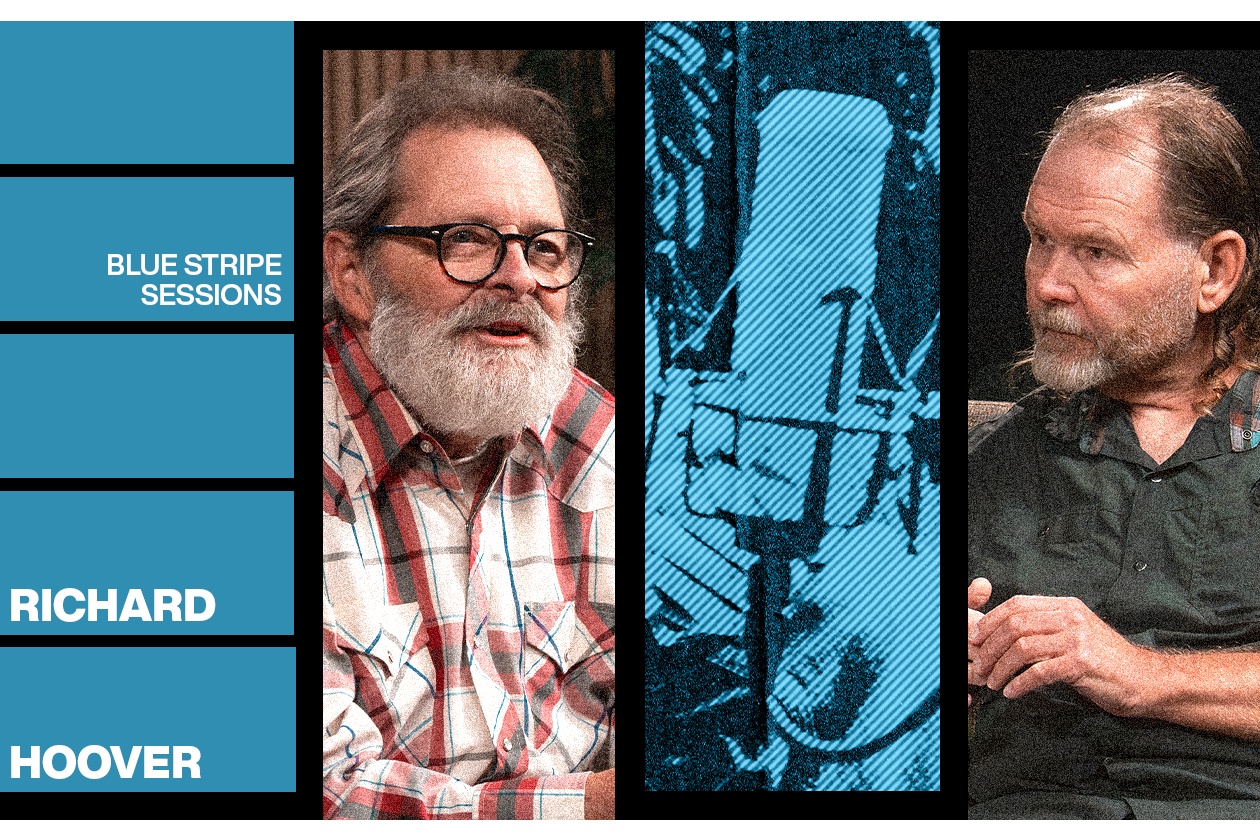
In a recent Blue Stripe Sessions conversation, Putnam sat down with Richard Hoover, founder of Santa Cruz Guitar Company. The subject was building things that last. A guitar maker and an audio equipment founder have plenty to discuss: materials, tradition, and the choices that shape how an instrument or tool responds to a player.
The series takes its name from the early blue-stripe version of his father’s 1176. Even the conversation format carries a piece of hardware history with it. Yet the topic reaches beyond collecting old objects. Both businesses depend on people making music with what they build.
On October 1, 2026, UA announced six Volt Gen 2 and Volt Max USB interfaces. The line brings together recording hardware, software, selectable preamp character, and, on the Max models, dynamics processing. Automatic gain features on selected models tackle the less romantic business of setting recording levels.
“Every artist has a sound they’re chasing,” Putnam said at the launch. It is a compact account of the customer he has in mind. The artist may be making a first recording or returning for another album. The equipment has to offer something useful at that moment.
The front-yard experiments and the desktop recording interface belong to the same long interest in getting sound to behave. Putnam has spent his career making that interest useful to musicians. Somewhere between the measurement and the song, he found work he wanted to keep doing.
Keep listening
Conversations, demonstrations, and more from Putnam’s world.