A box leaving Michigan has no opinion about geography. The person paying its freight bill does. In a seasonal fulfillment project described in 2023, Evans Distribution faced an awkward fact: a growing customer’s orders were spread across America, while Evans’ warehouses were concentrated around Detroit. More orders were good news. Sending them farther than necessary was becoming an expensive habit.
- Evans stores, packs, checks and moves goods for other businesses.
- Regional warehouse partners helped one customer cut freight spending.
- Its distinctive mix includes industrial logistics, ecommerce and customs work.
Consider the temptation here. A company with its own buildings, people and equipment has reasons to keep work close. But ownership can become a peculiar kind of blindfold. The practical question for a growing brand is whether its logistics partner can recognize when another location would serve it better.
01 / First, change the starting point.
Evans mapped shipments, compared freight costs from different origins and sought quotations. It chose Barrett Distribution Centers in New Jersey and States Logistics Services in Arizona. Evans reported first-year freight savings of $400,000, a 61% improvement in order-processing efficiency and a 20% reduction in delivery time. These are results from that customer project, rather than a forecast for the next customer.
Reported freight savings
The partner’s account adds an instructive detail. By the third season, States said the companies were still improving the flow and process. Coordination remained part of the job. A distributed network gives you more places to hold inventory, and more relationships to manage.
The copyable move is straightforward: draw the demand map before adding capacity. Then compare the total cost of serving it. For a small seller, splitting stock can create more replenishment work and leave the wrong item in the wrong building. The arithmetic depends on volume, destination and how reliably the operators exchange information.
02 / A warehouse learns new jobs.
Wellington Evans founded Central Detroit Warehouse in 1929. The archive shows men beside rail cars with hand trucks, doing the work a forklift would later make familiar. There is something clarifying about the photograph. Distribution begins with a physical obligation: somebody must get the goods from here to there.
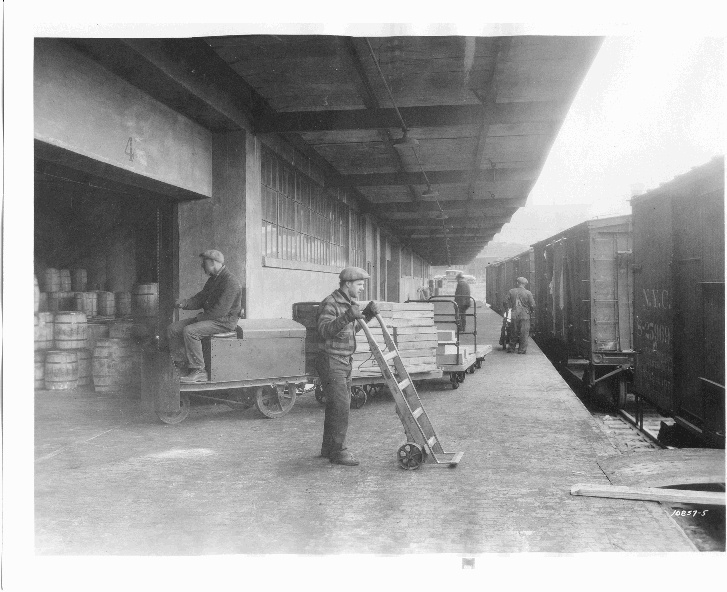
Over time, that obligation collected extra jobs. The company dates its value-added packaging work to 1976. Today it can kit components, label cartons, assemble products, inspect quality and rework goods. For a manufacturer or retailer, those are tasks that otherwise require people, equipment and supervision of its own.
Evans sells those capabilities alongside storage, fulfillment, transportation and staffing. A business can use a shared warehouse or a dedicated operation, then add the services its products require. The commercial arrangement starts with a quote for the project. Think of it as buying an operating capability: space is one ingredient.
For an online seller, the service continues after the sale. Evans processes returns, checks the condition of the goods, and can repair, repackage and return them to inventory. Its fulfillment operation handles categories ranging from beauty products to furniture and educational materials. That breadth changes the buying decision: a brand with unusual packaging or returns work can evaluate the actual tasks involved, rather than choose a provider solely by the price of sending a standard carton.
03 / Detroit does some of the work.
Location remains central to the proposition. Evans serves automotive, food and beverage, consumer goods, paper, chemical and renewable energy businesses. Its warehouse capabilities include rail access, hazardous-material handling, food-grade space and liquor licensing. A general-purpose ecommerce warehouse cannot be assumed to handle that entire list.
Its transportation business combines asset-based trucking with non-asset-based freight brokerage. That gives customers a way to connect warehouse activity with regional deliveries or a wider freight requirement. The service mix places Evans between a storage operator, an industrial logistics specialist and an order-fulfillment provider.
- 01ReceiveStore · track
- 02AdaptKit · inspect
- 03DeliverPick · transport
In June 2026, another use for the location arrived. U.S. Customs and Border Protection authorized a Container Freight Station inside Evans’ Melvindale facility. Evans allocated 51,200 square feet of bonded inspection space and 21 dock doors. A container selected for examination needs somewhere secure to be prepared; Evans offers that space alongside bonded drayage and container tracking.
04 / The camera needs practice.
Inside the warehouse, the technology story is pleasingly specific. Evans uses machine vision to classify package contents and compare them with the packing list. Its customer portal, evans365, exposes inventory, shipment and account information. Integrations connect the operation with shopping platforms and customers’ business systems.
The company invested in machine vision in 2019. In a January 2021 review, John A. Evans described the time and repetition needed to train the system. He reported a 32.7% output increase in 2020, alongside a new conveyor that allowed four lines to operate simultaneously. The measured improvement came with both software learning and physical changes to the line.
That is a more useful account of automation than a photograph of a camera. A tool has to learn the job, fit the process and leave enough room for the next step. Faster checking is only helpful if the surrounding operation can keep moving.
05 / Make the handoff somebody’s job.
Evans’ published operating system assigns an account manager responsibility for each customer and puts specific requirements into an operating manual. It calls for standards, monitoring and review. These sound like modest habits. They matter when one order passes through several teams, or several companies.
“It’s easier with Evans.”
The company tagline, shaped by customer interviews in 2003

The culture has a concrete example in Alexiz Perez-Padilla, whose company profile traces a move from stacking warehouse cartons to payroll and onboarding. His work included recruiting 24 associates for a demanding two-shift project. Labor availability belongs in the logistics plan as surely as shelf space does.
Evans’ appeal is strongest when a business needs several of these jobs to work together. The lesson for anyone selecting a partner is to inspect the handoffs: who owns the exception, who can see the inventory, and who changes the plan when the map stops making sense? A box travels through the arrangement you built around it.