A box of chocolates seems an unlikely place to discover a logistics company’s character. Yet consider the gift note. It has no useful weight, occupies almost no space and can ruin the delivery if it belongs to somebody else. A warehouse that sends the right chocolate to the right address has completed only part of the job. The small, apparently frivolous instructions are also the product.
- Evans handles storage, shipping, fulfillment, packaging and labor for businesses.
- Its Detroit-area operations serve manufacturers and consumer brands with very different handling requirements.
- The useful lesson: document the exceptions before trying to automate them.
The gift note is part of the shipment
In 2023, Detroit chocolatier Bon Bon Bon began working with Evans Distribution Systems. Growing demand had put pressure on a small internal shipping team. Evans used refrigerated storage, connected Shopify orders to its warehouse system and handled customized packing, including handwritten messages and selected tape designs. The January 2024 case study in Inbound Logistics reported faster order processing and greater capacity for large orders.
This is the business Evans inhabits: the gap between making something desirable and getting it to somebody intact. Its customers include automotive manufacturers and suppliers, importers, food businesses and online brands. Warehousing gives those companies somewhere to put inventory. Fulfillment turns that inventory into orders. Transportation moves it. Inspection, labeling and repacking make it suitable for the next recipient. Staffing supplies the people when the workload changes.
The combination matters because a shipment rarely respects departmental boundaries. A packaging requirement can alter labor needs; a late truck can alter the warehouse schedule. Buying these services together gives a customer fewer handoffs to coordinate. Whether that convenience justifies the bill depends on the actual operation.
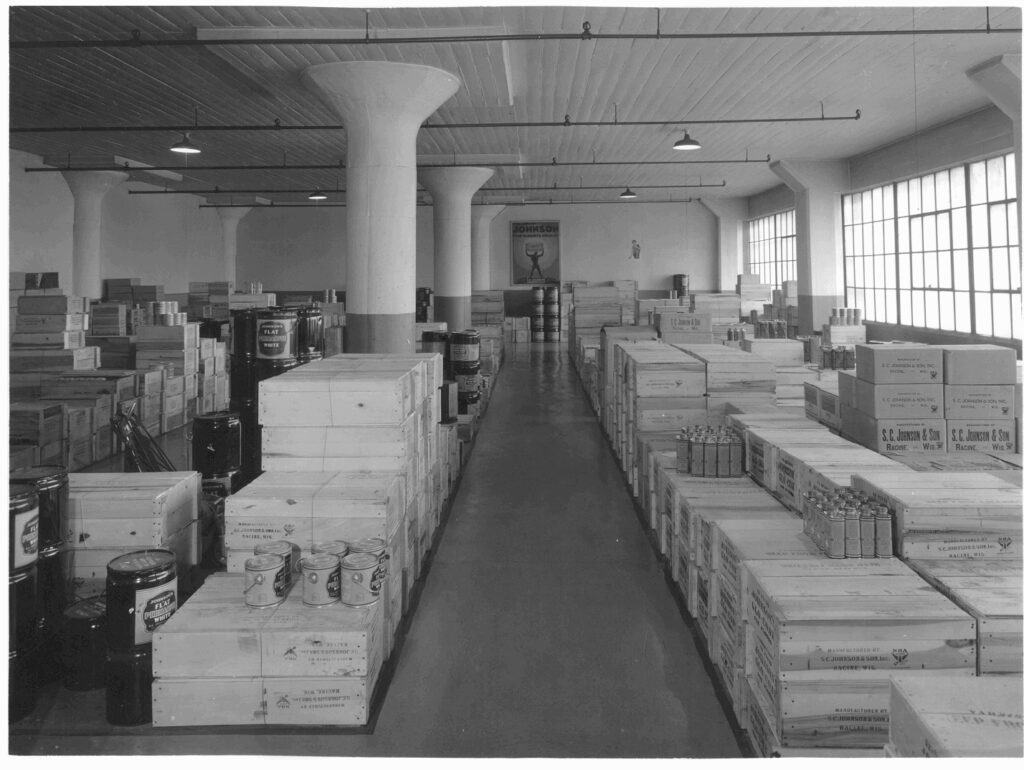
Evans began as Central Detroit Warehouse in 1929. Its early workers used push carts and dollies; trucking followed in 1930. Today, president and CEO John A. Evans represents the fourth generation of ownership. The continuity is interesting, but age alone is a poor purchasing argument. A customer needs to know whether yesterday’s institution can accommodate today’s inconvenient request.
The report that arrived too late
One answer emerged from a problem with Evans’s transportation software. In Trimble’s case study, transportation executive Tony Trocki identified the missing capability: real-time reporting. Managers needed information while they could still act on it. A report that describes yesterday perfectly may be remarkably unhelpful at this morning’s dispatch desk.
“With our prior system, we never had real-time reporting.”
Tony Trocki · Trimble’s Evans case study
Evans chose Trimble’s TMW.Suite. Its February 2025 announcement described route optimization, digital documents, customized reports and integrations with internal systems. By June, the company announced adoption across both its fleet operation and its brokerage. That distinction is consequential: the same customer can need a dependable regional truck one day and a different carrier arrangement the next.
- 01Capture requirements
- 02Store, pick, inspect
- 03Dispatch and deliver
- 04Report and review
Alden Logistics provides the regional asset-based service; Evans Logistics arranges freight through partner carriers. The customer portal, evans365, brings inventory and shipment information into view. This is operational software supporting a physical service business. Customers buy the movement and handling of goods, with visibility attached.
For a buyer, the cost question belongs at the beginning of the conversation. Evans sells through customized quotes. Ask for receiving, storage, packing, freight, returns and special handling to be itemized against your workload. Then compare the complete arrangement with your present operation. A cheap storage rate can be an expensive distraction if exceptions consume the savings.
A warehouse near the border
Geography supplies another reason to choose Evans. Its warehouses are concentrated in Southeast Michigan, close to Detroit’s manufacturing economy and international trade routes. A September 2026 announcement said nearly half its customer base was automotive-related. The same announcement reported nearly 500 associates and more than five million square feet of warehouse space.
Bonded space dedicated to container inspections at the Melvindale freight station.
In 2026, Evans added an authorized Container Freight Station at Melvindale. Import containers selected for further customs inspection can be routed to this secured operation. The facility combines inspection space, container tracking, security and bonded drayage. Here, proximity and procedural knowledge are part of what the customer purchases.
Evans also operates foreign-trade-zone storage. These services require a more careful conversation than ordinary pallet storage: the goods, customs status and intended movement matter. They suit customers with a relevant trade requirement. There is little virtue in buying complexity your shipment does not need.


Copy the paperwork before the machinery
The most portable part of Evans may be its published nine-point service system. Listen. Assign responsibility. Establish standards. Document requirements. Monitor results. Review the relationship. These sound like the instructions nobody reads until something goes wrong. Their value is in making customer knowledge survive beyond the employee who first heard it.
Its quality program adds corrective-action reporting, KPI reviews and training. The company describes a culture of staff development and recognition; those stated practices are more useful to examine than the family-business label alone. In 2003, customer interviews helped shape the promise now printed across its marketing: make the supply chain easier.
An account manager is the named point of responsibility in that system. Customer requirements go into an operating manual, which is updated as the work changes. Service and productivity standards are monitored together. This matters because speed without accuracy merely delivers the mistake sooner. The sensible purchasing exercise is to bring a provider examples of ordinary orders and troublesome ones, then ask how each will be handled. Include returns, seasonal peaks and changes in packaging. You are testing whether the service can accommodate your business as it actually behaves. The attractive presentation can wait; first establish who will notice a problem, who can fix it and how the correction reaches the next shift.
The alternative might be an internal warehouse team, a regional specialist or a larger contract-logistics provider. Compare them on the troublesome requirements: who handles a rejected shipment, who updates the instructions and who answers when inventory figures disagree? Evans’s pitch rests on coordinating several services and adapting the operation. That is a useful position in the market, provided the customer actually needs that coordination. For a straightforward shipment, a narrower service may be entirely sufficient.
For an operations team, the practical experiment is modest. Select one troublesome order, write down every exception, name its owner and agree on a measurable result. A Michigan warehouse will not suit every distribution network, and customization requires cooperation from the customer. But wherever the box travels, somebody must know what belongs inside. Including the note.