Every month, finance teams perform a small act of corporate archaeology. They dig through inboxes for invoices that have not arrived, interrogate Slack threads, compare vendor usage against contracts, and coax last month's spreadsheet into admitting what changed. Somewhere between what the business did and what the ledger says, an accountant supplies the connective tissue. Erin Kim has spent most of her career watching that tissue stretch.
Her company, Mesh, begins with a modestly radical premise: the logic should not have to live in one person's memory or twelve colored tabs. It can be captured, reviewed, corrected, and reused. The San Francisco startup builds AI workflows for reconciliation, accruals, and journal entries - the work that turns operational evidence into financial fact. The aim is not a chatbot wearing a green visor. It is a system an accountant can question and an auditor can follow.
This distinction matters to Kim because she learned finance before she built finance software. She started in Barclays' industrials investment-banking group, an environment famous for complicated models and uncomplicated deadlines. In an interview, she joked, “I kept trying to automate myself out of a job.” The joke doubles as a career thesis. Kim repeatedly moves toward the repetitive work, studies it until the pattern appears, then tries to give the pattern to software.
The useful detour
After Barclays, Kim joined Carta as one of its earliest finance hires. The position placed her inside a young fund-administration business, where capital calls, distributions, reporting, and close procedures had to become reliable at startup speed. She eventually crossed from doing the work into designing the product that supported it. That passage - operator to product leader - is the hinge in her story.
At Carta, Kim led a group of eight engineers and designers and helped the fund-accounting business grow from $20 million to $100 million in annual recurring revenue over three and a half years. The number is impressive, but the more revealing detail is how she describes the work: years spent optimizing close operations for more than 300 accountants. Growth was downstream of understanding where people clicked, copied, waited, checked, and worried.
Accounting software has an awkward relationship with reality. The rules are rigorous; the inputs are unruly. A contract changes halfway through a period. Usage lives in one system, approval in another, and the invoice arrives late. Traditional software handles the standard route beautifully. Businesses, with a certain genius for inconvenience, keep taking side streets.
“Accounting is the bridge between operational and financial outputs.”Erin Kim
Kim's product instinct is to treat those side streets as the map. Mesh now describes its work as a governance layer for financial logic: operational data enters; company-specific policies, AI steps, and human approvals are applied; explainable outputs emerge. The language is less glamorous than “autonomous CFO,” and more useful. Governance is what remains when the demo ends and somebody must sign the journal entry.
inboxes · systems · usage
human review
financial output
A co-founder trial run
Nandini Ramakrishnan was already part of the work. The two met at Carta and collaborated for years before Mesh existed. In 2022 they entered an internal hackathon with highLIT, a tool built for accountants to cite journal entries from operating agreements. Kim compares the idea to BamSEC, but tailored to the documentary burden of accounting. They won the hackathon and built a team around the project called Leverage Internal Tools, or LIT.
It was an unusually practical co-founder audition. They had a real user, an obstinate workflow, a deadline, and the daily test of whether they enjoyed solving hard problems together. Long before pitch decks and incorporation forms, there was evidence of pace and compatibility. Kim later called the hackathon a launchpad for their founder journey.
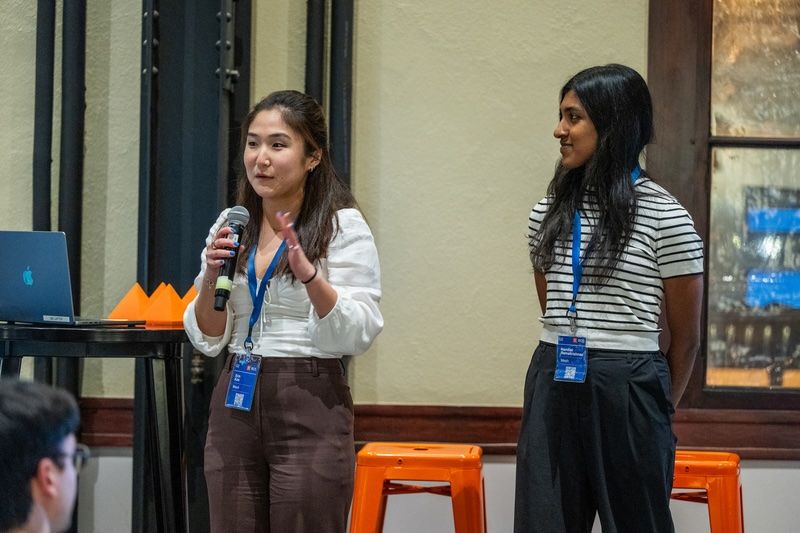
The personal ambition took longer to surface. Kim has written that she dreamed of building a company after watching her father launch one from the family living room. Still, she delayed, telling herself she needed more experience and financial security. In December 2024, she finally left her job to work on Mesh full-time. One month later, from inside Y Combinator's Winter 2025 batch, she described the choice without the usual founder varnish: the odds were poor, the work was not glamorous, and it was worth doing because she could choose which customer problems to solve each morning.
“No one has all the answers. But nothing gets you closer than truly listening to your customers.”Erin Kim, one month into full-time founding
The accountant in the loop
Mesh's early product mapped bank transactions against a customer's chart of accounts, flagged uncertainty, and prepared results for export to the general ledger. Kim described the approach as a first pass with human review: the system classifies, the user checks, and corrections become memory for the next round. Her stated target was more than 99 percent reconciliation accuracy. The final percentage matters, though the architecture around it matters more. A wrong answer should not arrive as an oracle's decree. It should expose the route by which it became wrong.
By 2025, the company had sharpened its opening around expense accruals. The reason came from conversations with controllers and CFOs who said the work remained stubbornly manual. Mesh pulls signals from AP inboxes, communication tools, procurement records, and historical journals, then organizes the evidence accountants use to estimate costs incurred before invoices appear. The product promises fewer chases and a close that can finish days earlier.
At New York's Finance and Accounting Technology conference, Mesh won the pitch competition. The team's field marketing was less solemn: hundreds of koozies appeared near coffee stations carrying the line “it's accrual world.” Accounting offers few natural openings for comedy. One should take them when they appear.
Software that remembers the reason
Kim is not asking accountants to admire artificial intelligence. She is asking whether it can carry context without erasing control. In a recent note about imperfect AI output, she advised users to stop fixating only on the answer and think like systems engineers: inspect the process, isolate the failure, correct it step by step. The advice has the unmistakable accent of an operator. A mistake is not absolution for returning to the spreadsheet; it is diagnostic material.
That posture also explains Mesh's broader ambition. The company talks about finance agents that work across systems, but it increasingly emphasizes policies, evaluation, audit trails, and governed approval boundaries. Foundation models are available to everyone. Institutional memory is not. If Mesh develops an advantage, it will come from encoding how companies decide, not merely generating faster guesses.
The destination Kim describes is a finance team with a different shape. A company might grow much longer before hiring a large in-house department; when it does hire, the finance professional could act less like a human data pipe and more like a systems controller, supervising agents and resolving exceptions. Kim has also pointed to agent identity and secure credential management as an underrated technical problem. A machine that can reconcile an account still needs carefully bounded permission to enter the account. The grand vision, in other words, depends on ungrand details: access, recall, precision, and the ability to explain yesterday's decision tomorrow.
Kim's community work offers another glimpse of the operator beneath the title. At Washington University, where she attended Olin on a four-year full-tuition scholarship, she worked with a student initiative consulting for small businesses in Ferguson and served as Director of Innovation for Olin Peer Ambassadors. She also volunteered with Let's Start, supporting formerly incarcerated women and their children. The record is consistent with the rest of her career: enter a system, attend to the people living inside it, and look for a practical way to reduce friction.
Mesh is still early. Its team is small, its category is busy, and financial software provides no mercy for novelty that cannot survive review. Yet Kim arrives with the kind of preparation that is difficult to counterfeit: six years close to the work, a co-founder relationship tested before the company, and a habit of regarding tedium as product research.
Month-end will never be romantic. That may be the opportunity. When financial logic becomes visible and reusable, the close can lose its ritual panic. The spreadsheet can return to being a tool instead of a shrine. And the accountant, released from another afternoon of chasing evidence, can spend more time on the work that required an accountant in the first place.