The most expensive line in accounting may be the one nobody enters into a ledger. It sits in a spreadsheet named “final_v4,” between a bank statement and a question no one has answered. Who made this deposit? Which fee belongs to it? Is the invoice evidence, or merely a promise? By the time a controller gets a clean number, someone has usually spent hours turning a pile of files into a story the books can believe.
The short version
- Truewind prepares bookkeeping, reconciliations and workpapers with AI, then routes the results to people for review.
- Its customers include accounting firms and in-house finance teams; Y Combinator lists more than 100 customers.
- It connects to QuickBooks Online and Sage Intacct rather than asking customers to replace their ledger.
- Truewind says its software absorbed 47% of month-end close tasks in customer workflows. That is a company-reported measure, not an industry benchmark.
This is the corner of finance that Truewind chose to inhabit. The San Francisco company calls its product a digital accountant. The name suggests a colleague who never sleeps; the practical version is software that ingests bank statements, invoices, payout reports and spreadsheets, then prepares transaction coding, reconciliations, schedules and journal-entry support. The accountant sees the proposal, the underlying material and the exceptions. The accountant decides what to approve.
It is a more specific proposition than “ask AI about your finances.” Truewind is trying to do the preparatory labor that keeps a monthly close from being a monthly surprise.
The awkward middle of accounting
Most modern companies already own accounting software. The trouble is what arrives around it. A payment processor has its own report. A bank has another. The payroll provider sends a file on a different schedule. A prepaid contract needs a monthly amortization schedule. A fixed asset needs depreciation. Every source can be correct on its own and still refuse to tie neatly to the general ledger.
Truewind’s Workpaper Agent begins in that awkward middle. A user uploads source documents and can define a standard operating procedure that the system reuses. The product prepares workpapers and journal-entry-ready outputs for QuickBooks Online or Sage Intacct. Its examples include prepaid expenses, fixed assets, bank and brokerage records, and custom workflows. The company says its sample-file processing usually takes under 15 minutes; the interesting measure for a real buyer is how much checking remains afterward.
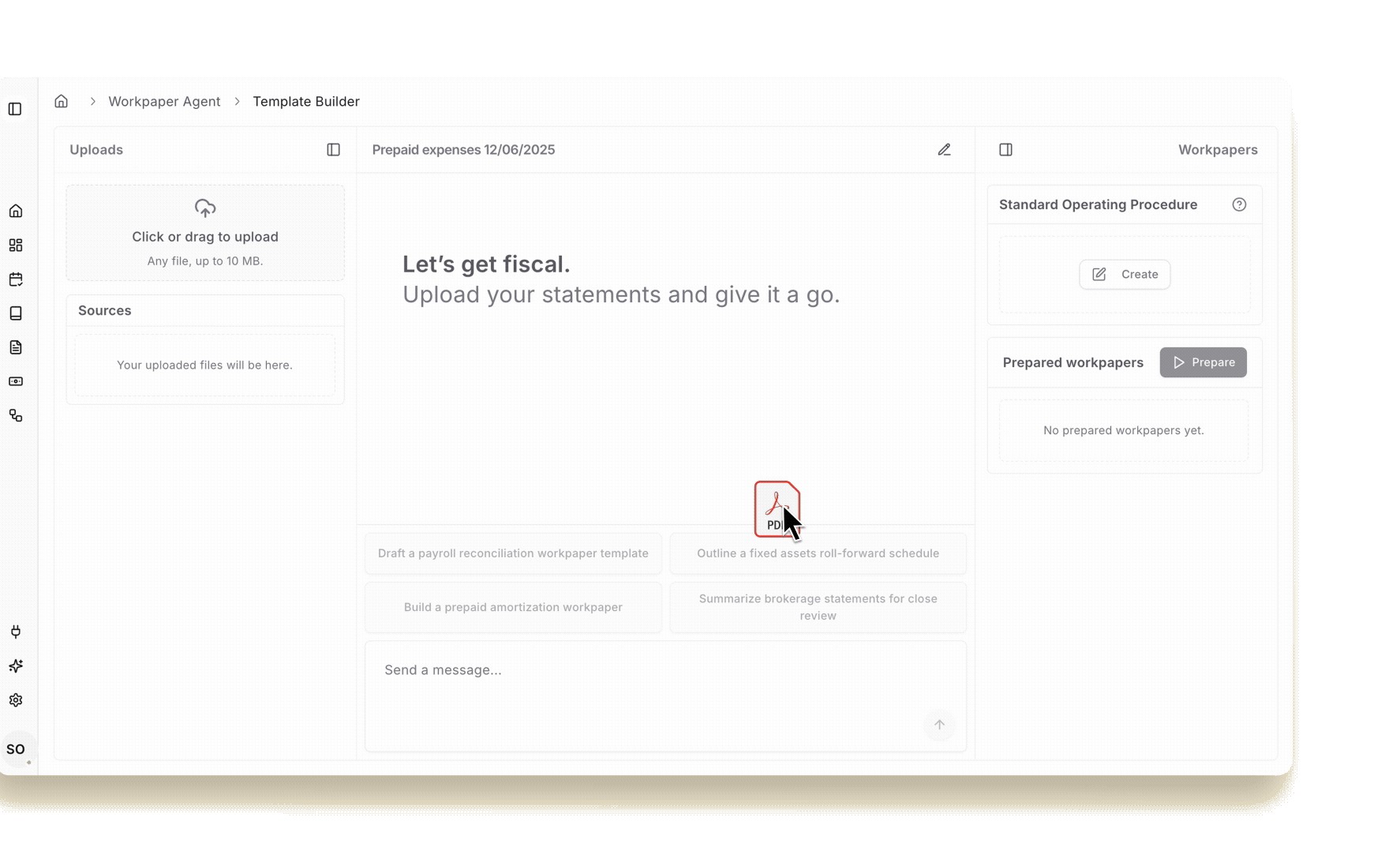
Statements, spreadsheets, invoices and payout reports arrive in their natural habitat.
Truewind applies rules, builds schedules and separates exceptions from routine work.
An accountant checks the support and approves the result for the existing ledger.
The design matters because the first failure in a slow close is often upstream. A beautifully organized checklist cannot reconcile a deposit whose source report is missing. A fast coding rule cannot explain a disputed transaction. Truewind’s emphasis on source files, reusable procedures and evidence is an attempt to make the work reviewable before the final entry reaches the books.
A firm opened its books to the builders
Truewind’s work with EisnerAmper offers a picture of how the product took shape. Rather than guessing at an accountant’s day from a conference stage, Truewind says its team sat in on the firm’s month-end close. They focused on senior-accountant workflows where hours were disappearing, then built and refined features with feedback from the people doing the work. That is a modest sounding method with an unusually large advantage: accountants are excellent at spotting a demo that ends one step before the hard part.
The company has also worked with Frank Rimerman and HHL Advisors. HHL partner Corbin Hanus says he encountered Truewind at AICPA Engage and decided to try it after seeing the team address bookkeeping problems in a way he had not seen before. He describes a measurable benefit in credit-card categorization. “On credit card transactions alone, I’d say Truewind has cut my categorization time by about 75%,” he says in Truewind’s customer material. It is a customer estimate for one task, not a promise for every firm. Even so, the distinction is useful. The machine can propose a first pass; the accountant spends more time on oddities, decisions and clients.
“On credit card transactions alone, I’d say Truewind has cut my categorization time by about 75%.”Corbin Hanus · HHL Advisors
For a firm, capacity is the commercial point. If the same team can close more clients without extending every evening in the first week of the month, the economics change. For an in-house controller, the prize is different: more predictable reporting and fewer mysteries waiting at the end of the period. The two buyers share a distaste for stray spreadsheets, but they do not buy for exactly the same reason.
A $13 million wager on the paperwork
Truewind was founded in November 2022 by Alex Lee and Tennison Chan, according to the company’s own account. It joined Y Combinator’s Winter 2023 batch and announced a $3 million seed round that year. Thomson Reuters Ventures added funding and a strategic partnership in early 2024. That December, Rho Capital and Thomson Reuters Ventures co-led a $13 million Series A, bringing the company-reported total to more than $17 million.
Truewind said its product absorbed 47% of month-end close tasks in customer workflows by December 2024. The figure describes those deployments, not a universal automation rate.
The investor list helps explain the market Truewind is courting. Thomson Reuters brings accounting-industry reach; the product is aimed at firms and finance departments that must defend their numbers to colleagues, clients and auditors. Truewind reported fourfold revenue growth in the year before its Series A, though it has not published a revenue total. Its public pricing is also custom: buyers book a demo and receive a quote shaped by their systems, workflows and close complexity. Anyone assessing cost has to ask for a scope, not scan a price grid.
The company now presents itself as an automation layer over existing accounting systems. It joined the Sage Intacct Marketplace Partner Program in 2025 and lists a QuickBooks Online integration through Intuit’s partner program. This keeps the ledger as the system of record. It also puts Truewind in a crowded neighborhood of close-management and accounting automation products, including Numeric, FloQast, BlackLine, Basis, Botkeeper and Docyt. Its sharper claim is that it starts earlier, when the evidence is still a PDF, a bank feed or an unruly workbook.
What a buyer should test
A good trial begins with a real close problem. Pick a recurring reconciliation that absorbs a senior accountant’s time. Give Truewind the ordinary source files, including the ugly ones. Ask it to produce the workpaper, show where each number came from, flag uncertain matches and prepare an entry for review. Then time the entire cycle, including correction and sign-off. Counting only the seconds an AI needs to generate a draft would be a charming way to miss the point.
The same test reveals when this approach may struggle. Missing source records, inconsistent account mappings or a stale ledger can make reconciliation slower, as Truewind’s own support guidance acknowledges. Its bank transaction workflow, for example, requires a matching amount before a ledger transaction can be selected. A team with no defined review owner or little appetite for standardizing recurring procedures will have fewer gains to compound. The software can prepare evidence; it cannot invent a trustworthy source document.
Truewind’s most persuasive idea is also its least theatrical one. Accounting judgment is valuable because it can be explained. If an AI colleague is to earn a place at the close, it must do more than return an answer. It must arrive with its workings, the exception that worries it and a place for a person to say yes. That sounds less like science fiction than a well-prepared accountant. Which, for this market, may be the compliment that counts.