The machine that changed Erik Nieves’s life was standing around doing nothing. He, on the other hand, was holding an 11-pound grinder at chin height, smoothing welds on cement mixer drums. It was a college summer job in Minnesota, with rather more metalwork than romance. When the foreman came by with a question about computers, Nieves had a compelling reason to sound interested.
The factory owned an industrial welding robot that nobody could get running. Nieves took the manual and worked through the instructions. Soon the robot was welding, and he could load the parts, press a green button and read while it worked. The reward for mastering automation included intervals of sitting down. For a student earning his way through college, this was a persuasive demonstration.
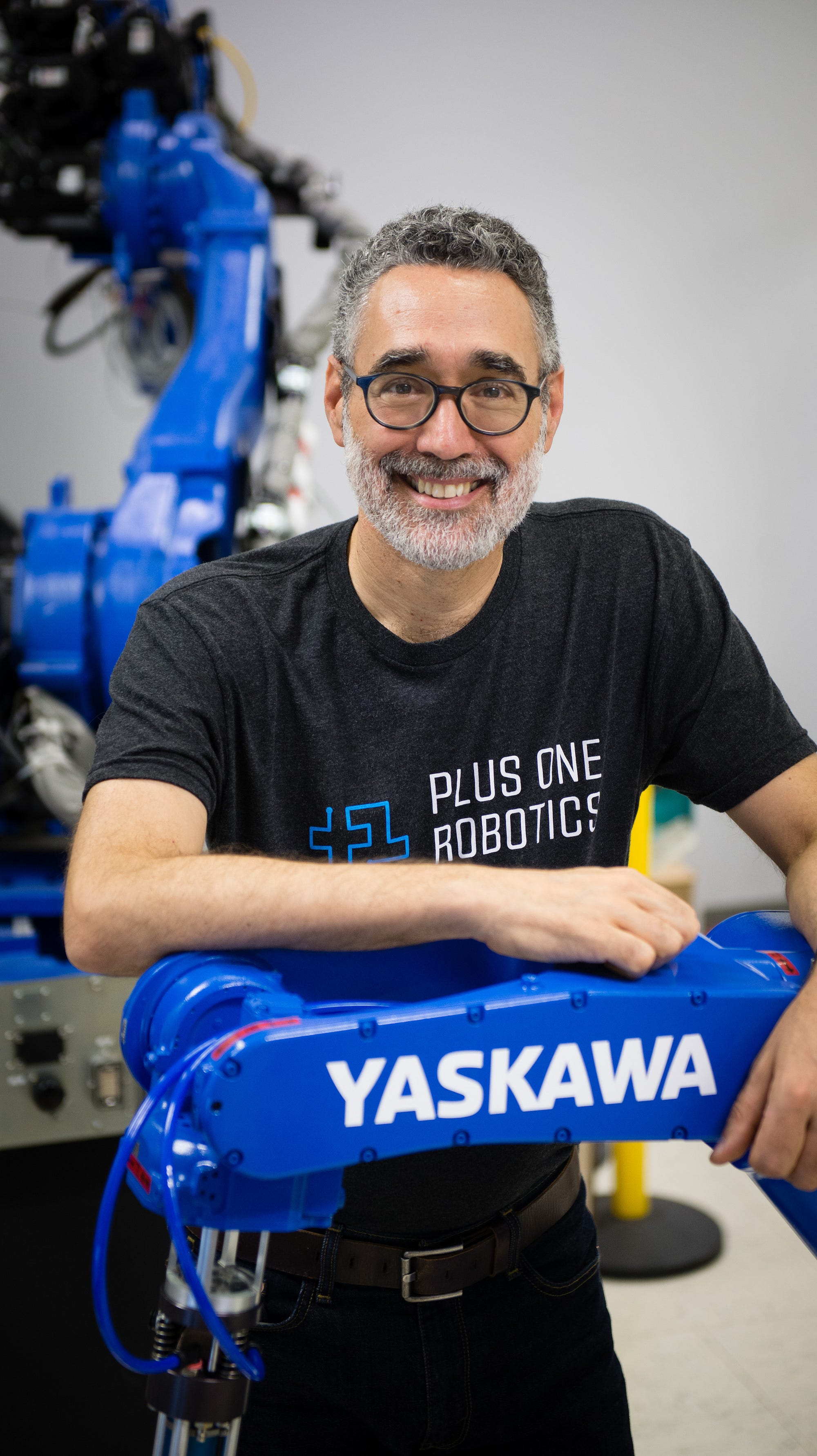
After graduation, he installed another welding system for the factory, then joined the company that supplied it. The summer detour became his profession. Today, as CEO and co-founder of San Antonio’s Plus One Robotics, he builds a business around a question he first encountered beside that idle machine: what does it take to make a robot useful to the person who actually has to work with it?
Before the warehouse, there was space
As a boy, Nieves wanted to be an aeronautical engineer. His family’s World Book Encyclopedia was a prized possession; the volume containing space tended to migrate to his bedroom. He knew the career had something to do with aircraft and spacecraft, which was enough to recommend it. The family moved to Texas in August 1982, and he attended Judson High School.
At Southwestern Adventist University, where he studied from 1986 to 1990, his interests included astronomy and infrared spectroscopy. He graduated with a bachelor’s degree in mathematical physics. During his final college year he also taught high-school physics, an experience he enjoyed enough to remember teaching as his alternative career.
San Antonio also remained a destination rather than simply a place he had left. While still at Yaskawa, Nieves wanted to move back near family. Toyota’s arrival created an opening: its operation would use the robot technology he knew. He volunteered for that work and returned in 2005, spending several years managing robots at the complex. The city that later became Plus One’s base had already given him a way to combine an industrial career with a reason to come home.
Robotics offered its own education. Over a long career, Nieves got to look inside unfamiliar manufacturing processes, from cutting to assembly. He has described the attraction as a succession of visits to see how things are made. There was even a connection to his childhood interest: work supporting NASA’s satellite-servicing ambitions. The factory floor had proved an unexpectedly good route toward space.
A quarter-century, then a different pile of problems
Nieves spent 25 years at Yaskawa Motoman Robotics. He began by training other people, helped establish a subsidiary in Mexico and eventually became technology director for North America. His responsibility grew to include finding new applications for industrial robots. He had moved from persuading one reluctant machine to work to deciding where a whole industry might go next.
The automotive business made that question urgent. In the aftermath of its downturn, Nieves spent 18 months mapping robotics development across the United States, Canada and Mexico. He kept encountering ROS, the open-source Robot Operating System. Research groups were using shared software to attempt things that conventional industrial automation made difficult.
In San Antonio, the work brought him together with Southwest Research Institute researchers Shaun Edwards and Paul Hvass. Their collaboration through ROS-Industrial preceded their company. Edwards developed software; Hvass helped build the consortium and its community; Nieves brought the perspective of an industrial robot manufacturer. Before they shared a startup, they had already practised working together on a common problem.
The arm was ready. The eyes needed work.
Plus One Robotics was founded in 2016. Its opportunity lay in the awkward contrast between a production line and a warehouse. A factory robot can repeat a movement with extraordinary consistency when the work arrives as expected. A heap of parcels is much less courteous. Bags fold, boxes overlap and the next object may bear little resemblance to the last one.
Nieves focused on perception: enabling a machine to interpret the scene before it reaches. The company’s name could suggest a business manufacturing robot arms, but its early distinction was software that helped existing hardware see and handle a changing assortment of objects. The clutter was the assignment. Making every parcel identical would have been a convenient solution, had anyone consulted the parcels.
The progression was practical. PickOne version 1.0 arrived in 2018. Yonder, its system for remote human assistance, was deployed in 2019. Robots using the company’s technology reached FedEx’s Memphis hub in 2020, followed by its first European Union deployments in 2021. Each step took the founders’ research further into places where packages had to keep moving.
the parcel pile.
goes to a Crew Chief.
The work resumes.
There is a person in the company name
“The ‘PlusOne’ is a person.” Nieves’s explanation gets to the company’s operating idea with admirable economy. When the software encounters a scene it cannot interpret confidently, a remote operator can see what the robot sees and guide the pick. The role has a name, Crew Chief, which sounds considerably more useful than waiting for a machine to become philosophical about a plastic bag.
This arrangement is called supervised autonomy. PickOne handles perception and picking; Yonder provides the route to human help. An operator can supervise multiple robots, stepping in for exceptions rather than continuously directing every movement. The intervention can also supply labelled information for the learning system, giving an unusual case a chance to become a more familiar one.
Scale Venture Partners led the company’s $50 million Series C financing in 2023. Its investment argument included precisely this human assistance: a way to keep customers’ work moving while improving the company’s data. For Nieves, leaving a person in the process was part of the product’s design from the beginning. The business had made room for the moment when the software needed a second opinion.
“The ‘PlusOne’ is a person.”
Erik Nieves
A billion is a milestone. Tomorrow is another shift.
In February 2024, Plus One crossed one billion picks. In April 2026, it announced that the cumulative total had passed two billion across its global fleet of parcel-induction and depalletizing robots. The company tied the announcement to its tenth anniversary. These are counts of completed handling operations, accumulated across deployed systems, rather than a claim that a single machine has become capable of every job.
Nieves’s public writing has meanwhile become increasingly concerned with proof. In a June 2026 essay, he urged the industry to be judged by sustained performance in customers’ buildings. His questions concern uptime, repair time, changing stock and conditions over a full peak season. Anyone can admire a neat demonstration. The warehouse has an entire shift to fill.
That insistence gives his career a useful continuity. The student with the manual needed a machine that would run. The executive now asks whether systems will keep running across unfamiliar sites and less accommodating conditions. A total pick count records past work. A customer signing up for automation is also buying an expectation about the next delivery of awkwardly packaged goods.
The physics teacher is still in the room
Nieves describes himself as a human exceptionalist. He serves on the board of the Association for Advancing Automation, and his involvement with education gives that outlook a local setting. His work with San Antonio’s CAST STEM has included talks, mentoring and welcoming high-school interns into Plus One’s lab. People get better at technical work by being allowed to do some.
He has spoken warmly about how those interns handled real assignments. The experience connects the college student learning from a robot manual with an employer giving younger people a chance at practical engineering. There is a small, satisfying reversal here: the person who once needed a foreman to point out an opportunity can now help provide one.
His stated approach to resources also carries the imprint of the workshop. He argues that constraints can prompt better engineering decisions, because limited means force people to get creative. It is a recognisable philosophy for a company whose name includes an extra person and whose origin includes a machine already sitting in somebody else’s factory. Useful things do not always require starting with a clean sheet.
What happens on the robot’s worst day?
By October 2026, humanoid robots and foundation models had supplied the industry with fresh reasons for excitement. Nieves welcomed advances in software while drawing a distinction that experience had taught him to watch: a system can become quicker to program without becoming physically faster at its task. Better tools can shorten deployment; equipment and process still set limits on output.
He expects purpose-built industrial automation to retain an advantage in high-volume, clearly defined work. More adaptable machines may find their place where the assortment of tasks changes and volumes are lower. His outlook leaves room for both. It also leaves room for supervisors, even as the number of machines each person can oversee increases.
“Robots work, People rule” is the phrase he returns to. His test is what happens when an unfamiliar situation arrives and the machine has its worst day. Can the customer trust the response? The question is less theatrical than a robot strolling across a stage. It is also closer to the original appeal of that welding machine: the work gets done, and a person gets a little more freedom about what to do next.