Eric Wu was back in his dad’s Volvo, carrying frozen dumplings in a cooler. He had already co-founded Gainful, taken it through Y Combinator and spent years building a consumer business. Now he was visiting independent grocery stores around the Bay Area, asking buyers to make room for another product. A second company had given him a familiar job: persuade someone to take a chance.
The dumplings belonged to Sobo Foods, which Wu founded with food scientist Adam Yee. Early on, the business was small enough for Wu to visit its stores personally. He could ask how sales were going, arrange a tasting and turn up again. In an industry fond of discussing distribution, he was doing quite a lot of driving. The product had changed, and so had the route to a customer. The useful conversation now happened beside a freezer.
His first company had sold products suited to online subscriptions. His next required freezers. Wu understood the inconvenience perfectly well. Asked why he had chosen this route, he offered a short explanation: “One, we’re masochistic.” The joke came with a serious attachment to the food itself.
A basement, a friend, a different kind of job
At Georgetown, Wu was surrounded by classmates considering consulting and banking. He wanted to try entrepreneurship. His studies offered a clue to where that interest might lead: he graduated from the School of Foreign Service in 2017, with a focus in Science, Technology and International Affairs.
His early experience ranged across distinctly different organizations. He worked in digital marketing at consumer-hardware company Hatch, completed a fellowship with True Ventures and served as chief operating officer of the Hilltop Microfinance Initiative. The Washington nonprofit worked with low-income and immigrant entrepreneurs. Before he had a company of his own, he had encountered both venture capital and the smaller businesses that rarely feature in its announcements.
Gainful began with a product he was making for himself. Wu experimented with protein powders in his college apartment basement; his high school friend Jahaan Ansari helped turn those experiments into something customers could order. Their respective contributions were concrete. Wu worked on formulations. Ansari built the algorithm and website. The company dates to 2017.
In Winter 2018, Gainful joined Y Combinator. A college project had acquired the obligations of a company: customers expecting deliveries, investors expecting progress and a growing list of jobs the founders needed to learn. The accelerator’s calendar gave the partnership a new setting. It also put a deadline on the distance between an interesting idea and a functioning business.
The captaincy footnote
Wu and Ansari’s friendship came with an attractive origin story. They had played soccer together growing up, and were often described as co-captains of their high school team. Wu eventually supplied the footnote: Ansari captained varsity, while Wu had captained the freshman team. “I was only captain of our freshman team.” He could have left the cleaner version alone.
It is a useful detail because the partnership had more substance than the anecdote needed. They knew each other before fundraising made their friendship a business arrangement. One brought the initial experiment; the other helped build the machinery around it. They also shared the less photogenic work. In Gainful’s early days, the founders handled manufacturing and shipping themselves.
Wu led Gainful as CEO from 2017 until 2020, then became COO. The distinction matters in a career easily compressed into the single word founder. Building the company meant changing his job within it. By 2021, the basement experiment was a business with an eight-figure annual revenue history and Wu was working as its chief operating officer.
Wu and Ansari were included in Forbes’ 2023 Food & Drink 30 Under 30 list. By that point, Gainful had recorded more than three million completed customer quizzes and over 850,000 orders. Those figures describe the scale their original collaboration reached. They also help explain why Wu’s return to making store visits for a new brand is such an appealing turn in the story.
An introduction with industrial equipment
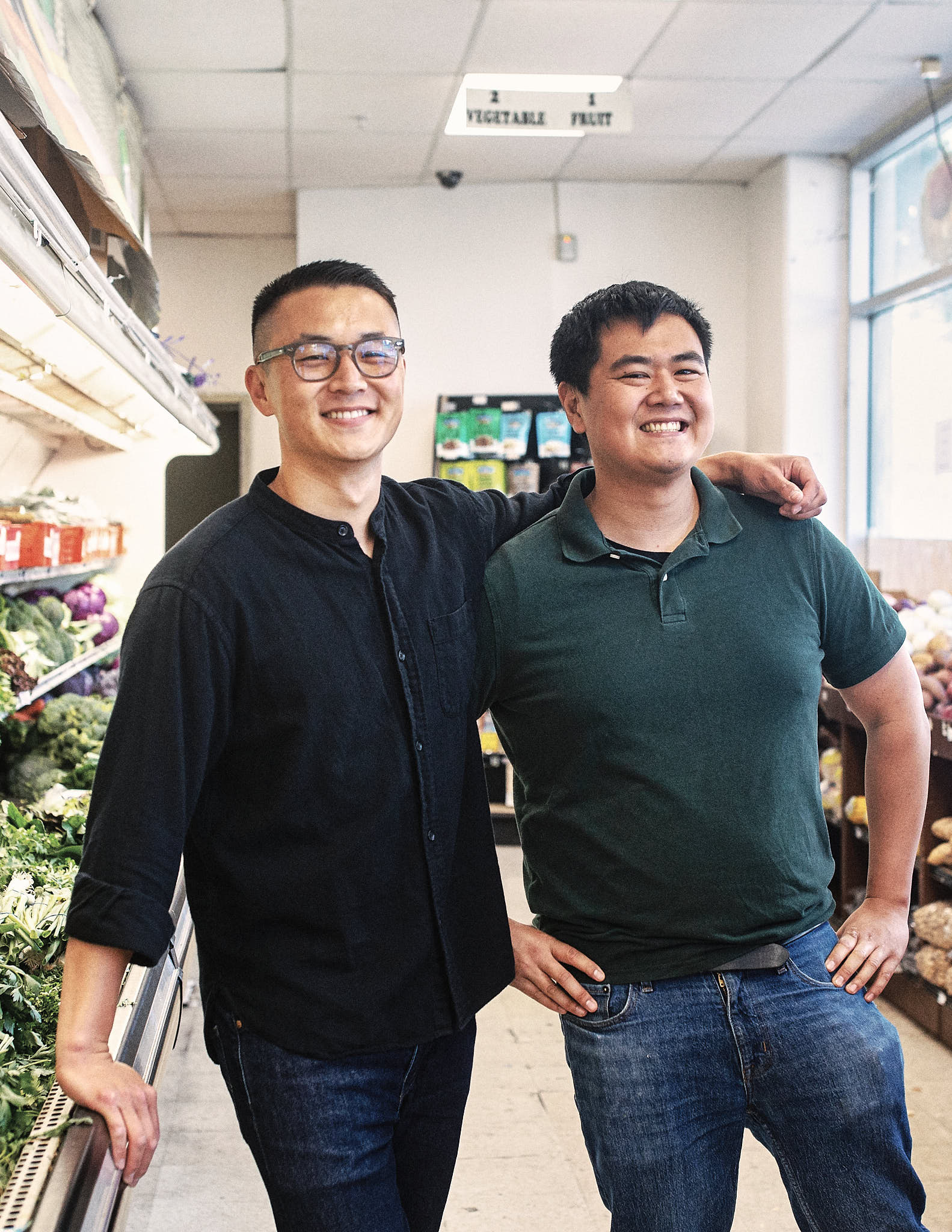
The connection to Yee began through KitchenTown, the food-business hub in San Mateo. Gainful and Yee’s earlier company, The Better Meat Co., had both worked there. Yee was looking for equipment to blend ingredients, something Wu’s company also used. It was a practical introduction, involving the sort of machine few people would think to include in a networking strategy.
They stayed in touch. When Wu decided to pursue another venture in 2022, the conversation resumed. Yee brought food-science and product-development experience. Wu brought his experience building a consumer brand. Both were Chinese American children of immigrants, interested in making products connected to the foods they had grown up with.
Sobo emerged publicly in May 2023 with $1 million in funding and three frozen dumpling varieties. Its early work centered on the Bay Area, including local events and food festivals. Wu was moving from New York to Oakland. The change in geography put him close to the community where he wanted to begin selling the food.
A childhood, folded into the product
The original flavors took several routes through Asian American home cooking: a Chinese-inspired pork-and-chive alternative, Japanese curry potato, and a kimchi-and-mushroom variety. All three were plant-based. Curry potato carried a particular connection for Wu, whose mother made Japanese curry as a familiar weeknight meal. A flavor did not need a long history inside a dumpling to earn a place in theirs.
Wu describes a childhood in which food occupied an unusually large share of family attention. His father entered local cooking competitions. His mother gardened and later had a food Instagram account that he helped manage. Dumpling-making meant relatives gathered around a table, talking while they worked. Away at college, even supermarket dumplings could summon home.
That history gave Sobo a point of view before it had much distribution. Wu wanted the brand to express an Asian American experience recognizable to people who grew up between cultures. The combinations were the foods he and Yee loved, made into something they could share. There is room in that brief for both recollection and invention.
“These dumplings are a love letter to my childhood.”
Eric Ji Sun Wu, on Sobo’s 2026 additions
The freezer changes the arithmetic
Wu had gone from a shelf-stable, direct-to-consumer product to something that could not spend an afternoon sitting around. He knew that frozen food would require a different approach. Sobo’s early plan emphasized learning locally before expanding, giving the founders time to see who bought the products and why.
The early retail push involved roughly two dozen Bay Area stores. Wu could reach them himself, speak with their owners and organize sampling. A store owner’s enthusiasm eventually helped attract a distributor’s attention. It is a small but revealing reversal of the usual pitch: someone who was already selling the dumplings wanted an easier way to get more.
The business interests also reached back to his education. At Georgetown, Professor Mark Giordano’s course, The Future of Food, had made a lasting impression. Wu had focused his studies on food sustainability and still credited the class years after graduating. His interests were broader than any single product. Frozen dumplings gave those interests a specific assignment, complete with manufacturing schedules and delivery runs.
- Make itDevelop the food with a specialist partner.
- Show upVisit local stores and serve samples.
- ListenLearn from buyers and people tasting it.
- ReturnBuild relationships before expanding.
The founders’ described launch approach, rather than a sales forecast.
A company is also a promise to people
The transition away from Gainful’s daily operations was announced in October 2022. Wu continued to describe himself as a board member and advisor in later interviews. Leaving the operating role did not erase the relationships: Gainful colleagues were among the people supporting Sobo. Starting again could involve bringing earlier connections along.
Wu’s reflections on running a company often return to colleagues. He has described the satisfaction of recruiting people whose abilities he admires, and the difficulty of having to let employees go after persuading them to join. The attraction and the responsibility arrive together. Someone else has agreed to spend part of their life working on your idea.
His working habits offer a smaller portrait. He likes a tidy desk and a decidedly untidy amount of screen space: a 40-inch curved monitor. Soccer remains a place where he can concentrate on the play in front of him. He has also said that dumplings follow him into his dreams. The product-development meeting, apparently, sometimes continues overnight.
The next box on the shelf
By February 2026, Sobo had announced a meaningful change to its original range. General Tso’s Chicken and Korean BBQ Pork dumplings were its first move beyond plant-based products. The company also announced a transition from pouches to boxes, with easier retail merchandising among the reasons. The new flavors were arriving at West Coast retailers.
Sobo was available across California, Hawaii, Texas, Oregon and Washington. That is a different footprint from the handful of nearby stores Wu could visit in a day. The company he began with Yee was developing beyond its first ingredients, first packaging and first routes. Its new product names still carried the reference points of Asian American food.
For Wu, starting over meant putting an accumulated education to work on something close to home. There were the lessons from Gainful, the class at Georgetown, the KitchenTown connection and the meals he remembered. Then came the buyers, the samples and the deliveries. The next company began with plenty of experience behind it. There were still dumplings to get into the car.