Forty-seven products. Five months. When Hyungseok “Dino” Ha described developing Kaja with Sephora, the numbers offered a compact introduction to his working life. There was a collection to make, a customer to understand and apparently little appetite for taking the scenic route. The collection arrived in 2018. Its founder had been rehearsing changes of direction for years.
Ha’s route into beauty passed through environmental engineering, the Army, New York fashion and Korean e-commerce. Each move required him to become a beginner again. Eventually he co-founded Memebox, a company whose early proposition could fit inside a parcel: pay for a selection of beauty samples, open the box, find something you like.
The company now operates as MBX, with brands including nooni, Kaja, I DEW CARE, i’m meme and PONY EFFECT. It makes products, builds audiences and works with retailers across markets. Following Ha through those changes reveals a practical question that has occupied much of his career: how do you help someone try something unfamiliar? A cardboard box was one answer. It was unlikely to remain the only one.
Kaja’s development sprint with Sephora, as Ha described it in 2019.
A first American friend, then New York
At Kyung Hee University in South Korea, Ha studied environmental engineering. During his Army service, he volunteered for deployment to Afghanistan. There, working alongside coalition forces, he made his first American friend. The encounter helped inspire a move to the United States. His next classroom would have rather different equipment.
He went to New York and attended Parsons School of Design. Fashion offered a new direction, and Tom Ford’s emerging business gave him a place to work inside it. He spent two years in public relations and marketing. A young brand gives its staff an unusually close view of how an identity gets assembled: the product, the presentation, the people who see it and the impression they carry away.
Ha later returned to South Korea to join TMON in 2011. Friends had founded the e-commerce startup; he worked on new businesses and sales. The experience made entrepreneurship feel concrete. He had seen the attention a fashion brand could command. Now he could watch a digital commerce business grow. Memebox would bring those interests into the same room.
The telephone was the first growth tool
Memebox officially launched in February 2012. Before the polished pitch came the unglamorous business of finding companies willing to participate. The founding team called beauty brands through customer-service numbers, then hunted for more useful contacts in website terms and conditions. An entrepreneur can learn a surprising amount from the small print.
Ha had interned at eight companies while studying, eventually joining Tom Ford’s staff. His errands included delivering clothes to Brad Pitt. Memebox later employed roughly as many interns as full-time staff. Learning close to the work remained part of the company’s early life.
The pace came with mistakes. Mobile payments could leave Memebox waiting three months for cash to arrive, an awkward interval for a growing business. Ha acknowledged the errors while continuing to favor quick decisions. When asked whether wealth and privileged connections had smoothed his way, he answered, “I wish I had that.” It is a useful pin to put in the more glamorous version of the founder story.
Palo Alto came with an office joke
By early 2014, Ha was working in Palo Alto. Memebox joined Y Combinator’s Winter 2014 batch, becoming the first Korean company accepted into the accelerator. Its American operation was still young, but the company was already thinking about the next market.
There was a revealing piece of office decoration: staff had combined Ha’s face with an image of Che Guevara. The joke concerned his relentless working schedule. Around him, Silicon Valley engineers were putting in long hours, and he described feeling compelled to compete with their intensity. A beauty company had arrived among the software companies, and its chief executive was taking the neighborhood seriously.
Customers could receive a curated box and then visit Memebox’s online shop to buy more. By that spring, the shop was already bringing in more revenue than the delivery service. Even while the box remained the company’s public calling card, the business behind it was changing. The name on the door was becoming a slightly unreliable guide to what happened inside.
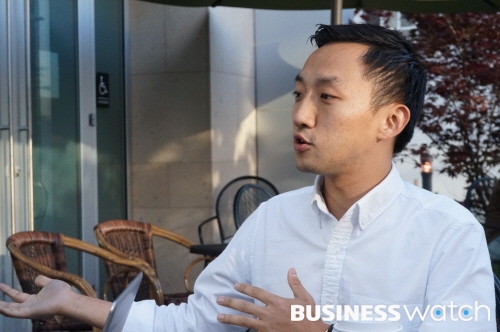
Photo: Business Watch
A global company costs more than a plane ticket
SparkLabs had accepted Memebox into its first accelerator batch in November 2012. The program’s ambition to help Korean startups expand internationally fitted Ha’s own. He would later credit its early backing with helping the company believe a global business was possible. Confidence, in this case, had people and an institution behind it.
Going abroad also brought complications. In 2019, Ha described the extra management, financial and communication costs of operating across countries. Staying in Korea, he believed, could have produced faster growth at that stage. He nevertheless valued what the American operation had taught the company, particularly through experienced recruits and the networks they brought.
He was willing to put a long clock on that trade, measuring returns over fifteen to twenty years. A founder known for speed was asking for patience. The distinction makes sense: a decision can happen quickly while its consequences take years to mature. Ha wanted the company to acquire capabilities that would outlast an early burst of sales.
“You have to think in terms of returns and success more in a 15 to 20-year timeframe.”Hyungseok “Dino” Ha · 2019
The customer gets a vote in the design
The shift from selling other companies’ products to developing brands brought Ha closer to a difficult detail: an item made for one market may need substantial changes to work in another. Language is only part of the job. Packaging, preferences and the setting in which someone shops all influence whether an unfamiliar product gets a chance.
Kaja gave those considerations a physical form. Co-developed with Sephora, it launched with products for complexion, eyes and lips. The range included broader shade choices for different skin tones. The partnership put a retailer’s knowledge of American customers alongside Memebox’s Korean product development. The collection had to make sense in the hands of the person buying it.
The launch prices ran from $14 to $24. Small formats, tactile formulas and playful packaging made experimentation part of the proposition. Kaja means “let’s go” in Korean, an appropriately brief instruction for a company that had already covered considerable ground. The invitation was to pick something up and try it, without needing a lecture first.
- Curated boxesTry unfamiliar products
- Online commerceReturn to buy favorites
- Owned brandsDesign for the customer
Sometimes the route to makeup begins with a song
In 2019, Kaja partnered with K-pop group (G)I-DLE. The collaboration included the group’s San Francisco adventures, a visit to Kaja’s headquarters and a stop at Sephora. Products appeared within a wider entertainment experience. Ha was interested in the possibility that someone might discover the music before becoming curious about the makeup.
That approach fits a career spent around presentation and commerce. A shopper can arrive through an artist, a tutorial or a recommendation. The business has to meet that curiosity somewhere useful. Memebox’s brands allowed it to shape both the product and the circumstances in which people encountered it.
By September 2026, a different sort of performance was attracting attention: Kaja’s Beauty Bento packaging clicking shut. An ASMR creator partnership prompted viewers to request a video with ten Bentos closing together. The follow-up grew from that request. MBX reported more than 7.6 million views across the two videos. The audience had effectively handed the brand its next brief. Sometimes market research has a percussion section.
Fourteen years later, a narrower focus
Ha’s 2026 updates describe a business concentrating on recognizable hero products. In July, he reported that a group of core items accounted for more than 60 percent of revenue. Among them were nooni Lip Oil, Kaja Beauty Bento and i’m meme Multi Stick products. The company was putting more weight behind things customers already knew how to ask for.
He also reported second-quarter revenue growth of more than 50 percent against both the previous year and the previous quarter, alongside its first double-digit EBITDA margin. His stated plan was to reinvest in product development, marketing and international sales. The brisk early experiments had given way to a more selective allocation of attention.
The ambitions remain large. In a May 2026 keynote, Ha set out nooni Lip Oil sales targets of 15 million units in 2026, 35 million in 2027 and 100 million in 2028. Those figures describe a plan. They also show how far the company’s operating questions have traveled from finding enough samples to fill its first parcels.
A familiar shelf, another beginning
In September 2026, Kaja entered Target’s Beauty Studio with a selection of 40 products. Ha described the opportunity as reaching shoppers through a retailer they already knew and trusted. For a founder who began by introducing unfamiliar beauty labels through the mail, the appeal is easy to understand. A familiar store can make an unfamiliar product feel approachable.
The October MBX & Dino newsletter reported Kaja in 611 Target stores and nooni’s arrival on Olive Young’s U.S. online store on September 28. Europe was the company’s priority for new distribution partnerships, with other opportunities being explored in the Middle East, India and Southeast Asia. Ha was still looking for the next point of entry.
Asked in 2026 what he would tell his younger self, Ha said he would spend more time enjoying the process of building the company. “Building a global consumer brand is never linear,” he observed. That admission suits a career with this many turns. The work has taken him from engineering to fashion, from telephone calls to retail shelves. Somewhere along the way, the beginner became a chief executive. He has kept finding reasons to begin again.
The plan gets bigger
More conversations with Dino
- MBX official website
- Ha on LinkedIn
- Dino’s Weekly Thoughts on YouTube
- MBX & Dino newsletter
- Watch: The Korea Society conversation
- Watch: Ha on nooni’s growth strategy
- Listen: Glossy Beauty Podcast
- Read: The early Memebox years
- Read: Ha’s 14-year reflection
- Read: Kaja’s move into Target
- Read: The 2019 conversation on going global
- Read: The Palo Alto visit