The business idea arrived in a suitcase. Korean women living in America would visit home and return with stacks of sanitary pads, the way another traveler might smuggle back good coffee or a particular hot sauce. The products were thinner, softer and, to these shoppers, simply better than the familiar American aisle. Yanghee Paik, Aness An and Binna Won saw an indignity hiding in that luggage: a product used every month for decades had been treated as if improvement were optional.
In 2017, the three Korean American founders launched Rael in Los Angeles. They paired responsibly sourced certified organic cotton from the United States with South Korean manufacturing and put their first pads on Amazon. No sprawling wellness catalog. No expensive temple of direct-to-consumer branding. Just a product with an immediately legible claim in a category where comfort, absorbency and skin irritation are intensely personal.
Within months, Rael was leading Amazon's organic pad category. It later became a top seller across pads more broadly. That ranking opened doors at Target, Walmart, CVS and Walgreens. By 2024, Paik said Rael was in roughly 20,000 American retail locations. The company had turned the most public part of Amazon - the review section - into a laboratory, an advertisement and a buyer's reference check.
01 / The wedge
A boring aisle is a beautiful place to hide
Paik did not arrive from a cosmetics lab. She had worked in consulting and spent years at Walt Disney Studios on distribution strategy and sales. Her co-founders brought different instincts: An had worked as a journalist and author; Won as an architect and art director. The shared problem was more intimate than their résumés. Conventional products had caused irritation and allergic reactions, while labels offered little help understanding what touched the body for hours at a time.
Their answer was not merely “organic.” Rael's disposable period products use an organic cotton cover, while the performance proposition comes from Korean material and manufacturing know-how. That combination matters. Cotton offered a clean, reassuring headline; thinness, fit and absorbency earned the repeat purchase. Competitors such as Cora and LOLA were also modernizing period care, but Rael had a useful cultural bridge: manufacture with the quality the founders knew from Korea, explain it in the language of American clean beauty, then sell it where American customers were already searching.
The Rael order of operations
In the early days, Paik has said she read every customer review on Amazon and Rael's own site. The team fed complaints and compliments back into new production runs. Years later, she described the company as having more than 200,000 Amazon reviews. Venture investors could read them. Retail buyers could read them. A category that makes shoppers understandably cautious came with a public archive of strangers saying, in great detail, what happened after use.
“In the early days of Rael, I read each one of our customers' reviews on Amazon and GetRael.com.”Yanghee Paik, co-founder and CEO
02 / The expansion
The pad became a passport
Once customers trusted Rael with period protection, the founders widened the aperture. Intimate washes and wipes sat close to the original use case. Heating patches addressed cramps. Disposable underwear handled heavy-flow nights. Then the company followed a second monthly nuisance: hormonal acne. Hydrocolloid pimple patches and sheet masks gave Rael a bridge into K-beauty, where Korean product credibility was already established.
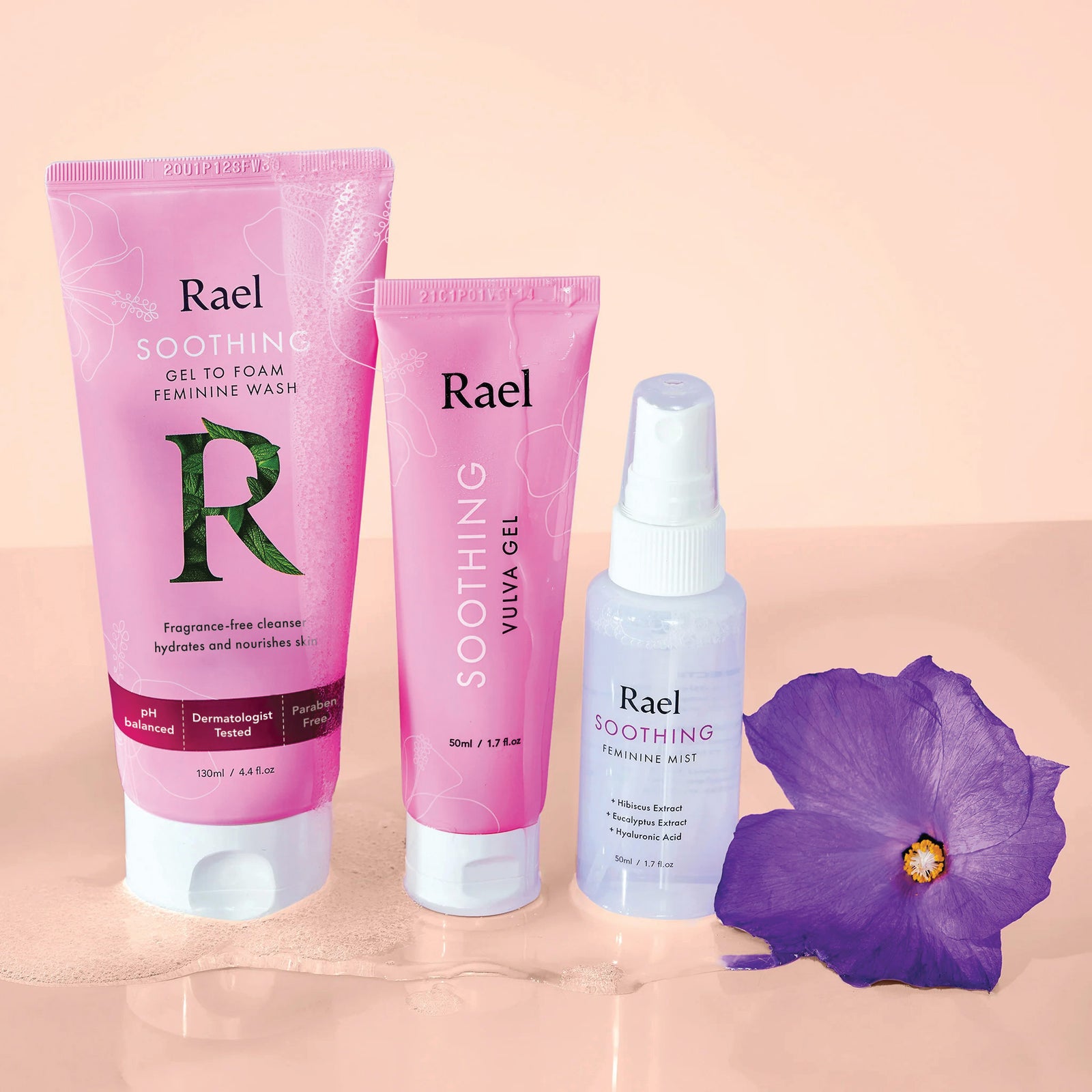
This changed Rael's organizing idea. It was no longer a company for the days someone bleeds; it was a company for the four-week hormonal cycle. Today the range runs through period care, vulva care, incontinence, blemish-focused skincare, masks and supplements. Its direct site adds subscriptions with a 10 percent discount, while Amazon supplies search demand and retailers provide reach. Repeat-use essentials create frequency. Skincare and wellness create a larger basket.
The shift was not free. Rael raised a $35 million Series B in 2022, bringing company-disclosed funding to $59 million. The money was earmarked for retail growth, product development in South Korea, leadership hires and international expansion. The initial launch bill has not been published, but the scaling bill is visible: inventory for thousands of stores, trade marketing, regulated product development and enough working capital to keep a national shelf full.
The customer is not a neat demographic so much as a set of moments: the teenager buying her first pads, the adult managing a heavy-flow night, the shopper whose skin erupts before a period, or anyone who has learned to scan an intimate-product label with suspicion. Rael explicitly says it makes products for all people who bleed. The common preference is for cleaner materials, gentler formulas and proof that performance has not been sacrificed for the green leaf printed on the box.
That user focus also shaped the company behind the packaging. Paik said in 2023 that women made up more than 95 percent of a global staff then numbering over 70. Product development straddles California and South Korea, with the Korean team watching manufacturing and beauty trends while Los Angeles sits close to American retailers and marketing. This is more than an appealing culture statistic. In a category historically designed and funded in rooms dominated by men, lived experience shortens the distance between an awkward complaint and a product brief. It does not guarantee a hit, but it makes certain problems harder to ignore.
03 / The correction
Not every adjacency deserves a permanent shelf
Rael's public story is unusually tidy, which should make any operator suspicious. The first visible stumble was not a catastrophic launch. It was ordinary portfolio drift. An earlier Skin Essentials collection - cleanser, toner, cream, serum and several other products - was discontinued. The current beauty offer is more tightly legible around blemishes, barrier care, masks and cycle-linked skin needs. The lesson is useful: adjacency works when the shopper can finish the sentence. “I trust your pads, therefore I trust your hormonal-acne patch” is cleaner than “I trust your pads, therefore please become my entire bathroom.”
The company kept pushing where it could claim a product reason, not only a brand reason. In 2026 it launched Slim Tampons at Target, using an ultra-slim applicator and top-loading design. Paik's provocation was that tampon mechanics had barely changed in roughly 80 years. It is an old Rael maneuver in a new format: find the neglected object, import engineering language from Korea, then give a mass retailer a simple story to place on the shelf.
Why it worked
A repeat purchase, a clear performance gap, public reviews, strong Korean product credibility and a retailer-friendly founder story all reinforced one another.
When it breaks
The loop weakens when reviews are untrusted, quality differences are invisible, repeat rates are low, marketplace ads are too costly or the next category has no credible bridge.
04 / The copyable bit
Do not copy the pad. Copy the proof sequence.
Rael fits between mass feminine-care incumbents such as Always and Tampax, modern clean-care rivals including Cora and The Honey Pot, and beauty-led acne brands such as Hero Cosmetics. Its differentiation is not a single material that no one else can buy. It is the stack: founders with lived product knowledge, Korean manufacturing, an Amazon-first feedback engine, an omnichannel footprint and a cycle-care frame broad enough to connect pads with patches.
The playbook is tempting because it sounds cheap: list a product, collect reviews, call Target. In reality, it requires a category where experience is obvious after one use, purchase repeats often, reviews carry emotional detail and manufacturing can keep improving. It also helped that the incumbents had trained shoppers to expect very little. Try the same trick with a rarely purchased product, an invisible quality improvement or a marketplace flooded with indistinguishable private labels, and the flywheel becomes an ad bill.
Five things a founder can steal
- Start with the complaint people already solve through awkward behavior - like filling a suitcase with products from home.
- Choose one product whose difference is felt quickly and purchased repeatedly.
- Put early proof somewhere skeptical buyers can inspect without your permission.
- Use reviews as manufacturing instructions, not merely social content.
- Expand by customer logic. Every adjacent product must inherit trust and add a reason of its own.
Rael's ambition now is to make “cycle care” feel as ordinary and navigable as skincare. That asks customers to see bleeding, breakouts, intimate comfort and supplements as parts of one system. It may work because the hormonal cycle is real and the shopping experience has long fragmented it. It may fail if the label becomes so broad that it explains everything and distinguishes nothing.
For now, the original pad remains the company's best argument. It is humble, recurring and difficult to fake in use. Rael did not persuade shoppers to believe a grand vision before the product. It let the product earn the right to make the vision bigger.