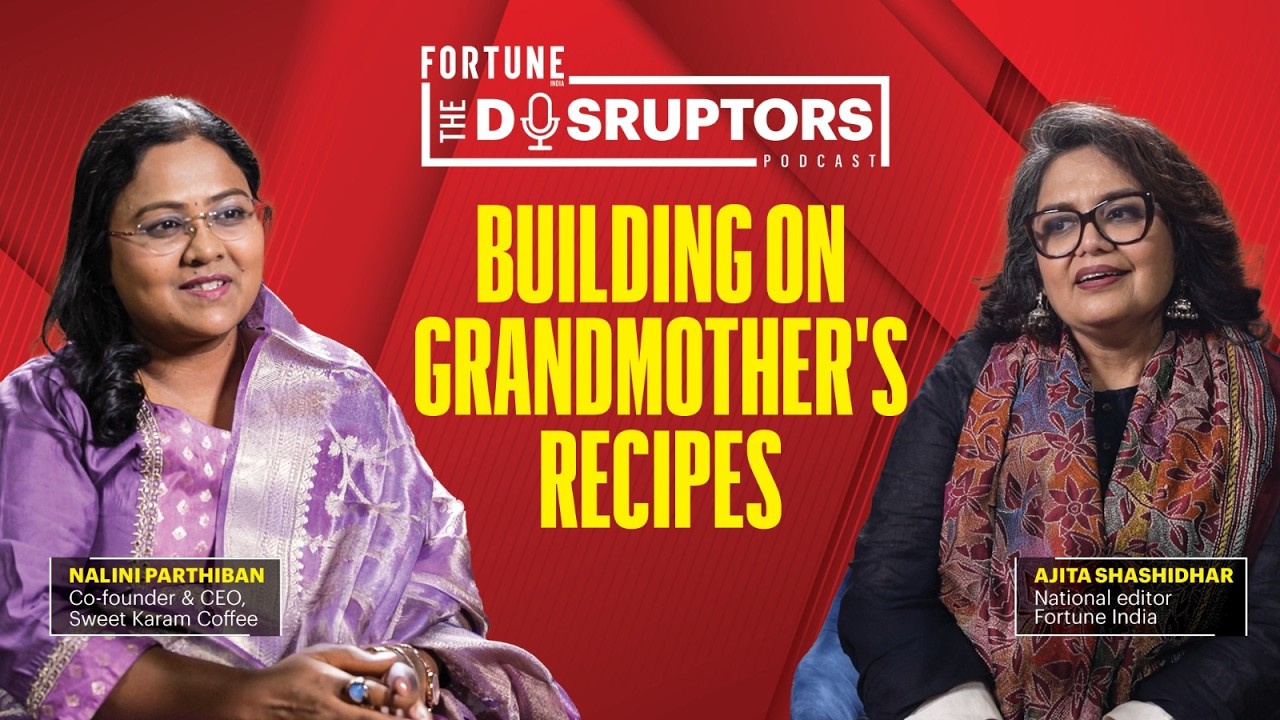
A grandmother’s recipe arrives with a considerable advantage: people already want to believe in it. It has survived family opinion, festival appetites and the difficult examination conducted by someone who remembers exactly how it tasted last year. For Nalini Parthiban, that inheritance became the beginning of Sweet Karam Coffee. It also created a demanding question. How do you take the food people associate with home and make a business that can keep earning the association?
Her answer has developed over more than a decade. The Chennai venture began in 2015 with ₹2,000 and a family’s repertoire of South Indian snacks. Nalini became its full-time operator in 2021. Institutional investors followed later. Through those changes, the ambition has remained recognisable: carry regional food beyond the places where customers already know its name. The less picturesque work involves packaging, producers, warehouses and listening carefully when affection for a recipe has outrun the recipe itself.
A recipe with a constituency
At the centre of the family story is Janaki, the grandmother of Nalini’s husband and fellow founder, Anand Bharadwaj. Her Diwali cooking included the sweets and savouries that helped give the business its direction. Nalini remembered helping with those preparations and enjoying the stories attached to them. Later, as a working mother, she found it difficult to make the traditional recipes with the time and attention they required.
That is a practical problem with an emotional aftertaste. Knowing what a dish should taste like does not conjure up the hours needed to make it. A memory can be remarkably exact about the result and thoroughly unhelpful about Tuesday’s schedule. Sweet Karam Coffee offered the family a way to work on that gap.
The name contains its own serving instructions. A sweet comes first, followed by karam, the savoury element, and then filter coffee. It describes a familiar South Indian sequence rather than a single product. The business could therefore range across the things that belong together on the table. A customer might arrive for mixture and leave with coffee; the company’s organising idea remained the occasion.
Six years before the leap
Nalini’s earlier career included Royal Bank of Scotland and IDP Education. She studied at Anna University, with a bachelor’s degree and an MBA recorded in her published career account. Those details give her route into entrepreneurship a different rhythm from the instant conversion usually suggested by a founding date. The company began in 2015; the decision to devote her working life to it came six years later.
There is room for a great deal of learning inside that interval. Starting a venture and choosing it as your occupation are separate commitments. The first can begin with a festival order. The second reorganises the day. Nalini left her job in 2021, while Anand followed into the business full-time in 2023. The family enterprise gradually became the centre of their professional lives.
Her own account of those early years stresses the modest beginning: sweets and snacks sold mainly around Diwali, followed by more categories and a warehouse operation. Members of the family brought different experience in finance, marketing and supply chains. The work widened along with the catalogue. What began as making food now required an organisation that could receive orders, prepare stock and keep promises to strangers.
“Build for the customer is my Mantra.”
Nalini Parthiban
It is a useful sentence to set beside the family origin. One looks backward to something worth preserving; the other keeps attention on the person deciding whether to buy. Both have a place in her story. The tension between them is where much of the actual management happens.
The people behind the packet
Sweet Karam Coffee’s recipes depend on a wider circle than its founders. Skilled home chefs and small producers are part of the business, and Nalini has repeatedly discussed women entrepreneurs’ role in making its food. At the Tamil Nadu Story event in Chennai in July 2024, she said almost 70% of the brand’s manufacturing came from women entrepreneurs. It is a dated measure of how the production network worked, rather than a decorative claim about community.
For a regional food company, the relationship has commercial weight. Knowledge of a recipe often belongs to people whose skill was developed outside a large formal operation. Building a business around that knowledge creates questions about consistency, capacity and who gets to participate as orders increase. Nalini has described helping this network scale as particularly fulfilling. The people doing the making belong inside her account of growth.
Her description of office life follows a related interest in how people develop. In a public reflection on leadership, she credited mentors with shaping her own judgement through guidance and corrective feedback. She wanted the company to give others space to learn together. A team outing included planning for the next quarter alongside activities intended to strengthen cooperation.
The values she named were concrete enough to be inconvenient: give people authority, let them own decisions, respond clearly and act promptly. Mistakes should become occasions for learning. Finger-pointing should give way to shared responsibility. These are her stated intentions for the organisation. They also reveal what she chooses to talk about when the subject moves beyond products and sales.
How far can familiar travel?
By December 2023, the company was describing international deliveries alongside its Indian business. A $1.5 million investment from Fireside Ventures that year supported plans to enter more channels and places. The family kitchen had become the origin of a distribution problem: making something available wherever the person who wanted it happened to live.
That changes the meaning of a regional brand. Some customers bring detailed memories to the purchase. Others encounter a snack without the childhood reference. The packet must make sense to both. Familiarity can persuade someone to try it, but for a newcomer the food has to establish its own credentials. Home is a powerful introduction; it cannot be present at every transaction.
At the Chennai event in 2024, Nalini gave a concise account of that changing relationship: “Your brand gets discovered online, but it gets built offline.” She also said almost 70% of its customer base was outside Chennai and Tamil Nadu. The distinction matters to her personal journey. A founder who begins with food recognised by family and neighbours eventually has to understand people beyond that circle. Their habits can test assumptions that once felt obvious. Her role expands with the audience: deciding how the company presents itself, where it turns up and how a first purchase can become a second.
In April 2025, Sweet Karam Coffee announced an $8 million Series A led by Peak XV Partners, with Fireside Ventures participating. The stated priorities included distribution across channels, product development, team building and technology for the supply chain. Its financial adviser also described investment in the infrastructure needed for expansion. The intended uses were quite a distance from the romance of a handwritten recipe, and essential to making it travel.
April 2025
reported April 2025
reported April 2025
At that point, the company reported deliveries to 32 countries and a presence in more than 2,500 quick-commerce dark stores in India. Nalini identified banana chips and Madras mixture as popular products. Nandhitha Indermohan, previously with Unilever, joined as chief operating officer, adding experience in operations and supply chains.
The business now had several ways of meeting a customer. A website could explain the family story at leisure. A quick-commerce listing had to work inside a more immediate shopping trip. A physical shelf put the packet beside somebody else’s. Each route asked the same company to be clear about what it offered, while the time available to explain it kept changing.
Permission to change the recipe
One recent product decision offers a particularly revealing test of the company’s priorities. Madras Mixture was already a bestseller. Then a blind comparison favoured a competitor’s crunch and crispness. Sweet Karam Coffee went back to work on its recipe. The exercise also helped lead to a testing group of around 100 regular customers.
That episode makes the family story more interesting. A successful product, an affectionate audience and a meaningful origin could all have supplied reasons to leave things alone. Instead, the business accepted an unflattering answer from the people eating. There is a certain economy to the lesson: before explaining why the customer should love the packet, find out whether the customer loves what is in it.
For Nalini, it fits the customer emphasis she had expressed earlier. Preserving a tradition requires judgement about what must endure and what can improve. The recipe, the packaging and the route to market do not all have to move at the same speed. Nor does respect for a grandmother require treating every later business decision as a family heirloom.
In a recent public post about visiting stores in the United States, she described seeing Sweet Karam Coffee far from the home kitchen where it began. She acknowledged crowded shelves and intense competition alongside her excitement. It is an apt place to leave her: looking at the food in the company of alternatives, where another person will decide what comes home.
The original ritual is small enough to fit into an afternoon. The business built around it asks for years. Nalini’s work is to connect those two measures of time, keeping enough of the first experience intact that someone, somewhere else, wants to repeat it.
More at the table
CONVERSATIONS & FURTHER READING