Aylon Steinhart brought sour cream to an investor interview. There were three versions: Eclipse’s plant-based prototype, conventional dairy, and a tofu alternative. Thomas Bowman, his co-founder and a chef, supplied the presentation, complete with vegetables and bento boxes. In Steinhart’s later account, several interviewers struggled to distinguish the Eclipse sample from the dairy one. The pair entered Y Combinator’s Winter 2019 batch. Their argument had arrived with something to dip into it.
The scene captures the wager behind his Eclipse years. A food startup can explain its purpose beautifully and still lose at the first mouthful. Steinhart wanted people to choose plants while retaining the experience they already liked. Put that proposition beside a familiar product, remove the labels, and the eater has an unusually direct way to disagree.
There is a pleasing indignity to this kind of entrepreneurship. All the ambition, financing, and preparation eventually answer to a spoon. For Steinhart, that was the point of beginning with something people could taste.
The business graduate changes the menu
His training began some distance from the dairy aisle. Steinhart graduated from UC Berkeley’s Haas School of Business, cum laude, in 2011. His early professional history includes AT&T’s leadership development program and account-management work in Puerto Rico. Software entrepreneurship followed, with ventures including Photopaz and BrideBox, a business associated with do-it-yourself wedding albums.
Wedding photographs and plant-based dairy seem an unlikely pair of interests. They share a founder’s practical assignment: take something people want, understand how they buy it, and build a business capable of delivering it. The connection is useful when considering his later work. He entered food with experience in bringing products to customers, rather than a chef’s apprenticeship.
Steinhart has described himself as a software entrepreneur who became a vegan advocate. He identified the documentary Cowspiracy as an influence on that change, saying it sharpened his attention to industrial animal agriculture. His account also connects the decision to a longstanding interest in nature and animals. The film helped turn that interest toward the food system.
He subsequently helped establish the innovation work at the Good Food Institute. Supporting alternative-protein startups meant working with entrepreneurs, investors, and strategic partners. Public biographies describe dozens of companies he helped incubate and speaking engagements at universities including Harvard, Yale, Stanford, and Berkeley. Before selling his own dairy idea, he had spent time encouraging other people to build.
An advocate finds a chef
A 2018 interview offers a glimpse of Steinhart in that earlier role. He discussed technical co-founders, consumer understanding, and resources for entrepreneurs entering alternative proteins. He named Pat Brown, Ethan Brown, and Bruce Friedrich among the people who helped draw him toward the field. The work involved connecting an appetite for change with the expertise needed to make a product.
His interests were also pleasantly concrete. Asked about a favorite book, he chose Artisan Vegan Cheese. A favorite food was a plant-based version of Tom Kha Gai soup. Those details put a kitchen beside the business-school biography. Food can be a market opportunity and still be something a person enjoys making, reading about, and eating.
Bowman brought a different set of tools to their partnership. He had worked in restaurant kitchens and then in product development at Hampton Creek, later known as JUST. His experience included plant-based mayonnaise, cookies, and dressings. Steinhart understood the commercial opening; Bowman knew how to work on the food. Their shared Eclipse ambition gave those skills a particular place to meet.
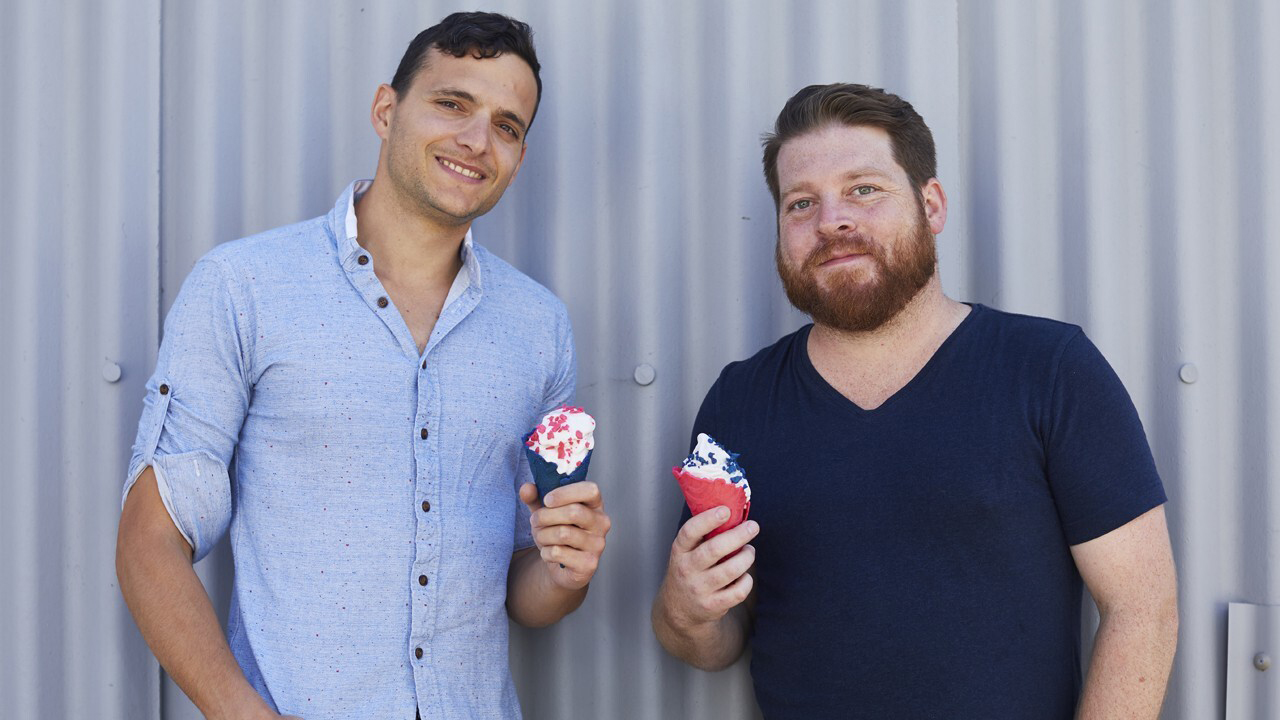
The pair saw progress in plant-based meat and eggs and a demanding opening in dairy. Existing milk and dessert alternatives gave shoppers plenty of options, yet Steinhart believed familiar dairy experiences were still inadequately served. Eclipse formed around the ambition to match those expectations closely. That was a claim the founders would have to test repeatedly, rather than an achievement a company name could confer.
The mixer makes an argument
One early breakthrough was audible. As Steinhart later described it, Bowman changed an ingredient and a processing parameter; a mixer that had been humming began making unfamiliar noises. Looking inside, Bowman found curds and whey. The plant-based mixture was behaving in a way associated with dairy. An odd sound from a machine had become a reason to keep working.
Eclipse described its approach through micelles, microscopic structures associated with milk’s behavior. Its process aimed to reproduce dairy-like functionality using plants. The business ambition extended across forms: a base that could support frozen desserts and other products. Success would depend on what the resulting food did in a kitchen and how convincingly it met an eater’s expectations.
That range created its own difficulty. Steinhart has recalled the temptation to work on numerous products once the founders saw what their base could do. A small team still had to choose where to put its effort. Ice cream became the focus. A refrigerator full of possibilities is an exciting prospect; a refrigerator full of unfinished projects is a less useful business.
The choice also exposed the product to a clear test. Ice cream is eaten for its own pleasures. People notice its texture, its melt, and the flavor left after a spoonful. A sauce or spread can share the stage with other ingredients. A scoop receives the attention directly. Concentrating on it gave Eclipse a specific promise to work toward.
“We remained optimistic.”Aylon Steinhart, reflecting on the founders’ early lessons
Three conditions at the freezer door
Steinhart’s explanation of consumer behavior kept returning to ordinary requirements. A person wants something enjoyable, at an acceptable price, in a place where they can buy it. A mission can help explain the product. Those requirements determine whether the explanation has a practical future. Each failed condition gives the shopper an easy reason to choose something else.
The spoonful earns attention.
The purchase has to make sense.
The customer has to find it.
He summarized those priorities as “taste, price, and availability.” The list is memorable because it leaves so little room for romance. It asks a founder to consider the entire purchase, including the unglamorous journey into a shop or a restaurant. The product has to be present when someone wants it. It also has to justify the money that changes hands.
Manufacturing belonged inside that argument. Steinhart described Eclipse’s approach as a mechanical process using plant components, with products that could be made in facilities already producing dairy equivalents. The ambition was to compete on price while maintaining a workable margin. Familiar production infrastructure offered a route toward scale. It did not remove the need to execute it.
The route from a cone to a shelf
Eclipse launched ice cream in late 2019 through foodservice. Restaurants and scoop shops could introduce people to the product in a setting where tasting was already the activity. By July 2020, the company had also opened nationwide direct-to-consumer ordering and was expanding into retail. Steinhart’s job now included moving the idea across different ways of buying dessert.
Those channels make different demands on a founder. A restaurant offers an encounter shaped by the people serving the food. A grocery freezer puts the package beside alternatives and lets the shopper compare. Direct ordering asks someone to seek the brand out. Changing channels means reconsidering how a customer first notices the product, buys it, and decides whether to return.
In late 2021, Eclipse announced Cookie Butter, Mint Chip, and Vintage Vanilla at Whole Foods locations in Northern California. The geography matters: this was a documented regional retail step, rather than a reason to imagine the product in every freezer. For Steinhart, it put the company’s promise into a familiar shopping trip, where repeat purchases would have to carry the argument.
Eclipse’s announced funding round supported plans for distribution, brand awareness, and product development. Company financing is separate from a founder’s personal wealth.
The business also drew support from people with experience in consumer brands, technology, and alternative proteins. Its backers included Initialized Capital, Forerunner Ventures, Sozo Ventures, and Seth Goldman. A 2022 partnership with Smashburger brought Eclipse into milkshakes at a restaurant chain. Such connections gave the founders routes to capital and customers; the food still had to earn its place.
Steinhart spoke about meeting mainstream consumers where they were. The phrase becomes more concrete beside a milkshake menu. Asking someone to try a familiar treat changes the size of the decision. The customer can judge a dessert before considering any wider allegiance. Eclipse’s mission depended on many decisions of that ordinary size adding up.
The refrigerator gets bigger
The wider dairy ambition continued beyond the early scoops. Eclipse’s current range includes a non-dairy whole milk aimed at coffee service, and its product page documents a March 2026 formulation change. A coffee bar presents another set of expectations: how the milk tastes in a drink and how it behaves when foamed. The original ambition has acquired a different daily setting.
The company also established a Japanese subsidiary in October 2023. Its expansion included convenience-store ice cream and a plant-based version of Takeshita Seika’s Black Mont Blanc for the Osaka-Kansai Expo in 2025. Later company developments show where the business traveled. They belong to the continuing Eclipse story, with responsibilities distributed across the people carrying it forward.
- 2011Business degree at Berkeley
- 2019Eclipse and Y Combinator W19
- 2021Northern California Whole Foods launch
- 2025Eclipse products reach the Osaka Expo
- 2026Steinhart’s public affiliation points to a stealth AI startup
Steinhart’s own public career has moved too. His LinkedIn profile now lists a stealth AI startup. Eclipse remains a company he co-founded and led through its formative years. Keeping the chronology visible allows the food story to retain its detail while recognizing that a founder can go on to another problem.
His Eclipse years leave a useful question behind: how much change can a product invite while allowing the customer to keep an experience they enjoy? Steinhart pursued that question through a partnership, a manufacturing approach, and a route to market. He chose a demanding starting point. Ice cream permits very little philosophical assistance once it reaches the tongue.
More from Steinhart’s world
- Explore Eclipse Foods
- Aylon Steinhart on LinkedIn · Twitter / X
- Watch: The Future of Food panel with Steinhart, Gregory Struck, and Bernat Ananos
- Listen: The Sweet Side of Starting a Dairy-Free Ice Cream Company
- Listen: Steinhart on technical co-founders and food entrepreneurship
- Read: The founders on their early lessons
- Read: Eclipse’s 2022 financing and dairy ambitions