Breaking
$12M Series A led by Sequoia Capital (2022) Used by Honeywell, Lockheed Martin, Northrop Grumman, OpenAI & HP Customers report 5-20x productivity on 30+ layer boards Spun out of UC Berkeley · YC Summer 2018 Migrating its design language to Python in Q4 2025 $12M Series A led by Sequoia Capital (2022) Used by Honeywell, Lockheed Martin, Northrop Grumman, OpenAI & HP Customers report 5-20x productivity on 30+ layer boards Spun out of UC Berkeley · YC Summer 2018 Migrating its design language to Python in Q4 2025
YesPress Profile · Company

JITX

Software-defined electronics. They want you to write a circuit board the way you write code.

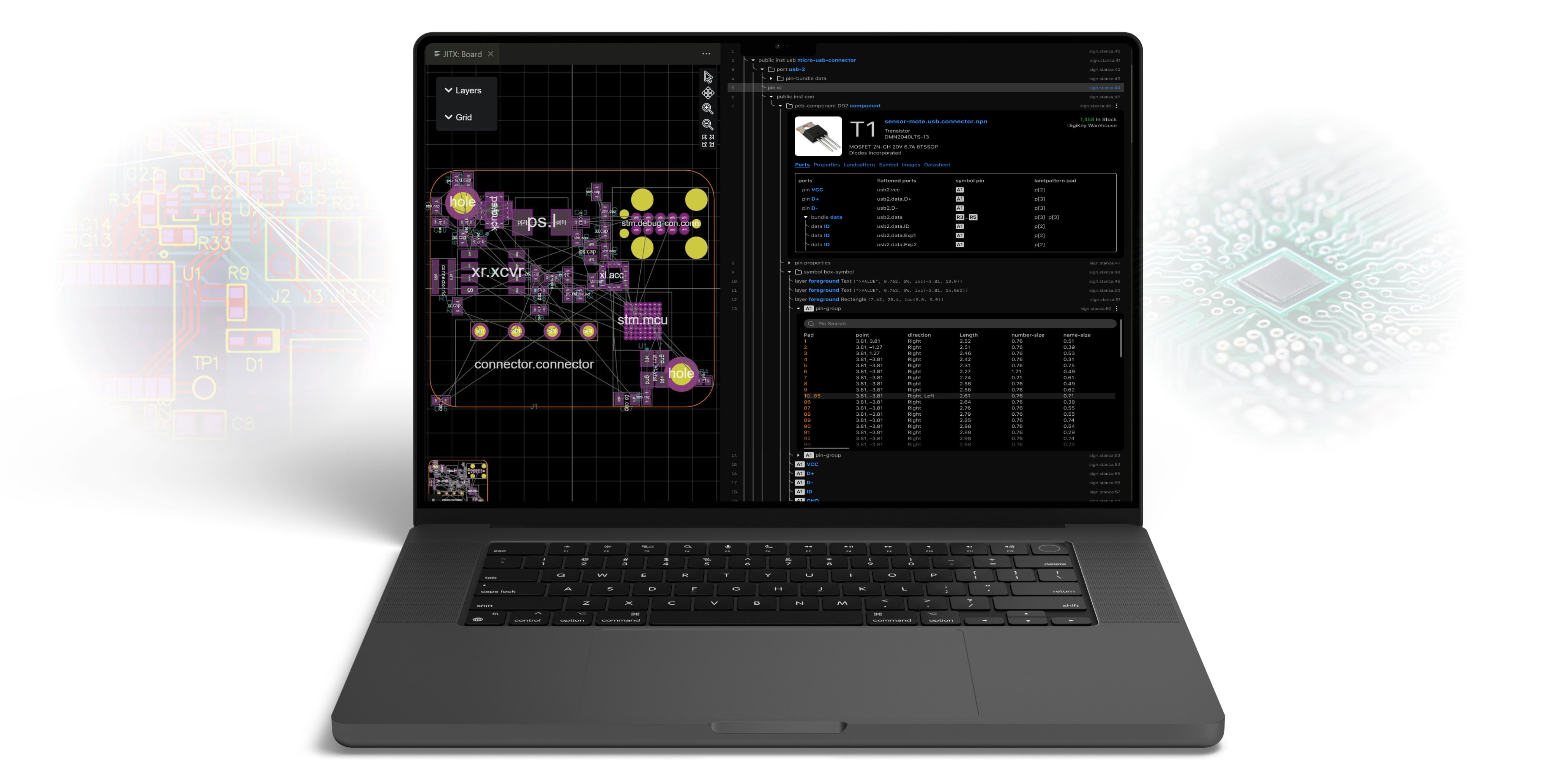
The JITX design environment running on a laptop

EXHIBIT A: The JITX environment, open on a laptop. Somewhere in here is a circuit board that nobody dragged around with a mouse.

HQ San Jose & Berkeley, CA Founded 2018 Backed by Sequoia · Y Combinator Stage Series A
Who they are now

A circuit board, written like software

Somewhere right now, an electrical engineer is not dragging a capacitor across a screen. They are typing. They describe what a board needs to do - the protocols, the power budget, the constraints - and JITX selects the parts, places them, routes the copper, and checks the whole thing against the rules. The board falls out the other end.

That is the pitch, and it is a strange one for an industry that has spent forty years treating board design as a point-and-click craft. JITX calls it "software-defined electronics." The rest of us would call it teaching a computer to do the part of engineering that engineers quietly resent.

The company is small - somewhere around a dozen people - and it is not trying to sell you a prettier schematic editor. It is trying to change the unit of work. Not the wire. The code that generates the wire.

"We realized how little of our time we were spending on our core activity - the research. All of our time was focused on low-level hardware design."

- Duncan Haldane, Co-founder & CEO
The problem they saw

The worst human endeavor

Designing a circuit board by hand is slow, it is fiddly, and it is exactly the kind of work that punishes a tired human. You read a 200-page datasheet. You pick a part. You draw a symbol. You assign every pin. You route every trace. You check it against rules that live in your head and three PDFs. Then you finish - and start over for the next board.

Haldane is blunt about it. The conventional approach, in his words, "sucks." It does not use an engineer's expertise; it buries it in bookkeeping. And the timing got worse. A global component shortage forced teams to redesign products around whatever parts they could actually buy. Systems got more complex. The veterans who held the tribal knowledge started retiring, and nobody was replacing them fast enough.

"The component shortage is causing engineers to redesign products to accommodate available parts. Systems are getting harder to design, and experts are retiring and not being replaced."

- Duncan Haldane

Here is the irony the founders kept circling: the people who design the chips that power the world's software had no software-grade tools of their own. Programmers got version control, compilers, reusable libraries, and automated tests decades ago. Hardware engineers got a faster mouse.

The founders' bet

From robots and chips to boards

JITX did not start as a company. It started as a frustration at UC Berkeley.

Duncan Haldane was a PhD student designing robots - the kind of work that earned him an IEEE best-paper award and, improbably, a Guinness World Record. Down the hall, Jonathan Bachrach and Patrick Li were building Chisel, a tool that let chip designers describe digital logic in code instead of by hand. One group was drowning in low-level board design. The other had already proven you could automate the equivalent problem one layer up, at the silicon.

The bet was simple to state and hard to execute: take the idea behind hardware description languages - the ones that revolutionized chip design - and aim it at the circuit board. Let engineers write intent. Let the machine handle the rest using, in the company's words, "clever representations and learned heuristics" for the sub-problems that are otherwise computationally intractable.

"It's the worst human endeavor. Imagine going through all that and then starting from scratch on the next design."

- Duncan Haldane, on the status quo JITX set out to replace

Y Combinator took them in the summer of 2018. Four years later, Sequoia Capital pre-empted their Series A - which is venture-speak for "we are not letting you take a meeting with anyone else."

Co-founder · CEO

Duncan Haldane

Former robotics PhD at UC Berkeley. IEEE best-paper award, one Guinness World Record. The public face of the bet.

Co-founder · Chief Scientist

Jonathan Bachrach

A 35-year track record in design tools. Led the Chisel project at Berkeley - the chip-design language that inspired JITX.

Co-founder · Advisor

Patrick Li

Built FIRRTL, the intermediate representation behind Chisel3. The compiler mind in the founding trio.
The product

You describe it. JITX builds it.

Tell JITX you want a board with Bluetooth Low Energy and a microphone. It selects the components, solves the power supplies, assigns the pins, plans the placement, routes the traces, and exports a design you can manufacture. Electrical, mechanical, and manufacturing constraints get handled at the same time - not in three separate, finger-crossed passes.

Code-driven design

Requirements as code

Constraints expressed in code that an engineer can review and an AI can edit. The board's intent lives in version control, not in someone's memory.

Constraint-driven autorouting

It generates, it doesn't just nag

A router that produces layouts meeting your signal-integrity rules - instead of finishing and then listing everything you got wrong. A topological autorouter has reportedly hit up to 33% higher density.

Runs on your infrastructure

Your secrets stay home

JITX can run locally on company machines with approved internal AI models. Proprietary fab rules and design tradecraft never leave the building.

Simulation in the loop

AI that checks its own work

Closed feedback loops with Ansys HFSS let the system simulate, read results, and update the design - in one demo, catching missing termination in a memory layout.

Programmers got compilers, version control and reusable libraries decades ago. JITX is the argument that hardware engineers deserve the same.

- The JITX thesis, paraphrased
Milestones

How a frustration became a company

~2016-2017 · UC BERKELEY
The origin. Robotics PhDs meet the Chisel chip-design team. The idea: automate boards the way Chisel automated logic.
SUMMER 2018
Y Combinator (S18). JITX joins the batch and launches on Hacker News: "Automating Circuit Board Design."
2018-2022
Proving it. JITX uses its own tools to design boards for other companies and joins DARPA's Electronics Resurgence Initiative.
SEPTEMBER 2022
$12M Series A. Sequoia Capital leads; general availability announced. YC, Funders Club and Liquid 2 join.
2025
AI writes the code. Constraint-driven routing, Ansys SI optimization loops, RF via-fences - and AI designing an industrial I/O board from raw datasheets.
Q4 2025
Hello, Python. JITX migrates its front-end from a custom DSL to Python, so modern AI can write and debug designs more easily.
The proof

Numbers that survive scrutiny

$12M
Series A, 2022
5-20x
Productivity gain*
30+
Layer boards handled
2018
YC Summer batch

*Customer-reported, measured on complex 30+ layer designs, memory interfaces, RF boards and LRU backplanes.

The data

Why teams switch

JITX's central claim is about speed and cost. In its own benchmarks, a design produced with the tool comes out roughly three times faster and a quarter cheaper than an experienced engineer working unassisted. The bars below put those numbers side by side - read them as the company's argument, not an independent audit.

Relative design speed (higher = faster)
SOURCE: JITX / IEEE Spectrum · baseline = unassisted engineer
Manual (baseline)
1x
JITX (reported)
~3x faster
Complex boards (low)
5x
Complex boards (high)
20x

And ~25% cheaper than an experienced engineer working without assistance.

Who trusts it

Hardware teams in aerospace, defense and tech

Honeywell Aerospace Lockheed Martin Northrop Grumman OpenAI HP

And the ecosystem around it

Ansys Siemens Altium NVIDIA Keysight DARPA ERI
The mission

Keep the knowledge from walking out the door

Strip away the routing demos and the funding headlines, and JITX is making a bet about people. The expertise that designs a good board is scarce, it is aging, and it is locked inside individual heads. Write it down as code, and it compounds instead of evaporating.

That is also why the company built ESIR - the open Electronic Systems Intermediate Representation - for DARPA's national push to revive American electronics design, and why it gives its tools away free for open-source work. A standard only matters if other people use it. JITX seems to understand that the moat here is not secrecy; it is adoption.

Bring the productivity of software to hardware, so engineers spend their time on creative optimization instead of busywork.

- The JITX vision, in one sentence
Why it matters tomorrow

Back to that engineer, still typing

Return to the scene we opened with. The engineer who is not dragging a capacitor across a screen. A few years ago, that person did not exist - the tools did not allow it, and the habit said you had to do it by hand. Today they describe a board, and increasingly an AI drafts the code, runs a simulation, finds the missing termination, and fixes it before a human ever sees the error.

Whether JITX becomes the default way the world designs electronics is still an open question - it is a small company taking on entrenched, billion-dollar tools, and the 5-20x numbers are its own. But the direction is hard to argue with. Hardware has spent decades watching software get faster, more collaborative, more automated. JITX is the bet that the gap finally closes, and that the board you hold tomorrow was written, not drawn.

The board you hold tomorrow may have been written, not drawn.

- The whole idea, in nine words