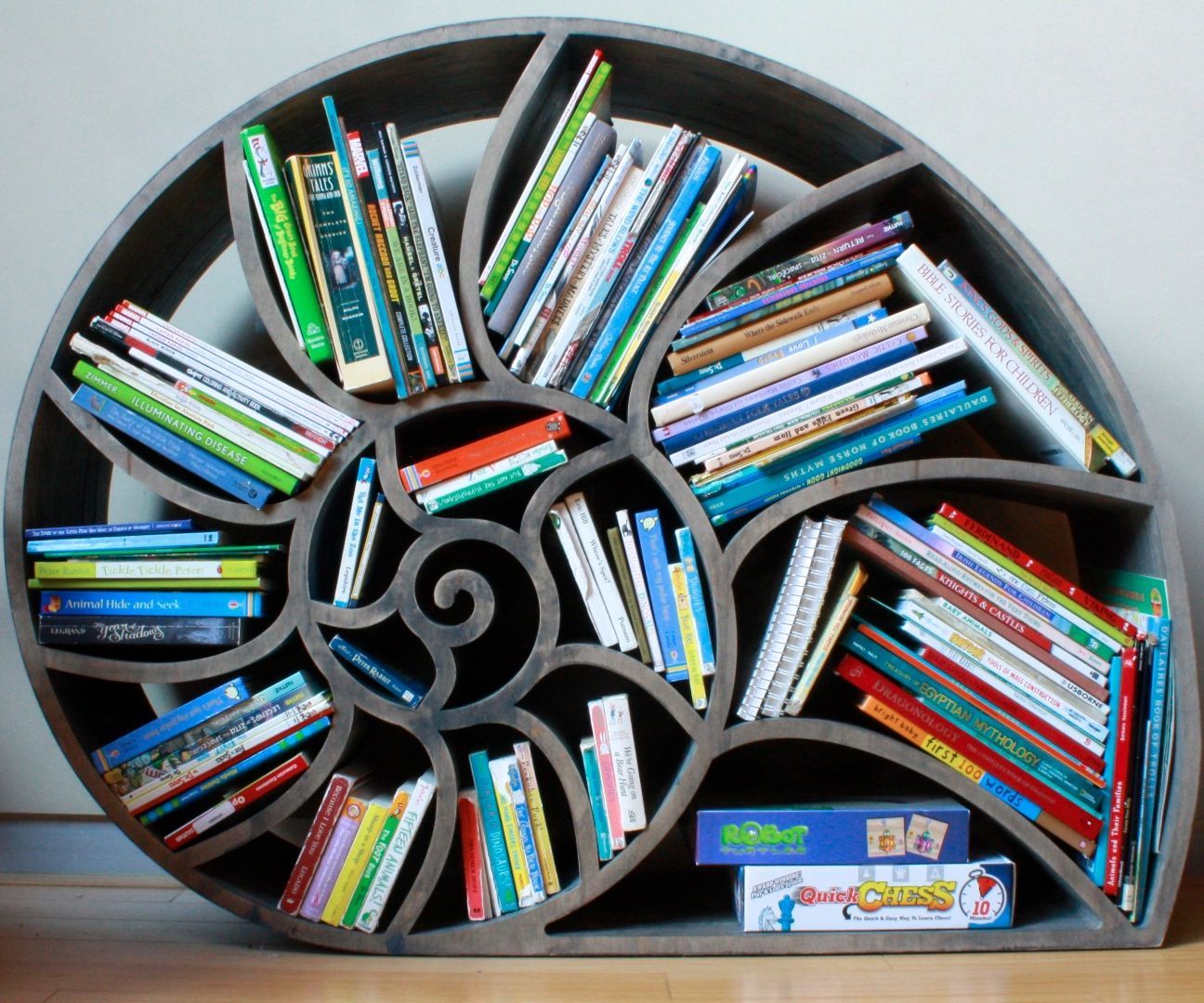
Eric Wilhelm had a problem with children’s books. They came in inconveniently different sizes. Some were too tall for the shelf; others left wasted space. He wanted compartments that varied in size, but the designs he was considering looked like crooked rectangles. So he asked his five-year-old daughter to draw the bookshelf she wanted. She drew a spiral.
He took the suggestion seriously. In AutoCAD LT, Wilhelm drew a logarithmic spiral, divided it into sections and checked the proportions against photographs of nautilus shells. He cut plywood profiles on a waterjet at Autodesk’s Pier 9 workshop, then stacked, glued and nailed the layers together. Sanding occupied scraps of time over several weeks. Friends at Because We Can helped with the finish.
Once the books were in, the children discovered another use for their father’s carefully engineered furniture: a slide. The customer, having supplied the original concept, had also expanded the product specification.
There is a fair amount of Eric Wilhelm in that bookshelf. A small domestic irritation becomes a technical project. Somebody else supplies a good idea. Advanced tools meet plywood, glue and patient sanding. Then he puts the process online, where anyone can inspect the decisions and make something of their own.
The kite came before the company
Wilhelm earned three mechanical engineering degrees at MIT: an SB, an SM and a Ph.D. His research involved printing electronics and micro-electromechanical systems using nanoparticles. It was work at a scale far removed from a child’s bookshelf, but both required turning a design into a physical object.
Alongside that academic training came a less orderly education in making kite-surfing equipment. Around 2001, Wilhelm, Saul Griffith and Tim Anderson began learning the sport. The equipment was expensive, and making their own offered both an experiment and a way into the water. The trouble was explaining what they had done.
Instructions lived on personal websites. People wanted the CAD files. Writing the HTML was another job after the building was finished. A useful design could travel only as far as its maker’s willingness to package it for strangers. Documentation had become a project of its own.
In 2004, Wilhelm joined Colin Bulthaup, Dan Goldwater and Griffith in founding Squid Labs. Consulting paid for room to pursue their own ideas. The group’s technical work ranged from solar-collecting concrete to human-powered energy devices. Instructables emerged from that environment in 2005, giving people a place to explain a project through pictures, steps and files.
- 01 Make
- 02 Document
- 03 Share
- 04 Improve
A visual reading of the project-sharing model Wilhelm helped build.
The progression matters. The platform grew from a difficulty its founders had encountered themselves. Before it could invite the world to make things, it had to make explaining those things less laborious.
A workshop with room for sewing
A kite-surfing documentation tool could have remained a rather specialized corner of the internet. Instructables made room for cooking, crafts, electronics, furniture and costumes. Its basic unit was the project, which gave people with very different skills a shared format.
Wilhelm liked the places where those interests overlapped: makers sewing LEDs or microcontrollers into clothing, for example. A circuit could become part of a garment. A sewing project could introduce somebody to electronics. The categories were useful entrances, with plenty of traffic between them.
In 2008, MIT Technology Review included him among its Innovators Under 35. At the time, Instructables had more than 300,000 registered users. That is a dated snapshot, but a telling one: a system developed to share workshop knowledge had attracted a community well beyond its starting circle.
Wilhelm’s own projects help explain the breadth. He has published a wooden train-track crossing, a LEGO table with an integrated parts bin and a father-and-son Mad Max costume. These are recognizable problems of play, storage and dressing up, approached with the same willingness to measure, model, cut and try again.
The LEGO table began with a $20 secondhand table and leftover chair rail. His daughter requested a mountain. Wilhelm added a hole through which loose pieces could be swept into a bin, and used a computer-controlled mill to make its cover. He also recorded a mistake: the shelf under the table needed more clearance for the bin’s lid. An honest instruction includes the thing its author would change.
The conversation below the instructions
For Wilhelm, publication was only part of the exchange. In 2012, he described comments as central to Instructables: people could ask questions, offer praise or suggest improvements. A set of instructions became the beginning of a conversation with its author.
That placed a social demand on a technical platform. People needed to feel comfortable showing unfinished work, asking basic questions and admitting errors. A clever upload form alone could do little about an unpleasant room.
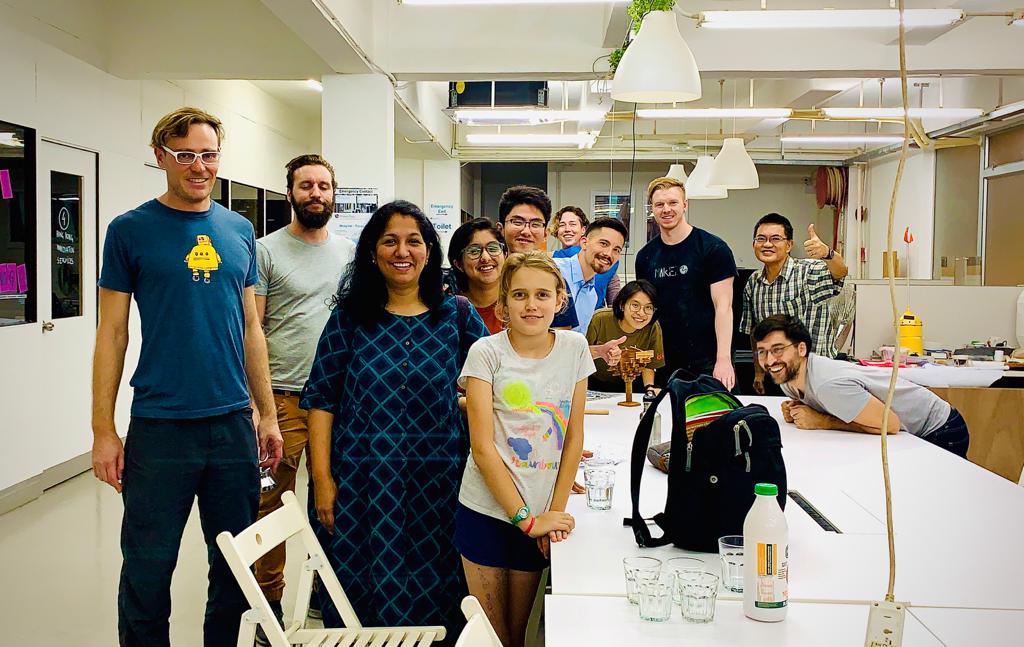
Christy Canida, who helped build Instructables’ community and marketing, described its deliberate moderation at a 2019 MakerBay discussion with Wilhelm. The site enforced a be-nice policy. Staff participated through community profiles. Showing the messy parts of making helped readers understand the effort behind a finished object.
The arrangement gave expertise a more approachable shape. Someone could admire a project, discover the awkward stage in its construction and ask how the author got through it. The distance between looking and attempting became a little shorter.
A company becomes another kind of tool
Autodesk acquired Instructables in August 2011. The buyer made design and engineering software; the community brought people already interested in turning ideas into objects. The acquisition connected the act of imagining a project with tools for designing and fabricating it.
Wilhelm went on to serve as Autodesk’s vice president for hardware and communities, and later led Fusion 360. His work moved between the community that encouraged people to begin and the software they might use when a project required more precision.
He was still encountering the same irritating details as other contributors. When Instructables introduced its iPhone app in 2013, he had published 142 projects. He knew the bother of moving photographs through a computer, organizing them and uploading them step by step. A phone could capture the work where it happened.
That experience makes a useful counterweight to the polished founder biography. The person running the platform was spending time arranging project photographs. Anyone who has tried to finish a tutorial after finishing the actual object will recognize the second shift.
Business, fun and a very short answer
Wilhelm can be economical with an explanation. Asked in a 2009 interview to define a trend, he answered, “Standard English will do.” He had rather more patience for the practical question of what would help Instructables: wider broadband access.
His ambition for the site was to encourage visitors to begin or finish their own projects. Asked what he hoped to be doing professionally in ten years, he wanted to keep business and fun blurred together. Long bicycle rides, kite-surfing, experimental cooking and home renovation supplied some of the overlap.
This was play with an expectation of follow-through. The nautilus shelf required weeks of sanding. The train-track crossing required measurements, a Fusion model and toolpaths before the mill could cut it. Delight might suggest the project; repetition and attention got it into somebody’s hands.
“Ideas are easy; execution is what matters.”
Eric Wilhelm, 2009
His interests have also wandered into children’s books. He has written about Marcus Aurelius and a giant destructive frog named Musa. Philosophy, a large frog and workshop instructions make an unusual shelf of publications. The bookshelf designer would presumably find a place for them.
The next obstacle is in the kitchen
After Autodesk, Wilhelm led SafeConnect Solar, working on making residential solar easier to install. By 2019, he was describing an automated safety inspector and an ambition to make solar feel more like an appliance purchase. The installation process itself had become an engineering problem.
He helped found Copper in 2022. Its induction ranges incorporate battery storage, allowing them to draw power from an ordinary 120-volt outlet and store energy for cooking. The appliance addresses a familiar obstacle for households considering electric cooking: the electrical work a conventional installation can require.
The technical subjects have changed since Instructables. There are batteries and household power circuits where there were once project editors and image uploads. Yet the family resemblance is visible. Both ventures put effort into the steps that stand between a person’s interest and their ability to act on it.
- 2005
- Instructables launches
- 2011
- Autodesk acquires the community
- 2022
- Wilhelm helps found Copper
By August 2025, Copper had begun shipping its ranges and announced $28 million in new financing. Sam Calisch was its CEO. Wilhelm’s work had brought him back to the household, where a technical decision has to survive the ordinary business of preparing dinner.
His public LinkedIn activity has included an invitation to people considering climate careers to talk with him about what that work might involve. Sharing knowledge remains part of the job, even when the subject is a career rather than a plywood profile.
The nautilus bookshelf offers a pleasing measure of all this. An engineer asks for help, takes a child’s drawing seriously and makes the object. Then he writes down how. Other people get the dimensions, the mistakes, the finishing decisions and the unexpected discovery that the shelf can double as a slide. A finished project leaves someone else with a place to start.
Follow the projects
- Wilhelm’s projects and public profile on Instructables
- How to Start a Business - Wilhelm’s account of Squid Labs
- LinkedIn · Twitter / X · Facebook
- Copper’s appliances and approach
- Watch: the video accompanying MakerBay’s community-building discussion
- Watch: Education and the Internet
- Autodesk’s acquisition announcement · Copper’s August 2025 financing
- Read: The Instructable You · The 2009 interview