When Walid Halty bought solar panels for his Houston home, he had an advantage most customers lack: he ran the company selling them. In a June 2024 account, the Monalee co-founder described entering his address and electricity bill, waiting ten seconds for a design and price, and adding batteries for a blackout-prone neighborhood. Sixty days later, the system was installed. It is a pleasing little experiment. It also contains the entire problem: ten seconds at one end, sixty days at the other.
- Monalee sold homeowners solar through automated designs and online quotes.
- New installations paused in September 2025; the company became Artemis in March 2026.
- The business now sells the software to contractors who handle the physical project.
A customer with an unusually good reason to complain
Halty’s purchase supplied an unusually useful demonstration. A roof could be modeled before somebody climbed onto it. A customer could see a price before enduring a sales presentation. Yet his own account still described utility documents, homeowners’ association documents and permit applications. Digitizing the purchase had compressed the conversation. The building work retained its calendar.
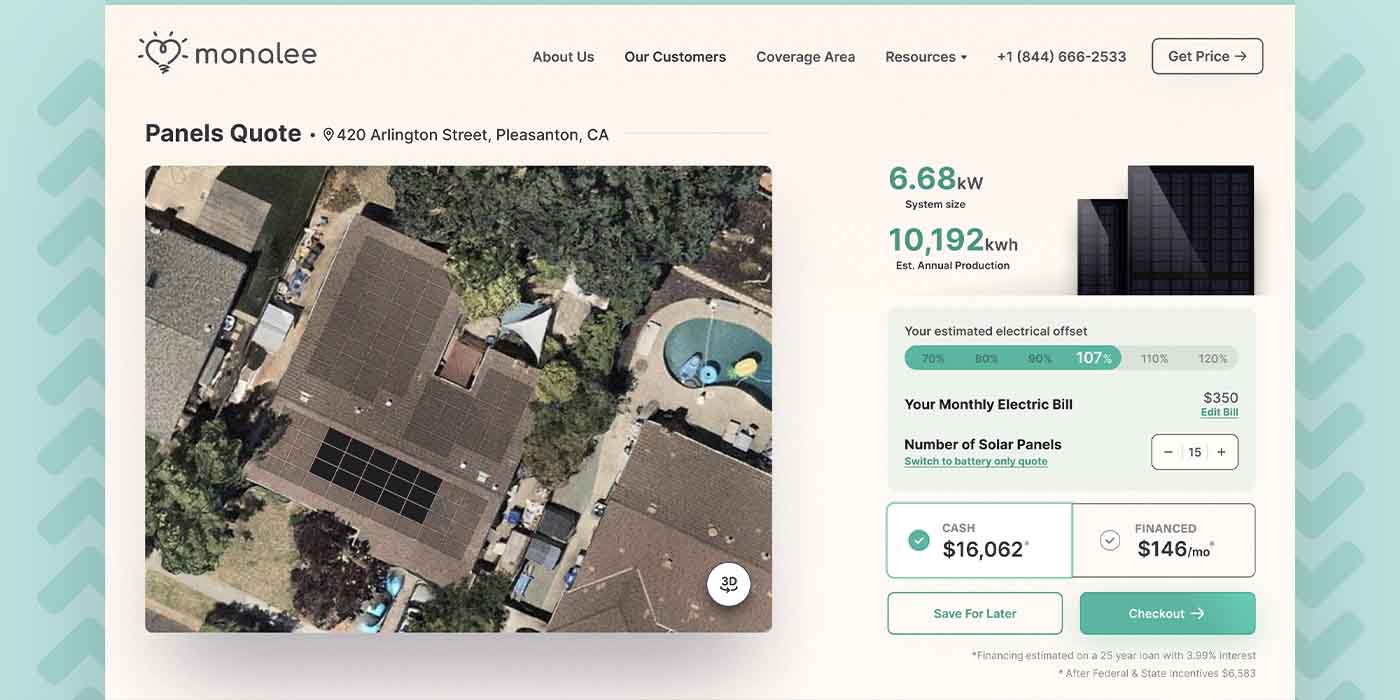
Monalee’s original customer was the homeowner who wanted solar without making a small research project of the purchase. Its platform asked for an address, electricity spending and a preference for panels, storage or both. Estimates, financing and project coordination followed. By May 2024, contemporary reporting put the company at 1,900 homeowners across 24 states. That was an operating business with roofs attached, rather than a clever calculator waiting for customers.
The expensive parts you cannot see
The tempting way to understand rooftop solar is to look at the panels. Monalee looked at the work surrounding them: acquiring the customer, drawing the layout, assembling the proposal and moving information between people. These are solar’s soft costs. They produce no electricity, but somebody has to pay for them.
The company’s June 2024 announcement said it had generated more than 150,000 free proposals. Removing commissioned salespeople and automating design were central to its savings pitch. An August sponsored article claimed average homeowner savings of $12,000. Treat that as a historical marketing claim, not a discount waiting at every address. A different roof, equipment package or financing agreement makes a different purchase.
The technical problem was less tidy than the checkout. In a 2024 interview, Halty explained that Google’s Solar API covered only part of the country; Monalee added imagery from other providers. Deep learning helped identify roof edges and obstacles. A chimney is a rather effective rebuttal to a rectangular spreadsheet. The software has to understand where panels can actually go.
Design + price
Halty’s reported checkout
Until installation
His reported elapsed time
The tool escapes the installer
Then an internal inconvenience became a product. In a June 2025 sponsored essay, Monalee said existing proposal systems were too costly and slow for its needs. It built Artemis for its own operation, then offered it to others. The essay advertised proposals in under fifteen seconds, unlimited users and revisions, and a website embed requiring three lines of code. Its named alternatives included Aurora, Solo and Solargraf.
That origin matters because the buyer changes. A homeowner wants an affordable, functioning system. A contractor wants the team to stop re-entering information. Artemis sells to the second customer while improving the first customer’s experience. Design, a live proposal, financing comparisons and signatures can occupy one workflow. A contractor can embed a storefront on its website rather than merely collecting a name for a later callback.
“Installers shouldn’t need six tools and a week of back-and-forth to sell a project.”
Walid Halty · March 2026 announcement
Portrait: Artemis

The expertise behind that proposition spans two trades. The company’s team page lists Halty’s Tesla and Colossus background, chief technology officer Juan Carrillo’s AI research experience, and researchers working in geographical information systems and remote sensing. The useful combination is knowledge of what an installer needs and knowledge of what an image can reveal. Neither makes the other optional.

A price tag with a timestamp
What does it cost? The 2025 essay advertised a starting price of $9.50 per proposal. The current Artemis pricing page displays $19 per design with 200 monthly designs selected, alongside a plan-dependent range of $6.50 to $20. The unit, volume and contract matter. A memorable number from an old advertisement is a poor substitute for the agreement you are about to sign.
The same page includes unlimited users, revisions and contract signing. That makes the comparison about the workflow purchased, not just the drawing produced. Its competitive advantage is the proposed reduction in separate tools and handoffs. Whether that advantage holds for a particular contractor depends on existing software, integration needs and the designs its team actually handles.
The ladder belongs to someone else
Monalee’s website says new solar and storage installations paused in September 2025, with support continuing for existing customers. In March 2026 it announced the Artemis rebrand and $6 million in financing, co-led by Long Journey and Copec WIND Ventures. Its announcement said more than 100 installers used the design tool.
Halty told Latitude Media that expanding construction nationally demanded too much capital. Installation assets went to regional partners; software became the focus. This was a change in what the company chose to own. The ten-second end of the transaction could travel through other contractors’ websites. The sixty-day end still needed people with trucks.
The financial history adds a complication. A.R.I. announced a $10 million credit facility in January 2025. In May 2026, the lender announced lawsuits in New York and Massachusetts, alleging default and financial misconduct. Those are the lender’s allegations, not established findings. A credit facility also differs from equity financing; adding both together conceals obligations rather than explaining them.
The lesson a reader can copy is to identify the repeatable work inside a service business and ask who else needs it. The condition is equally concrete: the service still needs competent delivery. Roof condition, unusual geometry, local approvals and utility connection can outlast a fast proposal. Monalee’s reinvention leaves a useful question for any instant-purchase business: once the customer clicks, who has to turn up?