In January 1984, Jon Hirschtick saw a notice on a wall at MIT offering the chance to earn money playing blackjack with a professional team. He went to the meeting. He had never played blackjack. The people recruiting him had capital, a method and a chart he was supposed to learn before returning the following week. It was an unusual extracurricular activity, even by the standards of a university where extracurricular activities can involve building a robot.
The detail worth keeping is the homework. In the popular version of this story, a gifted student takes on the casinos, wins money and turns it into a software company. Hirschtick’s own accounts give more space to training, teamwork and the practical uses of savings. When he began SolidWorks, the money helped pay for computers, office space and a phone system. It also let him go without an income while he got started.
There is considerable distance between a promising idea and a business that can pay its founder. Hirschtick had found an unusual way to finance that distance. The purchase was time. What he did with it would occupy him for years, and eventually give him a reason to build another company in the same field.
A notice on the wall
Card counting makes an irresistible biographical accessory. It supplies the tables, the stakes and the suggestion that the protagonist possesses a private arrangement with arithmetic. Hirschtick has been more interested in explaining calculated risk. Knowing what risk you are taking matters to him; discovering afterwards that you took one is rather less appealing.
His membership of the MIT Blackjack Team is real. The temptation to turn a software founder into a character from 21 requires more care. He has explicitly rejected being identified with the film’s fictional professor. A career can be entertaining enough without borrowing somebody else’s screenplay.
What makes the episode relevant to his later work is the organization behind it: people learning a system and acting together. Starting a CAD company would require another team, outside investment and years of engineering. Personal winnings could get Hirschtick moving. They could hardly write the software.
“Today is still the beginning. Today, we’re still just getting started.”
Jon Hirschtick, writing about Onshape in 2015
The apartment with very few tools
Hirschtick grew up in a small Chicago apartment. His recollection of the household tool collection is modest: pliers and a screwdriver in a kitchen drawer. The family home was hardly an apprentice workshop. A friend’s electronics projects offered an opening. Building circuits with that friend and his father gave Hirschtick the pleasure of making something and watching it work.
Space launches and magazines such as Popular Science and Popular Electronics fed the interest. The appeal was concrete. Something assembled by people could do something observable. Long before he was selling software to help others design products, he liked the transaction between an idea, a set of parts and a working result.
At MIT he studied mechanical engineering, earning his bachelor’s degree in 1983 and his master’s in 1986. An internship at Computervision in 1981 brought him into the computer-aided design business. He later managed MIT’s CADLab, founded Premise, which developed DesignView, and became director of engineering at Computervision. SolidWorks arrived after this education in both engineering and engineering software.
That sequence gives his founding story some useful ballast. The blackjack episode attracts attention because it is unusual. The years spent around design tools explain why he knew what he wanted to build. By the time he started SolidWorks in 1993, he had already spent a substantial stretch of his working life in CAD.
A computer on every engineer’s desk
The opening he saw was Windows. Three-dimensional mechanical design had been associated with expensive specialist systems. Personal computers offered a way to put those tools within reach of more engineers. Hirschtick and his colleagues set out to build a business around that change, with software that would run on the machines becoming familiar on ordinary desks.
He started recruiting the founding team in 1993. The ambition was straightforward to describe and difficult to execute. A mechanical design system has to do more than display a convincing shape. Engineers must be able to change it, fit pieces together and keep working as a project becomes more complicated. Making the first demonstration work leaves plenty of work for tomorrow.
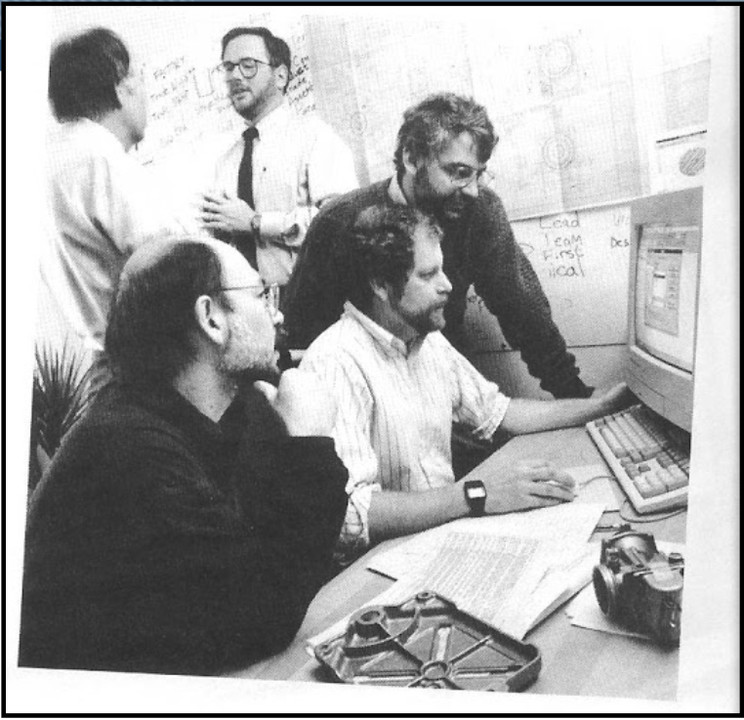
SolidWorks shipped its first product at the end of 1995. Hirschtick has been candid about the early software’s limitations and the time it took to mature. The first customers were working with a product that lacked much of what later users would expect. Their willingness to begin did not mean development was finished.
Dassault Systèmes acquired SolidWorks in 1997. Hirschtick stayed another fourteen years, leaving in 2011. That is a long postscript to an acquisition, long enough for a founder to see a young product become part of other people’s daily work. He also saw customers tackle bigger projects and work in larger teams than he had originally anticipated.
The long involvement complicates the usual account of entrepreneurial success, which likes a founding date followed quickly by a sale price. Here, the period after the sale matters to the next company. Hirschtick kept visiting customers. Success had made the software useful to many people. It also put him close to the inconveniences those people encountered.
Same field. A different place for the work to happen.
The trouble arrived in files
Some difficulties sat around the design itself. Getting software installed could take effort. Hardware and graphics configurations needed attention. Teams had to keep track of versions. Designs lived in files, and those files had to move between people who wanted to change things.
Each exchange introduced questions. Was this the current design? Had somebody already altered a related component? Could a colleague start working now? These are mundane questions with an impressive ability to consume a working day. A system intended to help people invent things could also give them a second occupation as custodians of files.
After leaving SolidWorks, Hirschtick took a year away. The emergence of cloud, web and mobile computing gave him another way to think about the problems he had watched. In 2012 he co-founded the business that became Onshape, alongside CAD veterans including John McEleney and Dave Corcoran.
His experience helped with fundraising. He has contrasted the difficulty of finding backing for SolidWorks with the interest surrounding Onshape. Andreessen Horowitz became an investor. A familiar field, an experienced team and a different computing architecture made a proposition he could take to people who had seen software change other industries.
Onshape’s public beta arrived in March 2015. In announcing it, Hirschtick said more than a thousand CAD professionals across 52 countries had already used the system during confidential testing. He emphasized that everyone would receive the latest release together. Updates would happen every few weeks.
These were choices about working life as much as distribution. A shared online design environment could change how people participated in a project. Keeping design information together could reduce the copying and checking that had occupied customers. Access through a browser or mobile device widened the places from which someone could contribute.
The old rival becomes the new address
In October 2019, PTC announced an agreement to acquire Onshape for approximately $470 million, net of cash acquired. The deal closed on November 1. Hirschtick, Onshape’s co-founder and CEO at the time of the transaction, would continue inside PTC; the completion announcement identified him as Onshape’s president.
Approximate announced transaction value, net of cash acquired.
There is a quiet joke in the corporate geography. PTC had been part of the competitive landscape confronting SolidWorks. Now it was buying the company Hirschtick helped build next. He had arrived at a former rival’s door with a new approach to the work they both understood.
He has since become PTC’s chief evangelist. The title leaves room for a recurring part of his career: explaining why another way of designing products might be worth trying. His public work has included a 2024 talk on artificial intelligence in product development. His attention continues to range beyond the mechanical act of drawing a part.
In a February 2026 interview, he was still discussing the structural problems of file-based CAD and the value of shared, current design information. The vocabulary has developed with the technology. The underlying complaint remains recognizable: engineers want to spend their time engineering, and collaboration should help them get on with it.
A magician rehearses the ending
Before the casinos and the companies, Hirschtick performed magic. He has recalled doing around 200 shows between the ages of fourteen and seventeen. It supplied an education in presenting something to people who had every right to lose interest.
“Magic is where I learned to demo things,” he has said. His advice includes rehearsing enough to leave mental room for talking to the audience, and carrying a backup when demonstrating software. An apparently effortless presentation can have a thoroughly practical contingency plan in its pocket.
That combination is an appealing way to read his career. He enjoys showing what a tool can do, while remaining interested in the work required to make it dependable. A demonstration earns attention for an afternoon. A design system has to earn its place again when an engineer opens it the next morning.
Hirschtick has spent decades on that second encounter. He helped bring CAD to Windows, stayed to watch people use it, then returned with Onshape when he thought a different architecture could address their frustrations. The card player understood the value of a calculated decision. The engineer kept finding another thing that needed to work.