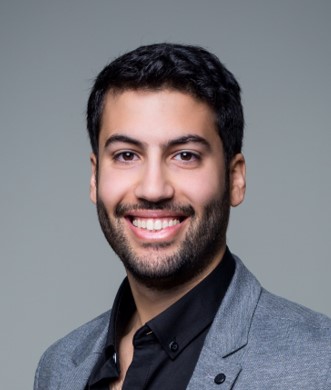
The Story
Teaching a machine to think in steel
Ask most founders what fuels them and you get a manifesto. Ask Maor Farid and you get one word: "Honestly, frustration." He had spent years inside the defense industry watching brilliant mechanical engineers burn their days on everything except engineering - hunting through old files, scrolling vendor catalogs, redrawing parts that already existed somewhere on a server nobody could find. Software engineers had GitHub Copilot. Writers had ChatGPT. The people designing cars, satellites and medical devices were stuck with a mouse and a memory.
Leo AI, the company he co-founded in 2023, is his answer. It is an AI copilot that lives inside CAD software and the systems engineers already use, trained on more than a million vetted engineering sources. It answers a question about a tolerance or a standard and then shows you the formula it used and where the number came from. That last part is the whole point. "Engineers are not anti-AI," Farid likes to say. "They're anti-BS."
We're building the most boring, unsexy AI.
- Maor Farid, on what makes Leo AI work
There is something almost contrarian about a man who studied chaos for a living deciding to build a company on certainty. His doctoral work was in nonlinear dynamics and chaos theory - the mathematics of systems that refuse to behave. He modeled how earthquakes ripple through nuclear facilities and helped develop energy-absorption technology that raised seismic resistance by as much as 90 percent. The lesson he carried out of that research was not that the world is unpredictable. It was that the cost of being wrong, in physical engineering, is measured in lives. A typo in an essay is a typo. A typo in a load calculation is a bridge.
The Brakim kid who never left the hard problems
Farid was born in 1992 in Ness Ziona, the eldest son of immigrant parents who came to Israel from Iraq and Libya. He met his future co-founder and CTO, Moti Moravia, at eighteen, when both were funneled into Brakim - the Israeli military's elite program for training mechanical engineers bound for the defense industry. Two teenagers, handed the hardest engineering problems the country had, told to solve them. Two decades later they would reunite to start a company.
The path between those two points reads like three careers stacked on top of each other. He earned his bachelor's, master's and doctorate at the Technion, finishing the PhD in 2017 at twenty-four - the youngest graduate in the institution's history. He served as a Captain, AI researcher and commander in Unit 8200, Israel's storied intelligence corps, and spent time at the Prime Minister's Office. The IDF named him an "Excellent Scientist," a designation reserved for its top three academics. Then he went to MIT as a Fulbright fellow - one of eight winners nationwide across every discipline that year - to study how to predict catastrophic failures in complex physical systems.
Why engineers trust Leo
// Accuracy on engineering questions, Leo AI vs generic AI tools
Leo AI (Large Mechanical Model)96%
It would have been easy to stay in the lab. The academic honors kept arriving - a Fulbright, an ISEF fellowship, an Israel Academy of Sciences grant, a Forbes 30 Under 30 listing. But research that predicts when things break is, at its heart, about preventing waste. And the waste Farid kept seeing was human: the smartest engineers on earth, spending half their time on tasks a well-trained machine could do in seconds.
The Idea
The Large Mechanical Model
Leo AI's bet has a name: the Large Mechanical Model, or LMM. Where a large language model learns from text, the LMM is built to understand CAD geometry, engineering standards, vendor parts and an organization's own accumulated knowledge - the so-called tribal knowledge that usually walks out the door when a senior engineer retires. The proprietary model reads CAD with 96 percent accuracy on engineering questions, against 46 percent for general-purpose AI. Translated into a workday: the company says engineers cut their time on grunt work by roughly 70 percent and shorten time-to-market by close to a fifth.
The pitch landed with people who know engineering software intimately. When Leo AI closed its $5M seed round - led by Flint Capital and pushing total funding to $9.7M - the cap table included TechAviv, 2 Lanterns, OurCrowd and Mento, plus Google's VP of Research and Engineering and Bertrand Sicot, the former CEO of SolidWorks. Sicot's verdict was characteristically blunt: "Leo is the first AI applied to engineering, and engineers are dying for this progress."
AI will not replace engineers, but engineers using AI may replace those who do not.
- Maor Farid
Today the copilot is used by teams across aerospace, semiconductors, automotive and medical devices - names like Toyota, HP, Mobileye, Philips and Scania - across the UK, the US, India, France, Germany, Poland, the Benelux and Israel. The company is headquartered in Cambridge, Massachusetts, a short walk from the MIT department where Farid once chased chaos for its own sake.
The book he gave away before the startup
Long before there was a cap table, there was a classroom. As a teenager, Farid founded Learn to Succeed, a nonprofit that grew into a registered organization with hundreds of volunteers, scholarships, mentorship and a hotline for at-risk youth from Israel's geographic and economic periphery. He wrote a book of the same name in 2019 and handed out more than two thousand copies to the kids it was written for. The work earned him the Moskowitz Prize, given for social entrepreneurship and leadership. He has described the stakes plainly: "Without proper assistance, youths from the periphery have no chance."
It is a tidy through-line for a career that can otherwise look scattered across continents and disciplines. The earthquake research, the intelligence command, the AI copilot, the scholarships - each one is a version of the same instinct: find the place where talent is being wasted by friction, and remove the friction. Leo AI is simply the largest lever he has found yet.
A teacher before he was a founder
It is worth pausing on the classroom, because it explains the product. Before the startup, Farid was a serial lecturer. He developed a course on analytic and machine-learning-based modeling of dynamical systems at the Technion and taught as an external lecturer at Ben-Gurion University, where students rated him 4.91 out of 5. He trained programmers inside Unit 8200 and led a Harvard Kennedy School emerging-leaders program. People who teach well share one habit: they refuse to let an answer stand without showing the working. That instinct is baked into Leo AI, which never simply asserts a number. It cites the standard, surfaces the formula, and points to the source. A copilot built by a teacher is, almost inevitably, a copilot that shows its homework.
It also explains his patience with skeptics. Engineers are a notoriously hard crowd to sell software to - they have seen a parade of tools that promised magic and delivered marketing. Farid does not argue with that suspicion. He shares it. The traceability in Leo AI is not a feature bolted on for compliance; it is the founder's own standard of proof, turned into code. When he says engineers are anti-BS, he is describing himself first.
There is a second number worth holding onto, beyond the 96 percent and the $9.7M: in one early quarter the company reported roughly 300 percent growth in annual recurring revenue. Startups inflate a lot of figures, but the shape of the demand is hard to fake when the customers are Toyota, Scania and HP. Engineers, it turns out, were not waiting for AI to dazzle them. They were waiting for AI to be useful, verifiable and quietly competent - the same qualities Farid spent two decades demanding of himself, his soldiers and his students. The most boring AI on earth may also be the most honest.
For all the hardware of his resume - the elite units, the prize money, the foundational model - Farid keeps describing the mission in oddly modest terms. He is not promising to replace the engineer's judgment. In high-stakes industries, he insists, responsibility and human judgment stay where they belong: with the human. The machine just clears the desk. Boring, unsexy, and exactly what 60,000 engineers turned out to be waiting for.